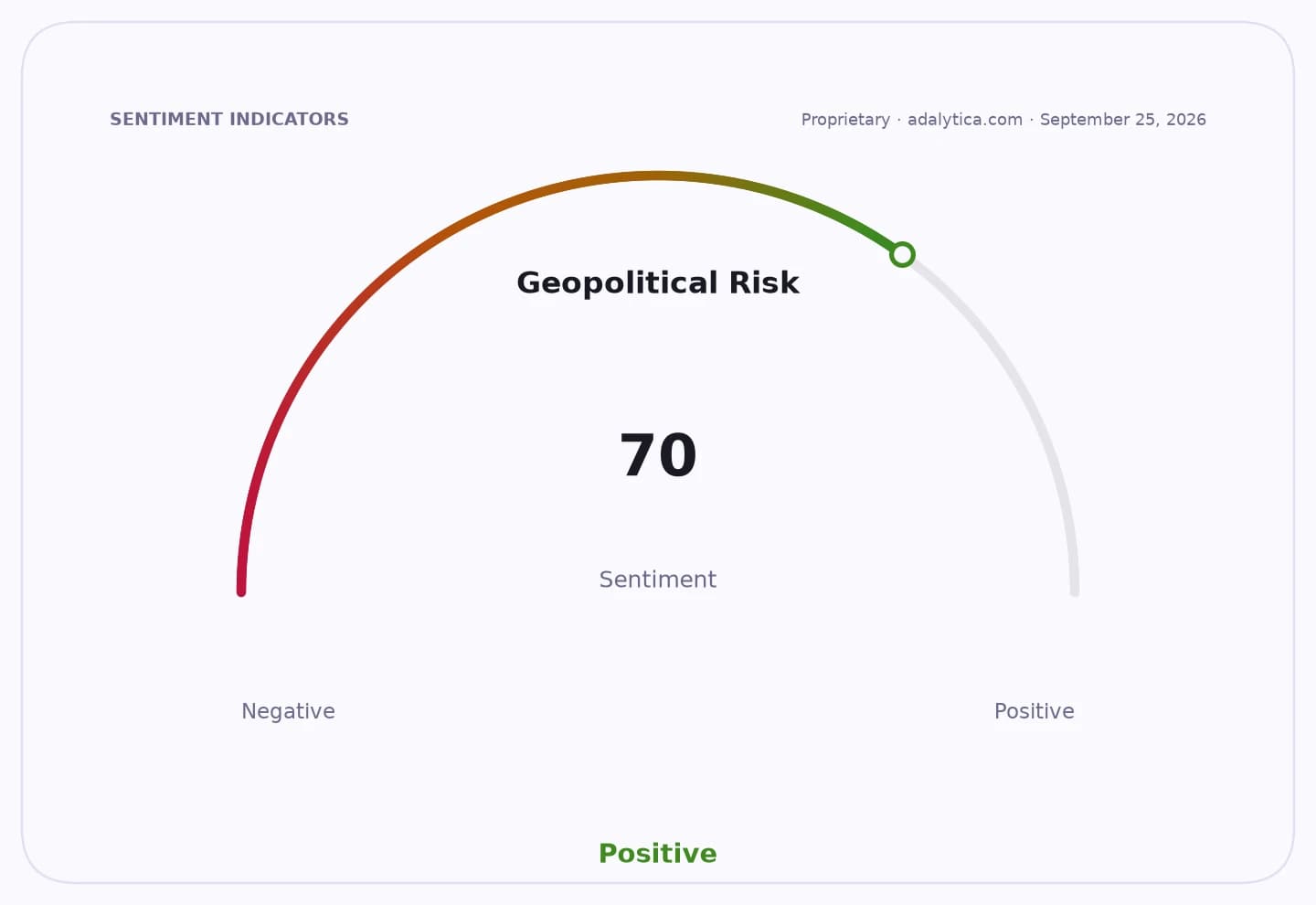
The biggest shift for investors is not in any one stock, but in the backdrop: U.S. 10-year Treasury yields are back above 4.5%, the dollar is under pressure, and broader market sentiment has slipped back to neutral after recent swings into fear, forcing a fresh review of what belongs in a portfolio and why.
Higher Yields Pressure Growth Valuations

That matters because a 10-year yield around 4.58% changes the hurdle rate for everything from megacap technology to capital-intensive financial assets. When the risk-free rate rises, valuation support for long-duration growth names weakens, and companies with cleaner balance sheets, stronger cash generation and more visible earnings tend to command a premium. For investors, that puts portfolio construction back at the center of the debate: holding mix is no longer just about owning winners, but about mixing businesses that can weather a more demanding cost of capital.
Sentiment IndicatorsⓘProprietary · adalytica.com · July 13, 2026
This is a snapshot — live sentiment, awareness and momentum for 130+ markets update continuously in the dashboard.Open AlphaPulse
The market evidence is mixed but instructive. Arm Holdings has still been the standout, with the stock up more than 220% in the first half of 2026, showing that investors remain willing to pay up for structural growth when the narrative is strong enough. Intel’s more modest gain of just over 6% suggests that cyclical recovery and analyst optimism can help, but do not deliver the same multiple expansion as a pure growth story. That divergence captures the core challenge in today’s market: fundamentals matter, but so does duration, and the market is paying a far higher price for certainty.
At the same time, technical readings suggest the rally in some names is not as one-sided as the headline performance implies. Arm has traded above its 50-day moving average and remains well above the 200-day trend, with RSI readings still elevated, which points to strong momentum but also a stretched setup if earnings or guidance disappoint. Uber has held around the mid-$70s, above its 50-day average but still below the 200-day trend, a pattern that reflects recovery without full re-rating. Brookfield’s BN has been comparatively softer, hovering near its long-term average after a weaker stretch, underscoring that even quality asset managers can be pulled down when investors demand more from returns and leverage discipline.
The macro picture reinforces that split. U.S. GDP is still expanding, with the latest forecast pointing to continued growth, while unemployment remains near the low-4% range, a combination that argues against an imminent recession. But that is not the same as an easy equity environment. Growth may be steady, yet higher yields compress multiples and force investors to distinguish between businesses that can compound through the cycle and those that only look attractive when money is cheap.
The dollar’s weakness adds another layer. Adalytica’s U.S. dollar trade signals show extreme fear and very low awareness, indicating that currency moves themselves are now an investor concern, not a background variable. A softer dollar can help multinational earnings translation and support commodities and foreign revenue streams, but it also reflects uncertainty that can amplify volatility across global portfolios.
That is why the narrative around holding mix matters now. The bullish case is that investors can still build a resilient portfolio by combining secular growers such as Arm, operationally improving names like Uber and steadier cash-generators such as Brookfield. The bearish case is that with Treasury yields elevated and geopolitical risk still unsettling markets, even good companies can underperform if they are priced for perfection or carry too much sensitivity to rates, execution or financing conditions.
For investors, the key question is less whether markets can keep rising than which businesses can justify their valuations in a 4.5%-plus yield world. The next catalysts will be earnings updates, guidance on margins and capital allocation, and whether Treasury yields stay anchored near current levels or push higher again. That will determine whether the recent leadership in high-growth names broadens out into a healthier advance or narrows further into a few expensive winners.
| Entity | Gains | Losses |
|---|---|---|
| Arm Holdings | ▲Growth premium | ▼Rate-sensitive valuation |
| Uber | ▲Operational leverage | ▼Long-duration multiple |
| Brookfield | ▲Cash-flow resilience | ▼Momentum investors |
| Bond investors | ▲Higher income | ▼Equity multiple expansion |