The market’s biggest speculative trades are breaking down together because the bond market is forcing investors to pay for duration again. That is the real message behind the slide in gold, bitcoin and the high-multiple Nasdaq names: yields are still too high to support a risk-on narrative built on cheap money, and capital is rotating out of assets that were priced for perpetual liquidity.
Higher Yields Pressure Speculative Risk Trades

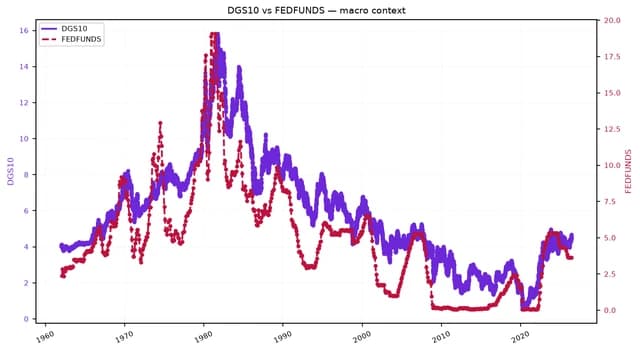
The 10-year Treasury is holding near 4.56%, while the two-year sits around 4.12%, levels that keep real financing costs restrictive and make it harder to justify extreme valuations in long-duration growth stocks. The Fed funds rate is still anchored at 3.63%, so the policy backdrop is not yet loose enough to rescue the crowding trade that powered everything from AI chips to digital gold. When money-market rates remain elevated and the curve stays stubbornly tight, investors start demanding cash flow today instead of promises tomorrow.
Sentiment IndicatorsⓘProprietary · adalytica.com · July 18, 2026
This is a snapshot — live sentiment, awareness and momentum for 130+ markets update continuously in the dashboard.Open AlphaPulse
That is why the hit list is so telling. Gold ETF GLD has dropped to 368.41 from a 2026 high near 490, with the 50-day moving average now above the price and the conventional RSI reading still only mid-range after a violent reset. Bitcoin has fallen back to about $64,658 after trading above $80,000 in May, while the Nasdaq-100 proxy QQQ has slipped to 695.33 from the mid-730s only days ago. These are not isolated moves. They are the unwind of a crowded macro bet that lower rates, easier liquidity and unbroken AI enthusiasm would keep every speculative asset levitating at once.
For investors, that matters because the losers are not just traders in gold or crypto. The same rate pressure is forcing a re-rating across the AI complex, where megacap technology has become increasingly sensitive to discount rates, capex intensity and any sign that earnings growth must outrun Treasury yields to justify current multiples. The recent selloff in semiconductor and memory stocks reinforces the point: when investors question whether AI spending can keep compounding at the same pace, the whole ecosystem — from chipmakers to cloud platforms to the ETF wrappers that own them — gets repriced together.

This is where the opportunity is hiding. The market underestimates how quickly leadership can shift when bond yields stop falling and liquidity stops doing the heavy lifting. I believe the next phase favors balance-sheet strength, pricing power and infrastructure tied to real cash generation, not the most crowded momentum names. If the Barclays read is right, the winning trades are likely to be the picks-and-shovels of the real economy — defense, power, grid, industrial automation and selective software with recurring revenue — while the weakest links are the assets and stocks that depend on a fresh wave of monetary easing to defend their valuations.
The broader setup argues for more volatility, not less. Renewed Middle East tensions have already lifted oil and injected another inflationary shock into an already rate-sensitive market, making it harder for the Fed to pivot aggressively without reviving price pressure. As long as Treasury yields stay pinned in restrictive territory, the great rotation will keep punishing the most duration-heavy corners of the market.
For investors, the takeaway is simple: don’t chase the old leadership just because it worked in the last liquidity cycle. The asymmetric bet now is on assets and stocks that can compound even if rates stay higher for longer. That means owning cash-flowing infrastructure and selective industrial beneficiaries, while being far more cautious on gold, bitcoin and the most expensive AI names until the bond market finally yields.
| Entity | Gains | Losses |
|---|---|---|
| Banks and cash-rich value stocks | ▲Higher net interest margins | ▼Duration-heavy growth stocks |
| Bondholders and savers | ▲Better yield income | ▼Speculators in low-rate trades |
| Defense, infrastructure and industrials | ▲Rotation into cash flow | ▼Gold, bitcoin and crowded momentum |
| Nasdaq mega-cap tech | ▲Some remain resilient | ▼Highest-multiple AI names |




