Washington’s latest attacks on Iran are designed to constrain Tehran’s ability to threaten shipping, not to force regime change, and that narrower objective is keeping a geopolitical premium embedded in oil, gold and the dollar even as diplomacy stalls.
Hormuz Tensions Keep Oil, Gold Premium Intact
The U.S. Central Command has now carried out four strikes in a week in retaliation for an attack on a commercial vessel in the Strait of Hormuz, a chokepoint that handles a large share of global crude flows. The immediate economic stakes are straightforward: any sustained disruption there would tighten physical oil supply, lift freight and insurance costs, and ripple through inflation expectations just as central banks are trying to gauge whether price pressures are fading.
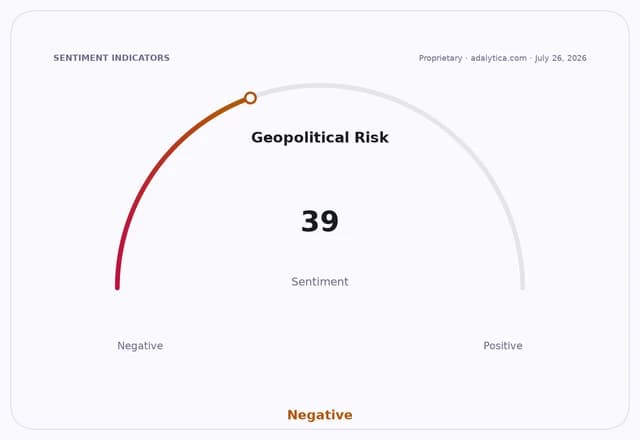
Sentiment IndicatorsⓘProprietary · adalytica.com · July 26, 2026
This is a snapshot — live sentiment, awareness and momentum for 130+ markets update continuously in the dashboard.Open AlphaPulse

Oil’s reaction has been sharp. USO, the U.S. oil ETF, has surged to $136.69 from $106.29 in late June, a move that took the fund far above its 50-day moving average and pushed RSI readings to 82.9, a level that typically signals an overstretched rally. Adalytica’s Oil WTI Trade Signals show “Extreme Fear” on sentiment even as awareness remains at 93, underscoring how traders are focused on supply shock risk rather than on calm pricing.
Gold has also held up as investors seek shelter. GLD closed at $371.90 on July 24, down modestly on the day but still far above its 50-day moving average, while the fund remains elevated after a year of repeated swings tied to Middle East tension, U.S. policy uncertainty and broader demand for hedges. The dollar, by contrast, is firmer on a relative basis, with UUP at 28.58 and above both its 50-day and 200-day moving averages, reflecting demand for safe, liquid assets even as Adalytica’s U.S. Dollar Trade Signals show extreme fear in the underlying sentiment gauge.
Geopolitical Risk vs USOadalytica.com
Explore this data interactively — full history, time series and cross-market comparisons.Open AlphaPulse
The broader market narrative is that Washington wants to degrade Iran’s coercive power without opening the door to a full-scale regional war. That distinction matters because a containment strategy can keep pressure on shipping lanes and energy prices without necessarily triggering the kind of all-out conflict that would force a more aggressive repricing across equities, credit and commodities.
For investors, the key question is whether the strikes remain limited or expand into a cycle of retaliation. Iran has already threatened further instability, including possible missile attacks on a U.S. base in Jordan, while diplomatic efforts led by Tehran’s foreign minister in Oman have so far failed to cool the confrontation.
If the Strait of Hormuz risk widens, energy producers and commodity hedges should keep their bid, while airlines, refiners and transport names would face another round of margin pressure. If talks resume and the attacks stop, some of the oil premium could unwind quickly, but for now the market is pricing a persistent, not temporary, Middle East risk.
| Entity | Gains | Losses |
|---|---|---|
| Oil producers | ▲Higher crude prices | ▼Demand destruction risk later |
| Gold holders | ▲Safe-haven demand | ▼Little if risk fades |
| U.S. dollar bulls | ▲Flight to liquidity | ▼Volatility if conflict escalates |
| Airlines and shippers | ▲Lower fuel only if de-escalation | ▼Higher fuel and insurance costs |




