US consumer prices are on track to rise again in July, reviving pressure on households and policymakers just as markets had started to price in a calmer inflation backdrop.
Hot CPI Could Favor Staples Over Discretionary
The latest data and forecasts point to a modest monthly increase in the headline Consumer Price Index after June’s slight decline, but the bigger issue is that inflation is proving sticky rather than fading. Headline CPI is forecast to rise 0.9% in July, taking the index to 335.512, while core CPI is expected to climb 0.33% to 337.1758. That would keep core inflation running well above levels consistent with the Federal Reserve’s 2% target and suggests that the disinflation trend investors had hoped for is fragile.
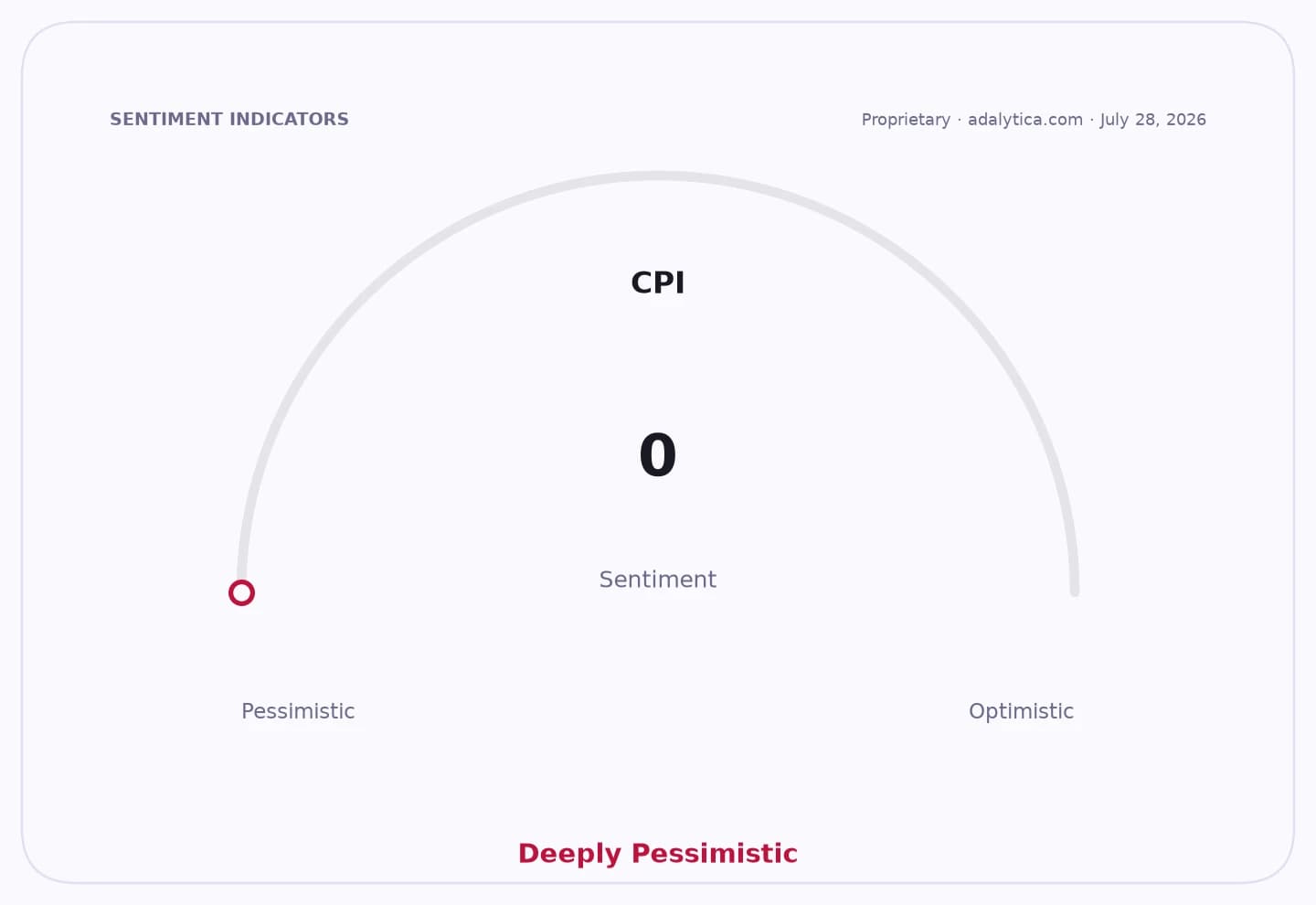
Sentiment IndicatorsⓘProprietary · adalytica.com · July 28, 2026
This is a snapshot — live sentiment, awareness and momentum for 130+ markets update continuously in the dashboard.Open AlphaPulse
That matters because inflation is no longer being driven only by the usual services categories. The producer price index is projected to jump 3.14% in July after a 1.26% drop in June, a sign that cost pressures may be working back through the pipeline. When wholesale prices turn higher alongside consumer prices, companies have more room to pass through costs, and households eventually face the bill. The result is a renewed squeeze on real incomes, particularly for staples such as tea, food products, autos and electronics, where price transmission tends to be quick once input costs rise.
For markets, the implications are immediate. The prospect of firmer inflation raises the odds that interest rates stay higher for longer, or that the Federal Reserve keeps policy restrictive even if growth cools. That is usually a headwind for rate-sensitive sectors and a tailwind for companies with pricing power, especially in consumer staples and energy. The consumer staples ETF, XLP, has held up better than broader consumer discretionary stocks, XLY, which has fallen back toward its 200-day moving average. That divergence suggests investors are already rotating away from demand-sensitive names and toward defensive exposure as inflation risk returns.
Energy has also staged a sharp rebound, with XLE trading well above its 200-day average and carrying an elevated RSI reading, reflecting the market’s sensitivity to any sign that inflation could be reinforced by higher commodity costs. That mix is important: when energy, food and goods prices firm at the same time, the inflation problem becomes broader and harder for policymakers to dismiss as temporary.
The bull case is that July’s increase is still manageable and may reflect a few volatile categories rather than a full-blown inflation regime change. The bear case is that fiscal pressures, supply bottlenecks and tariff-related cost pass-through are reasserting themselves just as confidence in the Fed’s inflation target is becoming more fragile. Adalytica’s CPI sentiment gauge shows “Extreme Fear,” while confidence in the Fed’s 2% target has only partially recovered, underscoring how quickly inflation expectations can turn.
For investors, the next reading matters less as a single print than as confirmation of a trend. If July’s CPI and PPI come in hot, bond yields could rise, equities could struggle to sustain recent gains, and companies with thin margins may face renewed pressure. If the numbers undershoot, markets may get temporary relief — but the burden of proof will remain on policymakers to show that the latest inflation scare is not the start of another round of price hikes.
| Entity | Gains | Losses |
|---|---|---|
| Consumer staples | ▲Pricing power | ▼Volume growth |
| Energy producers | ▲Higher commodity revenue | ▼Inflation-sensitive demand |
| Fed hawks | ▲Stronger case for restraint | ▼Rate-cut hopes |
| Households | ▲None | ▼Real purchasing power |