Hungary’s latest political turn matters less as a cultural statement than as a market message: the country is leaning harder into sovereign nationalism at a time when global investors are already demanding more compensation for political risk, higher rates and commodity shock exposure.
Hungary's nationalism signals higher political risk

That shift is economically significant because it sits inside a far more fragile global backdrop. The U.S. 10-year Treasury yield is pushing toward 4.75%, a level that keeps global discount rates elevated and tightens financial conditions for everyone from banks to industrials. At the same time, oil near $85 a barrel is a reminder that energy remains an inflation wildcard, especially for import-dependent economies in Europe. In that environment, any policy move that signals confrontation with old ideological constraints — or with external economic alignment — can quickly show up in funding costs, currency volatility and investor appetite.
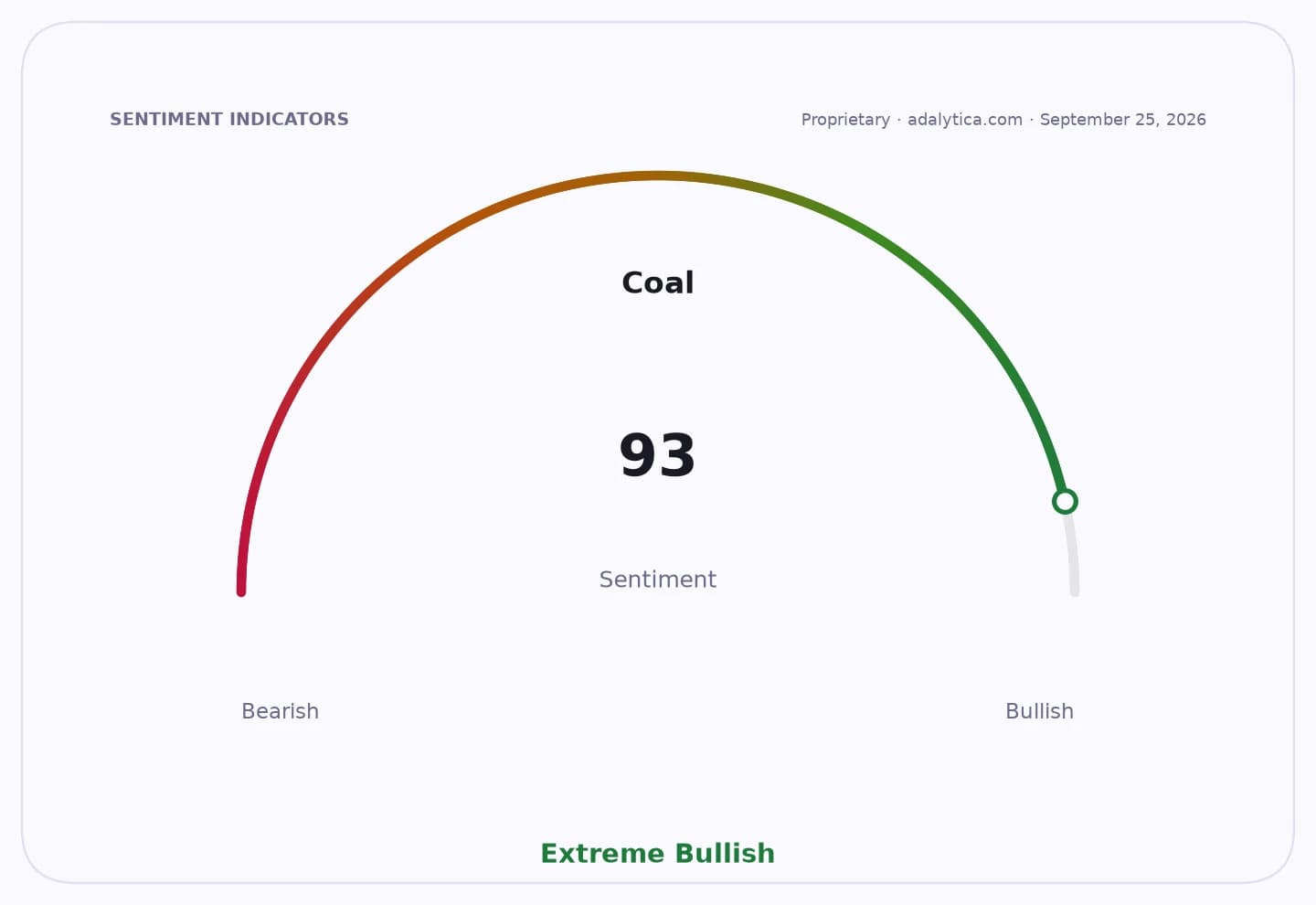
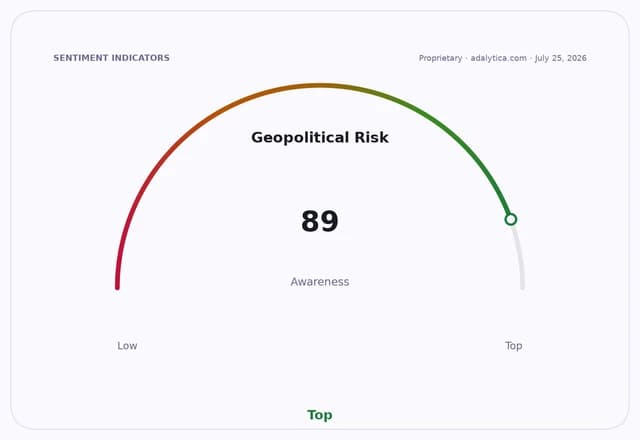
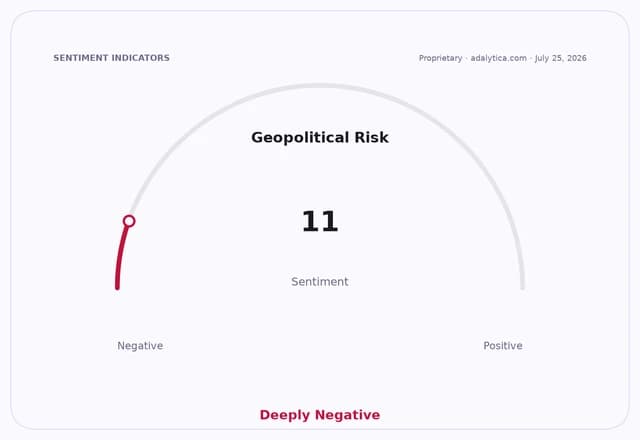
Sentiment IndicatorsⓘProprietary · adalytica.com · July 25, 2026
This is a snapshot — live sentiment, awareness and momentum for 130+ markets update continuously in the dashboard.Open AlphaPulse
For Hungary, the narrative is clear: the government is trying to convert identity politics into economic credibility at home, even as it risks making foreign capital more cautious. The message in the seed headline — “restored Hungarian dignity and self-respect” — is a sovereignty trade. That can bolster domestic support and give policymakers more room to pursue state-directed priorities, but it also tends to narrow the investor base. Global funds do not pay up for slogans; they pay for predictability, legal continuity and policy discipline.
Markets are already pricing a world of split outcomes. Adalytica’s global stability gauge shows extreme fear, while its S&P 500 trade signals have flipped to fear and extreme fear on awareness, a combination that usually accompanies rising uncertainty rather than broad risk appetite. China policy sentiment has also deteriorated sharply from earlier this year, reinforcing the broader thesis that geopolitical fragmentation is no longer a tail risk — it is the base case. That matters for Hungary because small open economies are usually the first to feel the strain when capital gets selective.
The investment implication is that the real winners are not the headline-makers but the toll collectors. In a world of sovereign assertiveness, the best positioned assets are often the ones that benefit from volatility, infrastructure spend, defense readiness and supply-chain reconfiguration. Banks with conservative balance sheets, exporters that can price in hard currency, and Europe-focused companies with limited policy dependence can outperform. By contrast, businesses reliant on cheap external funding, stable cross-border flows or a benign policy premium are the ones most at risk of multiple compression.
There is also a second-order energy trade here. Oil at this level keeps pressure on importers and keeps alive the case for domestic energy security, grid investment and alternative supply chains. That argues for exposure to infrastructure, storage, defense and industrial automation rather than pure cyclical beta. The market underestimates how often political nationalism translates into capex — not just rhetoric. Governments that want to project strength usually spend to prove it.
Hungary’s message, then, is not isolated. It is part of a broader reordering in which geopolitics, inflation and higher rates are forcing investors to separate sovereign winners from sovereign losers. The next move is to own the businesses that profit from fragmentation, not the ones that assume the old global order returns intact.
| Entity | Gains | Losses |
|---|---|---|
| Hungarian government | ▲Domestic political control | ▼Foreign investor trust |
| Local banks | ▲Higher local pricing power | ▼Funding stability |
| Defense and infrastructure firms | ▲Policy-driven spending | ▼Low-growth incumbents |
| Import-dependent businesses | ▲Short-term relief from policy noise | ▼Higher risk premia |