India and Canada are trying to turn a diplomatic reset into something more valuable: a trade and investment channel that could unlock new flows across energy, technology and services if both sides can finally deliver a long-delayed pact.
India and Canada Reopen Trade Pact Talks

Prime Minister Narendra Modi’s “warm and productive” call with Canadian Prime Minister Mark Carney matters because it signals that the two countries are not just repairing political relations — they are putting a commercial agenda back at the center of the relationship. The immediate economic prize is a Comprehensive Economic Partnership Agreement, or CEPA, which both leaders said they remain committed to negotiating. For investors, that is the real story: a formal framework could reduce friction for exporters, open the door to greater cross-border capital flows and support sectors tied to commodities, infrastructure, banking and education.
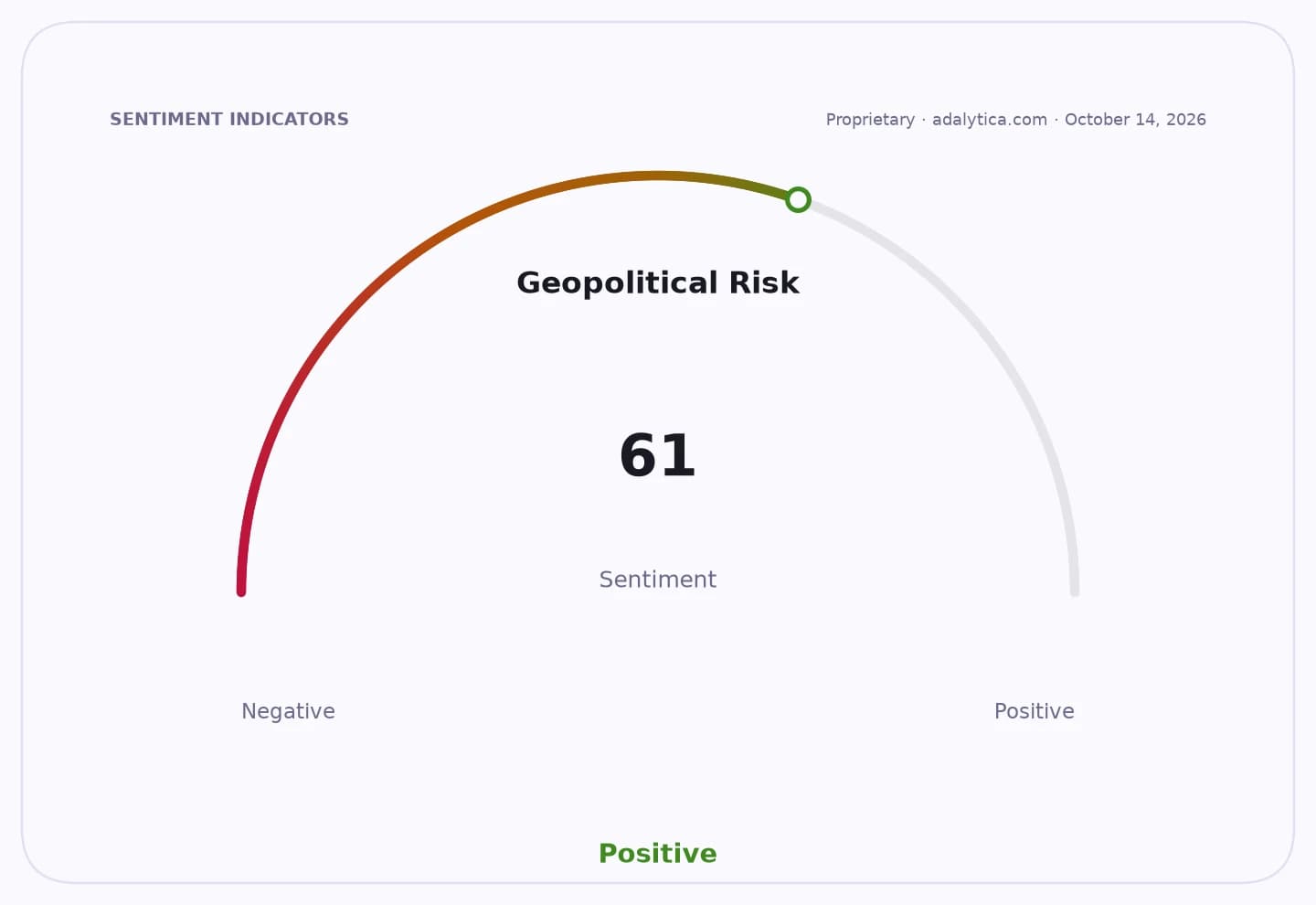
Sentiment IndicatorsⓘProprietary · adalytica.com · October 14, 2026
This is a snapshot — live sentiment, awareness and momentum for 130+ markets update continuously in the dashboard.Open AlphaPulse
That is particularly relevant now because both economies have reasons to deepen external ties. Canada is looking for growth beyond a sluggish domestic backdrop, while India is pushing to broaden access to energy, capital and advanced technology as it tries to sustain one of the world’s fastest-growing major economies. A trade deal would not be a headline-grabbing overnight catalyst, but it would matter over time by lowering tariff and non-tariff barriers, improving visibility for dealmaking and strengthening supply-chain links between two large democracies that have spent the past two years repairing strained ties.
The market angle is more nuanced. India-focused assets have not exactly been priced for a sudden breakthrough, and that creates optionality. The iShares MSCI India ETF, INDA, has been trading below its 50-day moving average and its 200-day average, even after a rebound from recent weakness, while RSI readings remain below overbought territory. In other words, the market is cautious, not euphoric. That is precisely why progress on CEPA could matter if it starts to shift expectations around trade, foreign investment and industrial capex. Canadian lenders and capital allocators, meanwhile, would stand to benefit from any expansion in India-linked financial activity, especially if the relationship becomes more durable and institutional.
The geopolitical layer is just as important. A warmer India-Canada relationship reduces one more source of uncertainty in a world where supply chains, energy security and strategic alignment increasingly influence trade policy. Canada can offer hydrocarbons, critical minerals and financing capacity. India can offer scale, labor, digital adoption and long-run demand. That combination is why the connection deserves more attention than it usually gets: it is a classic picks-and-shovels story for investors who want exposure to secular commerce rather than one-off political headlines.
For the near term, the key catalyst is Modi’s planned visit to Canada in December. If both sides arrive with real progress on CEPA, investors should watch for beneficiaries in transportation, financials, industrials and India-linked ETFs. If talks stall again, the opportunity remains deferred — but the fact that the channel is open again is itself a constructive shift. In a market that increasingly rewards tangible policy follow-through, this is the kind of diplomatic thaw that can eventually turn into capital allocation.
| Entity | Gains | Losses |
|---|---|---|
| India exporters | ▲Lower trade barriers | ▼Status quo friction |
| Canadian commodity producers | ▲Better access to India demand | ▼Limited market reach |
| Banks and investors | ▲More cross-border flow | ▼Policy uncertainty |
| Trade skeptics | ▲Little in the short term | ▼A renewed reset narrative |