India’s private sector began November on firmer footing, with a pickup in manufacturing offsetting a softer pace of services growth and keeping the economy on a strong expansion path.
India Flash PMI Rises as Manufacturing Strengthens
The HSBC flash composite purchasing managers’ index rose to 56.3 from 56.2 in October, signalling that activity continued to expand at a healthy rate even as the mix of growth shifted toward factories. A reading above 50 indicates expansion. Manufacturing led the improvement, with its PMI climbing to a nine-month high of 56.0 from 54.7 and output rising to 58.3, while the services business activity index eased to 55.3 from 55.8.
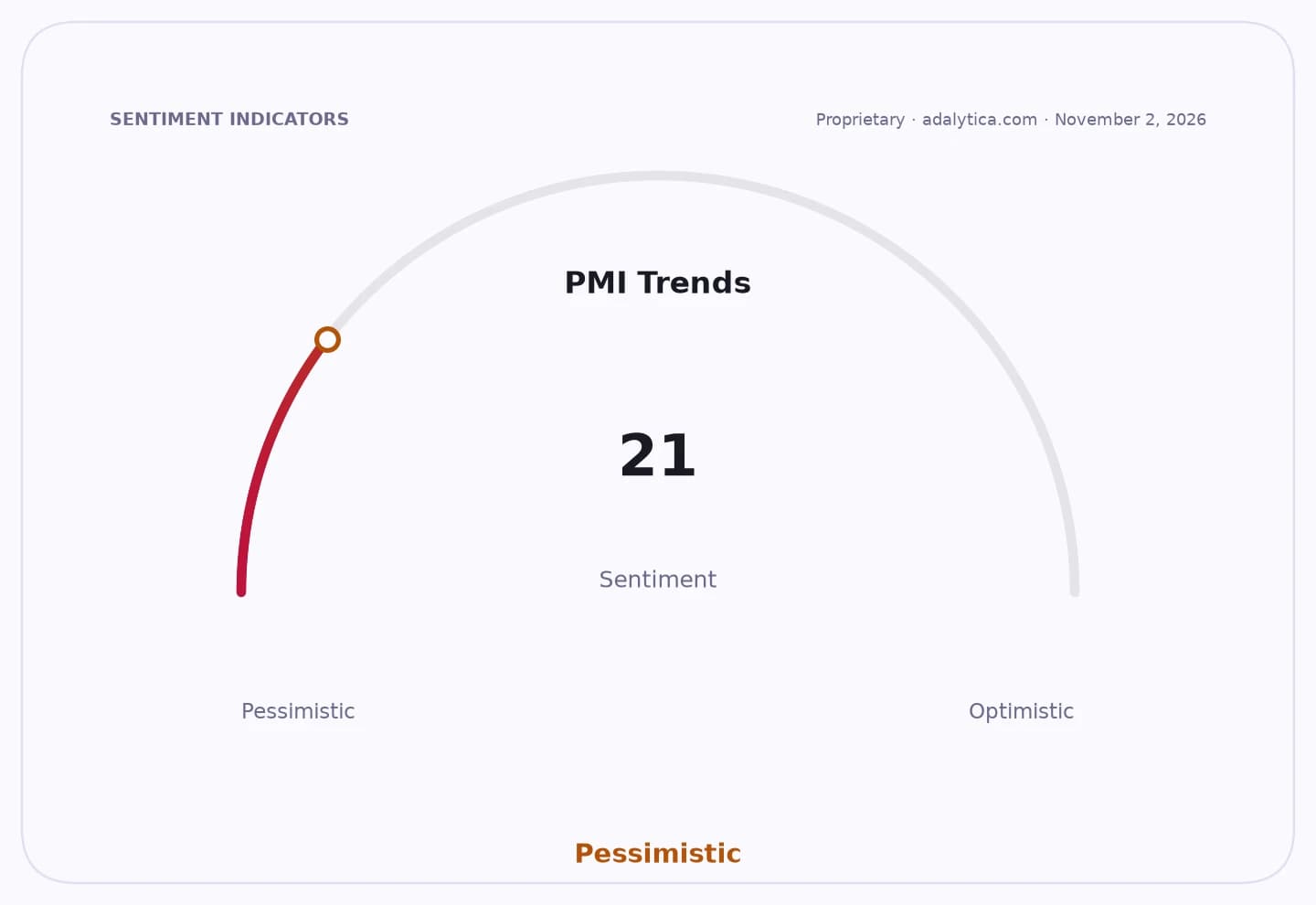
Sentiment Indicators
The data matter because they point to an economy that is still growing above trend at a time when many major economies are struggling to maintain momentum. For policymakers, the report suggests domestic demand remains resilient enough to support output and hiring without requiring an immediate response. For investors, it reinforces the case that India continues to stand out as a relative growth market in Asia, with manufacturing beginning to contribute more meaningfully alongside services.
A notable feature of the report was the strength in new business. Overall new orders expanded at the quickest pace since June, driven by stronger manufacturing demand, while international orders grew at the fastest rate in four months. Manufacturers continued to outpace services firms in export growth, though the pace of export gains moderated for goods producers and accelerated for services companies.
That mix is important for markets because it suggests the recovery is not being driven by one-off factors alone. HSBC chief India economist Pranjul Bhandari said the manufacturing rebound was primarily supported by stronger domestic demand, a signal that local consumption and corporate spending are helping offset a softer services reading. Manufacturers also increased input purchases at the fastest pace since May, built raw material stocks at the strongest rate in nine months and lifted finished goods inventories to the highest level since the survey began in 2005, suggesting firms are preparing for further demand rather than simply restocking after a weak patch.
The employment component was more mixed. Private sector hiring rose only marginally overall, with manufacturers adding workers at the quickest pace in seven months, while services companies cut staff slightly for the first time in nearly a year. Pending business declined for a second month, implying that service-sector backlogs are easing even as factory activity improves. That combination points to a steady, but not broad-based, acceleration.
Price pressures remained contained, even as selling price inflation picked up from October. Operating costs rose only slightly across both sectors and output charges increased at a modest pace by historical standards. That should comfort bond investors watching for signs that strong growth is spilling into inflation, though the acceleration in selling prices will keep pressure on the Reserve Bank of India to stay alert.
Business confidence also improved, reaching its highest level since May, although it remained below its long-run average. That suggests firms are becoming more optimistic about the next year, but not yet fully convinced that the upswing is durable.
For equity investors, the report supports the constructive case for India-linked cyclicals, industrials and domestically focused firms that benefit from accelerating orders and inventory build. The bear case is that the services slowdown and weak backlog growth could limit the breadth of the expansion if external demand softens or if the manufacturing lift proves temporary. For now, the November flash reading argues India’s growth engine remains intact, with manufacturing taking a larger role as the year closes.
| Entity | Gains | Losses |
|---|---|---|
| Indian manufacturers | ▲Faster output, stronger orders | ▼Margin pressure from input costs |
| Services firms | ▲Stable new business growth | ▼Softer activity, job cuts |
| Equity investors in cyclicals | ▲Better growth outlook | ▼Higher expectations if momentum fades |
| RBI / policymakers | ▲Contained inflation, solid growth | ▼Less room for policy easing |