China is losing its long-held growth edge over India, and the gap is now showing up across currencies, trade expectations and market positioning. India’s economy is running at 6.6% growth, above China’s 4.3% pace, underscoring how Beijing’s post-pandemic slowdown has become a broader drag on regional demand while India draws capital as the faster-growing large economy.
India Outgrows China as Markets Reprice

The divergence matters because growth rates are now driving everything from policy flexibility to investor flows. China is contending with a weaker yuan, softer external demand and a market that remains under pressure, while India’s stronger expansion gives it more room to sustain infrastructure spending, defend domestic demand and attract long-duration foreign capital.
Sentiment IndicatorsⓘProprietary · adalytica.com · July 22, 2026
This is a snapshot — live sentiment, awareness and momentum for 130+ markets update continuously in the dashboard.Open AlphaPulse
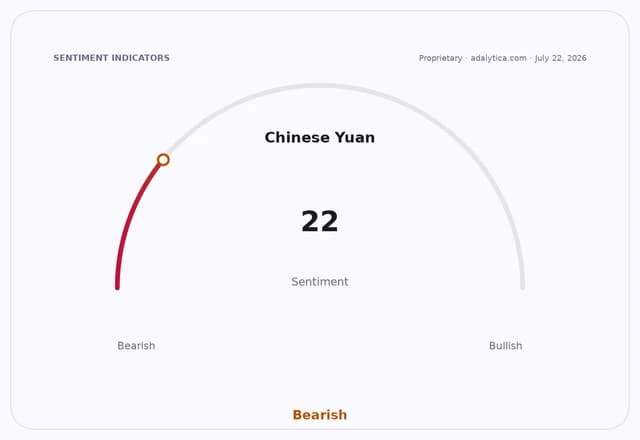
That split is visible in the foreign-exchange market. The yuan is trading around 6.77 per dollar, below its 50-day moving average of 6.78 and its 200-day average of 6.92, with RSI readings in the mid-30s and MACD still below the signal line, technicals that point to a currency under persistent pressure. By contrast, the rupee is around 96.54 per dollar, with its 50-day average near 95.54, but India’s currency has held a stronger trend versus China’s as investors focus on relative growth, not just nominal levels.
China’s slower growth also feeds through to global equities tied to the country. The iShares China Large-Cap ETF, FXI, has slipped to about $34.63 from more than $40 earlier in the year and still trades below its 200-day moving average of 37.13, reflecting lingering skepticism over Beijing’s ability to reaccelerate demand. The ETF’s RSI has been elevated, but that has not been enough to reverse the broader downtrend.

The policy backdrop adds to the narrative. U.S. rates remain elevated, with the fed funds rate at 3.63% and the 10-year Treasury yield around 4.57%, keeping dollar funding conditions relatively tight for Asia. That environment typically hurts slower-growing economies more, especially those trying to stabilize currencies and revive confidence in credit and consumption.
Adalytica’s China Economic Growth Target Sentiment gauge still reads “Greed” at 75, but awareness is at “Extreme Greed,” suggesting the market is watching Beijing’s growth objective closely even as confidence remains fragile. The Chinese yuan trade signal is the opposite, with “Fear” at 22 and “Extreme Fear” awareness, a sign investors are still leaning cautious on the currency and the outlook it implies.
For investors, the message is straightforward: China remains the bigger market, but India increasingly looks like the better growth story. That shift supports India-linked equities, domestic consumption plays and infrastructure beneficiaries, while pressuring exporters, commodity demand expectations and China-sensitive names. The next catalyst is whether Beijing can stabilize the yuan and deliver more convincing stimulus, or whether India keeps widening the growth premium.
| Entity | Gains | Losses |
|---|---|---|
| India equities | ▲Faster growth premium | ▼Relative valuation discount narrows |
| China policymakers | ▲Little if slowdown persists | ▼Credibility on reacceleration |
| FXI / China bulls | ▲Short-covering if stimulus hits | ▼Downtrend and weak sentiment |
| Global investors | ▲India allocation upside | ▼China exposure risk |




