India and Poland are deepening economic ties just as a long-awaited India-EU free trade agreement moves closer to implementation, creating a potentially larger market opening for exporters, technology firms and investors on both sides.
India and Poland deepen trade ties before EU pact
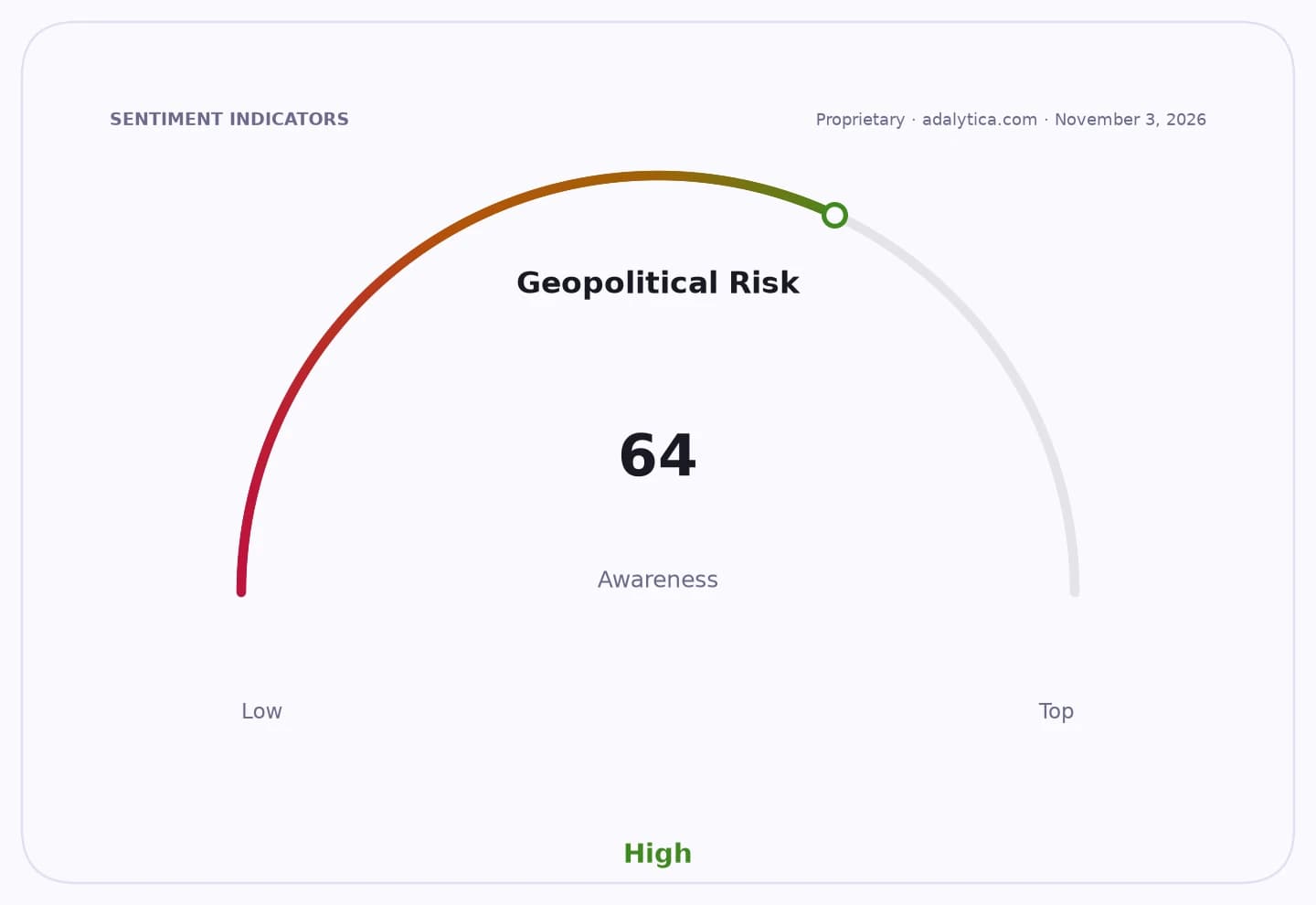
Geopolitical Risk
The immediate significance is less about diplomacy than about timing: New Delhi is trying to convert a higher-level political relationship into commercial flows before the trade pact takes effect in coming months. That matters because Poland is one of the European Union’s faster-growing manufacturing hubs and a useful gateway into the bloc for Indian companies seeking market access, local partners and supply-chain footholds.
Sentiment Indicators
Minister of State for Commerce and Industry Jitin Prasada’s November 2-3 visit to Warsaw, accompanied by 12 Indian companies, came after Polish Prime Minister Donald Tusk’s trip to India last month and follows the two countries’ strategic partnership launched in 2024. The sequencing suggests both governments want to lock in business activity before the broader EU trade framework changes the calculus for tariffs, sourcing and investment decisions.
For investors, the focus on artificial intelligence, semiconductors, data centres and cybersecurity is the clearest takeaway. Those sectors sit at the intersection of Europe’s industrial policy and India’s push to move up the value chain under the Make in India program. The push for co-development, co-production and technology transfer points to a model that could benefit Indian electronics, software and engineering firms while giving Polish companies access to lower-cost production and a larger market.
The delegation also highlighted agri-tech, food processing, critical minerals and start-up partnerships, areas where trade liberalisation could have more immediate commercial impact. If the India-EU deal lowers friction around goods and services, small and medium-sized enterprises may get a bigger role than in previous India-Europe outreach efforts, especially in niche manufacturing and digital services.
Poland’s importance extends beyond bilateral trade. As one of the EU’s central industrial economies and a country seeking stronger resilience in strategic sectors, it offers India a route into European supply chains at a time when both sides are rethinking dependence on China and other concentrated production centres. That makes the discussions on resilient global supply chains more than diplomatic language; they point to a diversification strategy that could reshape sourcing, investment and procurement decisions.
The visit also had a defense-adjacent dimension. Prasada’s stop at WB Electronics, a Polish defence company with business interests in India, underscores how industrial cooperation is increasingly overlapping with security-linked technology transfer. That broadens the opportunity set for Indian firms, but it also raises the bar for execution, compliance and localization.
The bear case is that the relationship remains more aspirational than transactional. India has signed many trade and investment initiatives that have taken years to convert into measurable flows, and the India-EU pact itself still faces the usual delays around market access, standards and domestic political compromises. Poland’s own political backdrop, including tensions around institutional reform, adds another layer of uncertainty, even if it has not yet derailed its external economic agenda.
Still, the near-term setup is constructive. With the trade agreement approaching, high-level contact intensifying and companies on both sides identifying specific sectors, the India-Poland corridor looks less like a ceremonial partnership and more like a test case for how India can translate Europe policy into deals.
| Entity | Gains | Losses |
|---|---|---|
| Indian exporters and IT firms | ▲EU market access | ▼Tariff and regulatory barriers |
| Polish manufacturers and investors | ▲Indian sourcing and partnerships | ▼Dependence on slower legacy supply chains |
| SMEs in both countries | ▲New trade and co-production opportunities | ▼Scale advantages of larger incumbents |
| China-centric suppliers | ▲— | ▼Potential diversion of sourcing and investment |