India’s plan to replace the wholesale price index with a producer price index is more than a technical statistical update: it would give policymakers a more accurate read on inflation pressures in an economy where services, supply chains and taxes now matter as much as old-style factory prices.
India Shift to Producer Price Index

The shift matters because the wholesale price index, long used in India as a proxy for producer inflation, captures a narrower slice of the economy and can distort the picture when taxes, trade margins and imported inputs move sharply. A producer price index is designed to measure prices received by domestic producers at the factory gate, before retail markups, and is generally seen as a better gauge of pipeline inflation. For investors, that means a potentially cleaner signal on margins, monetary policy and sector pricing power.
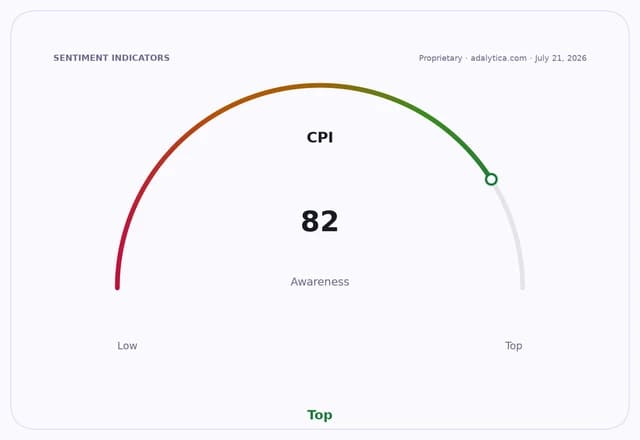
Sentiment IndicatorsⓘProprietary · adalytica.com · July 21, 2026
This is a snapshot — live sentiment, awareness and momentum for 130+ markets update continuously in the dashboard.Open AlphaPulse

The case for the change is rooted in how India’s economy has evolved. Manufacturing still matters, but services account for a much larger share of output than when the WPI was first built. The WPI also omits many items that now influence domestic inflation dynamics, especially in a more integrated economy with shifting global commodity prices, shipping costs and import dependence. In practice, a PPI can help distinguish between a temporary surge in wholesale pass-through and a more persistent rise in producer costs.
That distinction is economically important. If producer prices are rising faster than final demand, companies may face margin compression before they can pass costs on to consumers. If producer inflation is cooling while consumer prices remain sticky, it points to weak pass-through and could give the central bank more room to stay cautious. In India, where inflation management has direct implications for the Reserve Bank of India’s policy stance, a more granular producer price measure could improve forecasting and reduce policy error.
The broader backdrop underscores why the timing matters. Global industrial price pressures have been uneven, with commodity markets, transport costs and imported inflation still capable of feeding through to domestic producers. India’s own industrial production has been improving, suggesting firms are operating in a firmer demand environment, but that does not remove cost pressure. A PPI would help reveal whether rising output is being matched by pricing power or being offset by higher input costs.
For markets, the change is likely to be welcomed by economists and fixed-income investors who rely on inflation data to price policy expectations. Bond yields, rate-sensitive equities and currency markets all react not just to the level of inflation, but to whether the data are viewed as credible and comparable over time. A better producer price series should make it easier to model margins for industrial, consumer and logistics companies, especially those exposed to imported raw materials and energy.
There is also a corporate angle. Exporters and manufacturers would benefit from a better measure of factory-gate pricing, while sectors that rely on regulated pricing or heavy input pass-through could see their inflation dynamics parsed more accurately. The downside is that a switch in methodology can complicate historical comparisons, at least initially, and investors may need to recalibrate models that were built around WPI trends.
The likely endgame is not just a new data label but a better policy toolkit. If India adopts a PPI, it would align its inflation framework more closely with international practice and give officials a measure that better reflects the modern production economy. For investors, the key implication is straightforward: the new index should improve the quality of inflation signals, but it may also expose sharper swings in producer margins and sector pricing than the old wholesale series ever did.
| Entity | Gains | Losses |
|---|---|---|
| Indian policymakers | ▲Better inflation gauge | ▼Less continuity with WPI history |
| RBI and bond investors | ▲Cleaner policy signal | ▼More model recalibration |
| Manufacturers/exporters | ▲Better factory-gate visibility | ▼Wider exposure to cost swings |
| Firms with weak pricing power | ▲More transparent pass-through data | ▼Margin pressure becomes clearer |