Indonesia’s manufacturing sector is back in expansion, and that matters because it signals a real pickup in activity at a time when investors are looking for evidence that growth can outpace sticky inflation and rising import demand.
Indonesia Manufacturing PMI Rebounds to 52.4
The Ministry of Finance said the country’s manufacturing Purchasing Managers’ Index rose to 52.4 in September from 49.8 in August, the strongest business conditions since February and a clear move back above the 50-point line that separates expansion from contraction. The rebound was driven by firmer new orders at home and abroad, with export demand growing at its fastest pace since May 2022. For an economy that relies on manufacturing to anchor employment, investment and commodity-linked supply chains, that is the kind of data point that can reprice expectations fast.
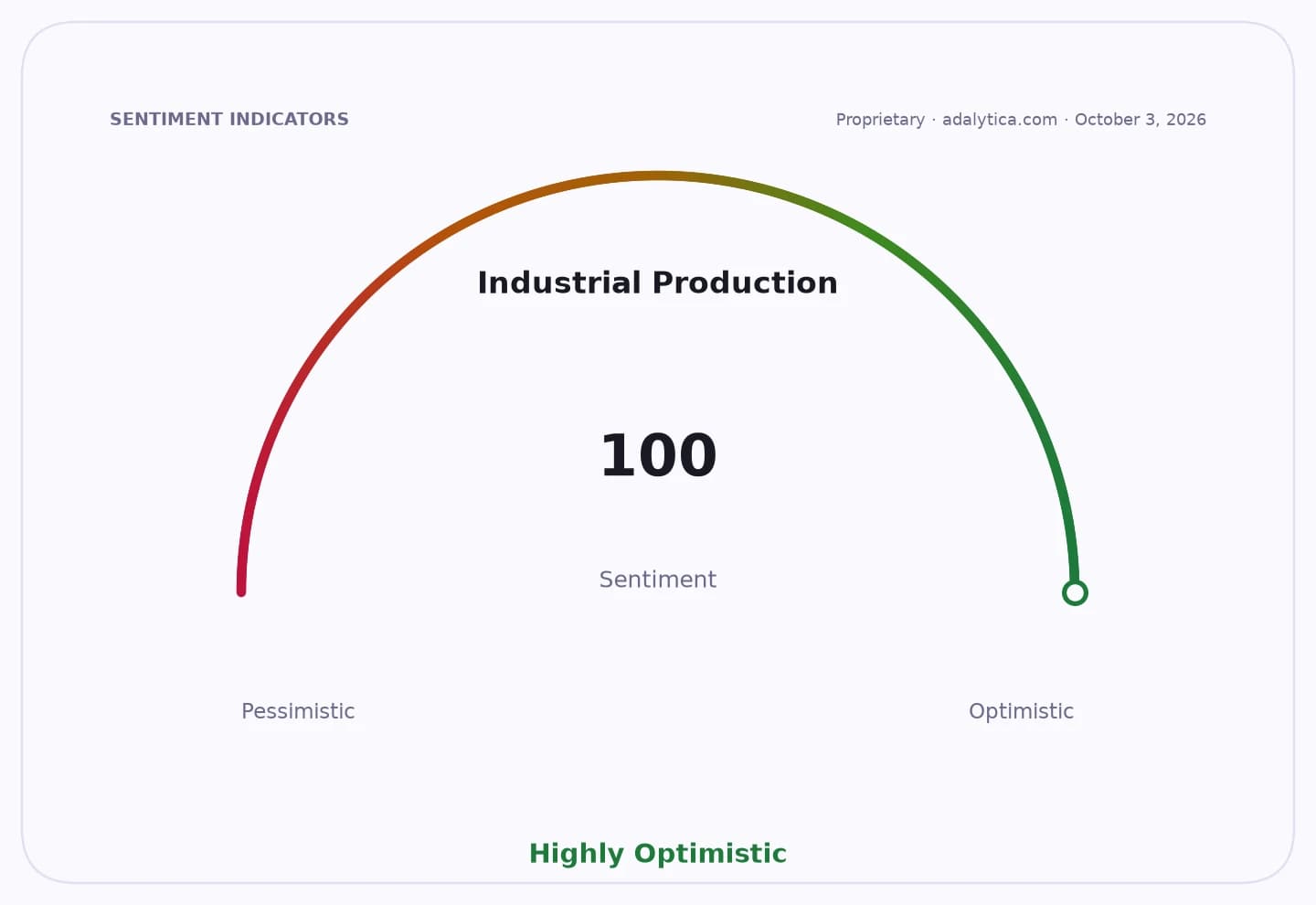
Sentiment IndicatorsⓘProprietary · adalytica.com · October 3, 2026
This is a snapshot — live sentiment, awareness and momentum for 130+ markets update continuously in the dashboard.Open AlphaPulse
The macro backdrop is constructive but not frictionless. Inflation in September was 3.28% year on year, with food prices still showing pressure, while the trade surplus remained intact at $3.35 billion in August. That surplus is an important buffer, but the composition of trade is just as telling: imports jumped 19.09% from a year earlier, led by raw materials, intermediate goods and capital equipment. In other words, companies are buying to produce, not just to consume. That is exactly what you want to see at the start of a manufacturing upswing.
The demand picture is also broadening beyond the factory floor. Consumer confidence improved, retail sales edged higher, car sales surged 32.4% and motorcycle sales rose 3.2%, while cement and electricity sales also increased. That combination suggests the recovery is not isolated to one sector or one buyer group. It is spilling into housing, logistics, transport and industrial production, which increases the odds that the PMI rebound feeds into broader GDP momentum over coming quarters.
For investors, the key takeaway is that Indonesia is showing the classic ingredients of an early-cycle industrial recovery: stronger orders, rising imports of inputs and machinery, stable enough inflation to keep policy supportable, and a trade surplus that preserves external resilience. The market often waits for hard earnings before assigning value to this kind of turn. That is usually too late. The better entry point is when the data first confirms that factories, suppliers and capex are all moving in the same direction.
The opportunity now is less about chasing the headline PMI itself and more about the second-order winners: industrials, logistics, building materials, power demand, banks lending into capex, and exporters tied to an improving global manufacturing base. With policy makers signaling they will keep prices contained, protect purchasing power and streamline investment rules, the setup favors domestic cyclicals with leverage to production and infrastructure rather than pure consumer defensives.
The next catalyst will be whether September’s rebound translates into stronger output, sustained export orders and firmer private investment through year-end. If it does, Indonesia’s recovery will stop looking like a monthly bounce and start looking like a durable industrial upcycle. That is where the market tends to miss the move.
| Entity | Gains | Losses |
|---|---|---|
| Indonesian manufacturers | ▲New orders and output | ▼Recession fears |
| Industrial/input suppliers | ▲Higher raw-material demand | ▼Idle capacity |
| Domestic cyclicals | ▲Broader growth impulse | ▼Defensive positioning |
| Import-dependent consumers | ▲Stable prices if policy holds | ▼Higher cost pressures |