People’s fear of inflation is becoming an economic force of its own, and that matters because expectations now risk doing damage even before prices do. When households, businesses and investors assume costs will keep rising, they change spending, hiring, pricing and wage demands in ways that can keep inflation sticky and growth weaker at the same time.
Inflation fear, CPI and TLT levels on July 29

That is the real market problem behind the latest inflation backdrop. The consumer price index is still running far above the Federal Reserve’s 2% target, with the headline gauge at 332.568 in June and a forecast of 335.512 for July, while the 10-year Treasury yield sits near 4.7%, a level that keeps financing costs elevated across the economy. Unemployment, by contrast, remains relatively low at 4.2%, underscoring the awkward mix policymakers face: growth is not collapsing, but confidence in price stability is fragile.
Sentiment IndicatorsⓘProprietary · adalytica.com · July 29, 2026
This is a snapshot — live sentiment, awareness and momentum for 130+ markets update continuously in the dashboard.Open AlphaPulse

The tension is showing up in markets. The SPDR S&P 500 ETF Trust closed at 734.45 on July 29, but the trade signal snapshot from Adalytica.com shows sentiment has slipped to neutral even as awareness sits in greed territory, a sign that investors are still willing to buy risk but are increasingly alert to inflation shocks. Treasury investors, meanwhile, have kept a wary eye on duration as TLT, the iShares 20+ Year Treasury Bond ETF, traded at 83.84, below both its 50-day and 200-day moving averages, with a weak MACD reading that suggests bonds are not yet pricing in a durable inflation relief story.
That matters economically because inflation fear can become self-fulfilling. If consumers believe prices will accelerate, they rush purchases forward. If companies think input costs and wages will keep climbing, they lift prices pre-emptively. If workers expect higher living costs, wage pressure follows. The result is not just higher measured inflation, but slower real activity as confidence erodes and policy stays tighter for longer.
CPI vs TLTadalytica.com
Explore this data interactively — full history, time series and cross-market comparisons.Open AlphaPulse
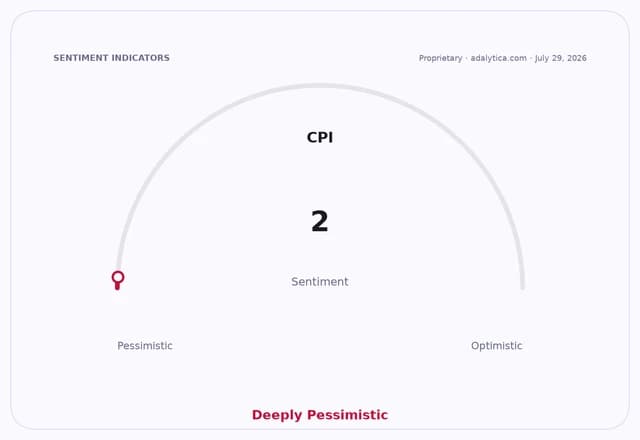
The Adalytica.com CPI Sentiment gauge captures that anxiety clearly: confidence in the Fed’s 2% inflation target sits in extreme fear territory, even after a brief improvement in the latest reading. That low confidence is the kind of backdrop that can keep rate cuts limited, real yields higher and equity valuations under pressure, especially for longer-duration sectors that depend on cheap capital.
For investors, the opportunity is to lean into the parts of the market that benefit from persistent inflation uncertainty rather than fight it. Energy, defense, commodities, pricing-power retailers and short-duration cash generators tend to hold up better when inflation expectations are unstable. Long-duration assets, rate-sensitive growth names and highly leveraged balance sheets remain vulnerable if the public continues to treat inflation as a permanent rather than transitory problem.
The bigger takeaway is that inflation fear itself is now part of the macro trade. Until households and businesses trust that prices are stable, the Fed will have a harder time easing, bond yields may stay elevated, and the market will keep rewarding companies that can pass through costs or profit from geopolitical and supply-chain stress. Investors should position for a world where credibility, not just CPI, is the battleground.
| Entity | Gains | Losses |
|---|---|---|
| Energy and commodities | ▲Higher pricing power | ▼Demand-sensitive sectors |
| Treasury bondholders | ▲Shorter duration protection | ▼Long-duration bond funds |
| Pricing-power retailers | ▲Cost pass-through ability | ▼Margin-compressed sellers |
| Fed credibility | ▲Rebuilding trust if inflation cools | ▼If inflation fears persist |




