Intel shares fell after Elon Musk suggested his planned Terafab semiconductor project could end up with a larger role for Taiwan Semiconductor Manufacturing Co., raising the risk that Intel may not be the main manufacturing beneficiary investors had been counting on.
Intel falls on Musk Terafab TSMC role report
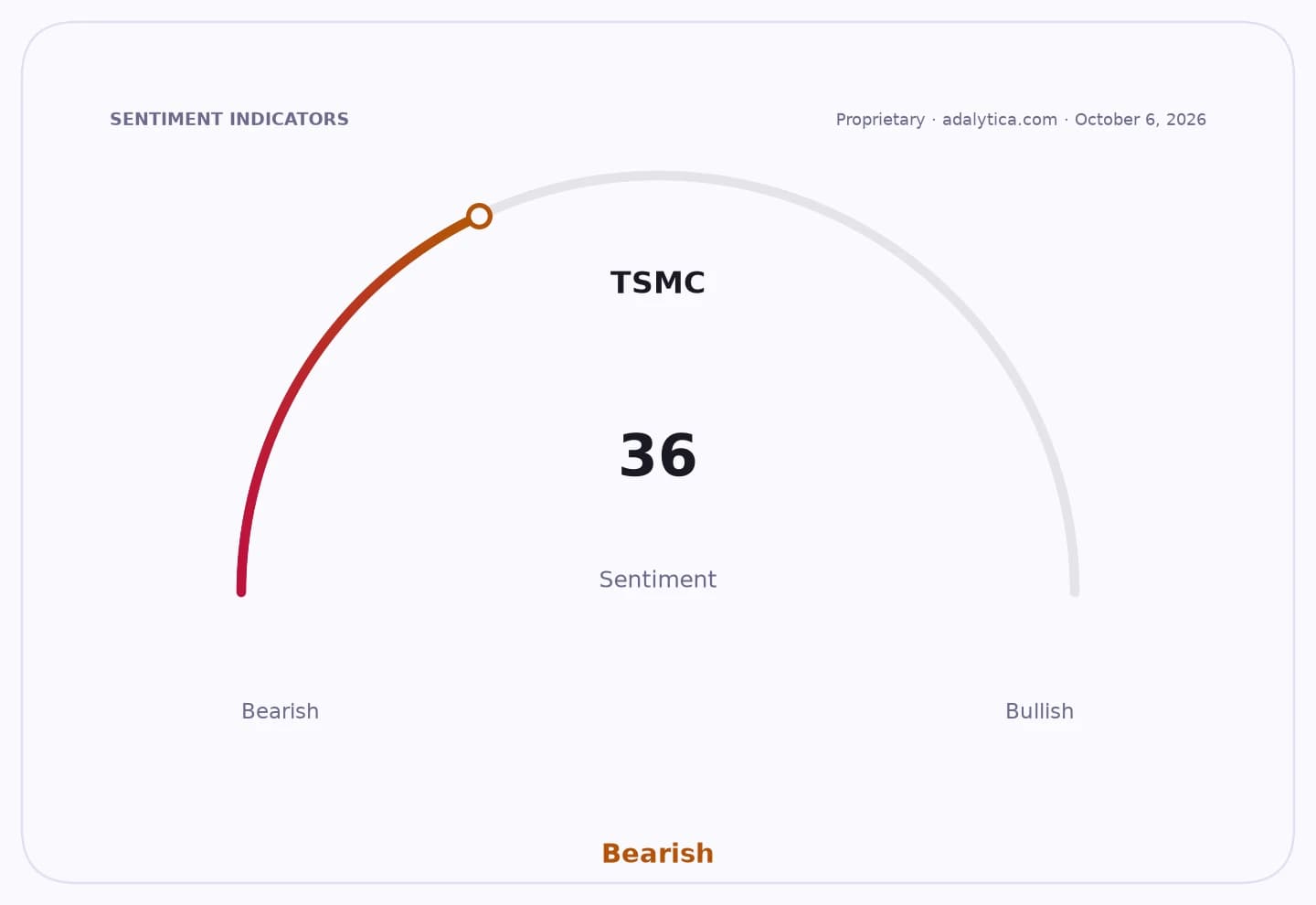
The stock dropped as much as 3% on Monday and briefly touched $115.31, even though Intel remains up 213% this year. The move shows how sensitive the shares have become to any sign that the company’s role in Musk-linked chip plans could be diluted. TSMC gained about 1% in early trading.
Sentiment IndicatorsⓘProprietary · adalytica.com · October 6, 2026
This is a snapshot — live sentiment, awareness and momentum for 130+ markets update continuously in the dashboard.Open AlphaPulse
Musk’s post followed a report by tech journalist Tim Culpan that TSMC could work with Terafab, which Musk has described as a planned semiconductor fabrication effort tied to Tesla, SpaceX and Intel. Musk said the talks were “only discussions” for now, but that “something could come of it.” For investors, the problem is not an announced deal — there isn’t one — but the possibility that the Taiwanese foundry could become the lead builder or operator of the plant.
That matters economically because ownership of chip capacity is becoming one of the most valuable assets in the artificial intelligence supply chain. If TSMC takes a bigger role, Intel’s upside from the project could shrink, while TSMC would gain another high-profile foothold in advanced manufacturing outside its own core customer base. Analysts and traders have increasingly treated Terafab as a strategic prize, not just a one-off factory plan.
The market reaction also shows how much of Intel’s valuation has been built on expectations rather than execution. Intel only joined Terafab in April, when the shares rose on the prospect of a deeper role in the project. Monday’s decline suggests investors had been positioning for Intel to be the principal hardware winner and are now reassessing that assumption. Stocktwits data showed retail sentiment turned negative after Musk’s post.
TSMC’s share price held up better, reflecting the market’s view that any expansion of its role would be additive rather than disruptive. That lines up with Culpan’s argument that the likeliest outcome is TSMC “owns and operates” the new factory, a model that would fit its scale advantages and process leadership.
For Intel, the key question now is whether the Terafab project becomes another example of the company fighting to retain relevance in the most attractive parts of semiconductor manufacturing, or whether Musk ultimately leans toward the industry’s dominant foundry. For investors, the near-term focus will be whether talks deepen beyond speculation and whether Intel can preserve a meaningful role in a project that had been one of the clearest catalysts behind its strong share rally this year.
| Entity | Gains | Losses |
|---|---|---|
| TSMC | ▲Larger role in Terafab | ▼None yet, but still only talks |
| Intel | ▲Retains project optionality | ▼May lose lead manufacturing role |
| Tesla/SpaceX/Musk projects | ▲Access to top foundry capability | ▼Greater reliance on outside partner |
| Intel shareholders | ▲Higher activity around the name | ▼Dilution of Terafab upside |