Iran’s threat to target undersea internet cables running through the Strait of Hormuz raises the economic stakes of any renewed conflict with the United States by putting a critical piece of digital infrastructure in the firing line.
Iran Threatens Strait of Hormuz Internet Cables
The warning matters because submarine fiber-optic lines are not just telecom assets: they carry data traffic that underpins banking, business communications, cloud services and cross-border commerce. Even though the Strait of Hormuz handles less than 1% of global international bandwidth, disruption there could ripple through a region that depends on a narrow set of routes for connectivity and could force carriers, governments and companies to reroute traffic at higher cost.
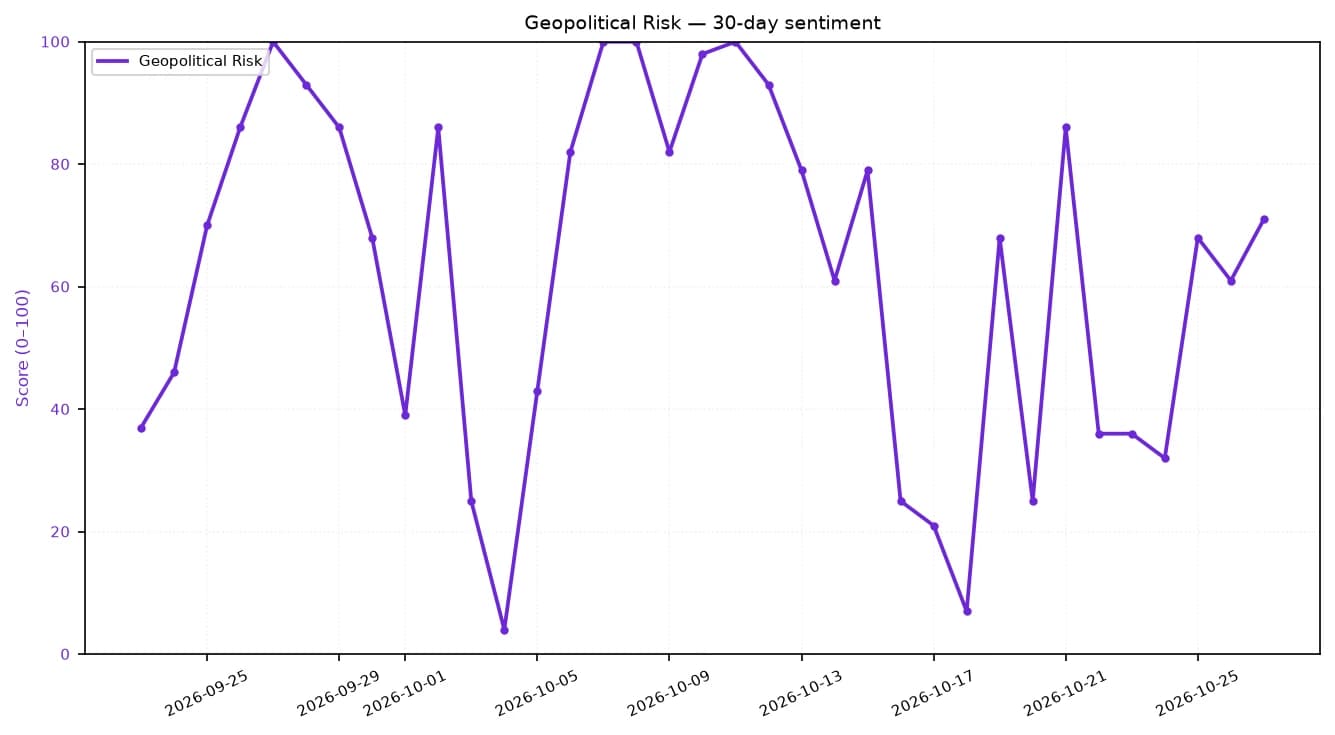
Sentiment Indicators
The threat also broadens the battlefield. Iranian officials have already signaled that data centers and artificial-intelligence facilities linked to the US could be targeted if hostilities escalate, suggesting Tehran is thinking beyond oil tankers and missiles to the infrastructure that supports modern commerce. That makes the risk harder to contain and harder to price, because attacks on cables can create operational disruption even without a large kinetic campaign.
For investors, the immediate significance is less about a direct hit to global internet capacity than about the tail risk of a wider Gulf disruption. Telecom operators with exposure to Middle Eastern routes, cloud and networking providers, and companies reliant on low-latency data flows could face service interruptions, repair costs and contingency spending. The broader market effect is a familiar one: a geopolitical shock that can lift energy-security concerns, pressure risk appetite and raise the premium on infrastructure resilience.
The move comes as Washington and Tehran remain locked in tense, unresolved talks, and as US rhetoric keeps alive the possibility of fresh strikes on Iranian targets. That combination increases the chance that critical undersea infrastructure becomes a bargaining chip, not just a military target. For now, the threat is a warning shot; for markets, it is a reminder that the next escalation in the Gulf may run through cables as much as through crude.
| Entity | Gains | Losses |
|---|---|---|
| Iran | ▲Deterrence leverage | ▼Diplomatic credibility |
| US and allies | ▲— | ▼Infrastructure security |
| Telecom carriers | ▲Security spending demand | ▼Network disruption risk |
| Energy markets | ▲Geopolitical hedge bid | ▼Stability and risk appetite |