Iran’s disclosure of a new underground missile city is the latest signal that Tehran is hardening its arsenal against the risk of another round of strikes, even as it warns the US and Israel that its missile and drone production can continue under bombardment.
Iran underground missile city raises escalation risk
The announcement matters because it goes beyond messaging. By moving missile and UAV assembly lines underground, the Islamic Revolutionary Guard Corps is trying to reduce the vulnerability of a core deterrent capability that has become central to Iran’s security strategy. If Tehran can preserve production during a sustained air campaign, then outside powers have fewer ways to degrade its capacity through limited strikes, which raises the military cost of escalation and complicates any effort to pressure Iran back to the negotiating table.
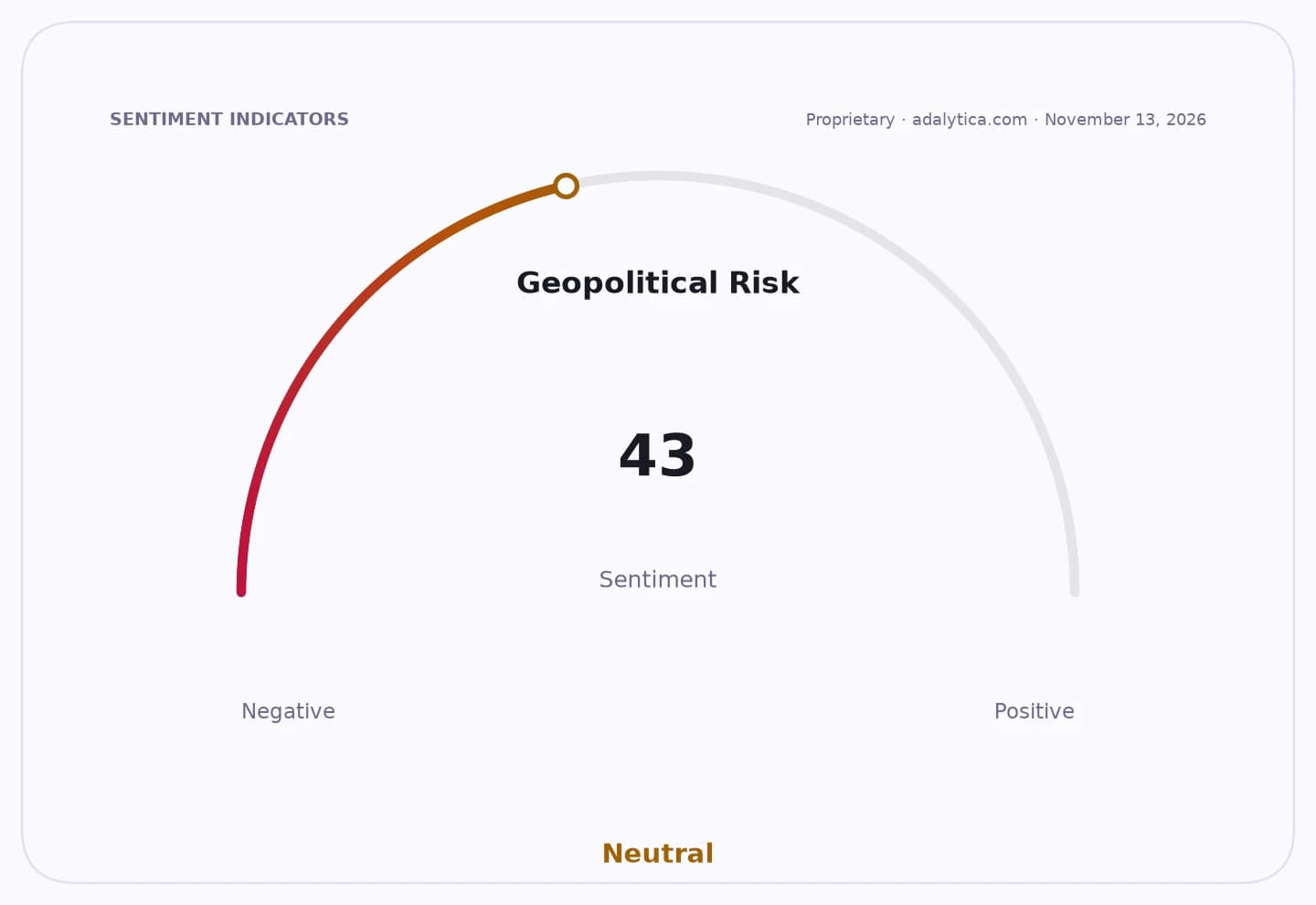
Sentiment Indicators
The IRGC said its aerospace force has shifted production facilities below ground and will unveil a new missile city along with other military advances. Brigadier General Hossein Mohebbi said the aim is to ensure weapons manufacturing cannot be disrupted “even when subjected to intense bombing,” and that Iran’s stockpiles would not simply run down as its adversaries expect. He also claimed the force has expanded domestic development of missiles, drones and air defenses, and said future capabilities would be revealed if confrontation deepens.
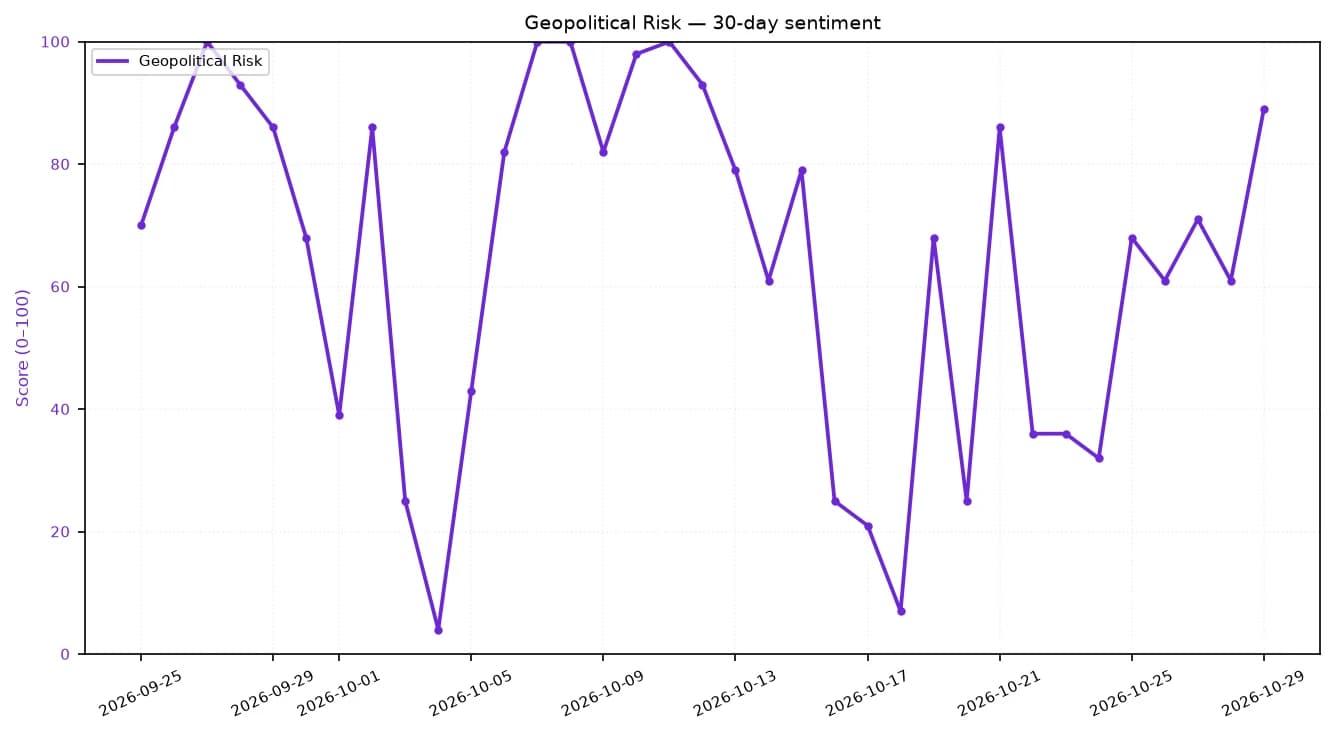
For investors, the immediate market impact is less about the missile itself than the risk premium around the region. Any sign that Iran is preparing for a prolonged confrontation typically supports oil prices, widens geopolitical hedging and keeps defense shares bid on expectations of sustained procurement. The Adalytica Global Stability gauge sits at 43, still in neutral territory but with awareness at an “extreme fear” reading of 4, underscoring how fragile market confidence remains when Middle East tensions flare.
Geopolitical Risk — 30-day sentimentadalytica.com
Explore this data interactively — full history, time series and cross-market comparisons.
That backdrop helps explain why major US defense contractors remain in focus. Lockheed Martin, Northrop Grumman and RTX all trade above their 50-day moving averages in the latest data, suggesting the sector has kept underlying support even as individual names have pulled back from earlier peaks. Lockheed closed at $596.04, above its 50-day average of $553.54 but below its 200-day average of $564.47; Northrop finished at $550.43, still above both its 50-day and 200-day lines; RTX ended at $198.58, slightly above its 50-day average and just under its 200-day. None of that is a direct readthrough from Iran alone, but it shows how geopolitical risk can buttress order expectations for missile defense, sensors and intercept systems.
The strategic significance is that Iran is not just talking about survivability, but about industrial resilience. Underground production lines are designed to make targeting harder and to preserve output if above-ground infrastructure is hit. That is a direct challenge to US and Israeli planning, because it suggests Tehran is betting that dispersion, concealment and domestic manufacturing can outlast precision strikes. If true, it strengthens the case for a longer campaign rather than a quick punitive raid — a far more destabilizing prospect for markets and for regional security.
The counterargument is that these disclosures are as much deterrent theater as operational proof. Tehran has every incentive to project resilience after months of confrontation, and claims about interception rates, export success and protection against US systems cannot be independently verified from the statement alone. Still, in a region where perception often shapes deterrence as much as hardware, the message is clear: Iran wants adversaries to assume that its missile pipeline will survive the next round.
What to watch next is whether the unveiling is followed by any change in US or Israeli strike posture, further sanctions pressure or retaliation across the Gulf. If tensions escalate again, energy markets are likely to react first, while defense names and missile-defense suppliers remain the clearest equity beneficiaries.
| Entity | Gains | Losses |
|---|---|---|
| Iran / IRGC | ▲Deterrence posture | ▼Vulnerability of missile production |
| US and Israel | ▲— | ▼Higher escalation risk |
| Oil markets | ▲Geopolitical risk premium | ▼Stability premium |
| Defense contractors | ▲Missile-defense demand | ▼— |