Italy’s benchmark spread over German Bunds has narrowed to 77.1 basis points, signaling that investors are demanding less compensation to hold Italian debt at a time when euro-area rate volatility is easing and credit markets are showing a stronger appetite for duration.
Italy Btp-Bund Spread Narrows to 77.1 Basis Points

The move matters because the Btp-Bund spread is one of the clearest barometers of confidence in Italy’s fiscal and political stability. A tighter spread lowers borrowing costs for the Italian state and can filter through to banks, corporates and households through cheaper funding. It also tends to reflect a broader reduction in fragmentation risk inside the euro zone, which is especially important when investors are reassessing how much sovereign risk they want to carry after a prolonged period of policy tightening.
Sentiment IndicatorsⓘProprietary · adalytica.com · August 5, 2026
This is a snapshot — live sentiment, awareness and momentum for 130+ markets update continuously in the dashboard.Open AlphaPulse
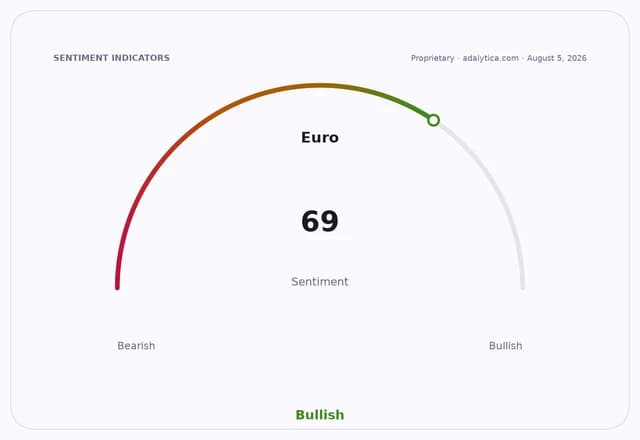
For markets, the narrowing spread is a relative-value signal as much as a macro one. Italy’s debt remains heavy, so any improvement in pricing can meaningfully ease financing pressure at the margin. The decline also suggests buyers are becoming more comfortable with peripheral sovereigns versus Bunds, particularly as euro-area sentiment has improved. Adalytica.com’s Euro Trade Signals snapshot shows extreme awareness and a recent rise in sentiment, while US Treasury bond signals also point to strong demand for duration, reinforcing the idea that fixed-income investors are reaching for yield in a more stable rates backdrop.
The bullish case is that Italy is benefiting from a search for carry and a perception that near-term political and fiscal risks are contained. The bearish case is that the move may be more about global bond demand than a durable re-rating of Italy’s credit profile. If German yields rise or Italian growth weakens, the spread could widen again quickly.
For investors, the key issue is whether 77.1 basis points marks a structural tightening in Italy’s risk premium or just a cyclical rally in sovereign debt. If the former, Italian banks and domestic risk assets should remain supported. If the latter, the spread may prove vulnerable to any setback in euro-zone growth, fiscal credibility or broader risk appetite.
| Entity | Gains | Losses |
|---|---|---|
| Italy sovereign debt | ▲Lower funding costs | ▼Less room for fiscal slippage |
| Italian banks and corporates | ▲Cheaper borrowing conditions | ▼Wider spreads if risk aversion returns |
| Bunds/German debt | ▲Safe-haven demand | ▼Relative outperformance narrows |
| Yield-seeking investors | ▲Better carry in peripherals | ▼Bond prices if spreads reverse |




