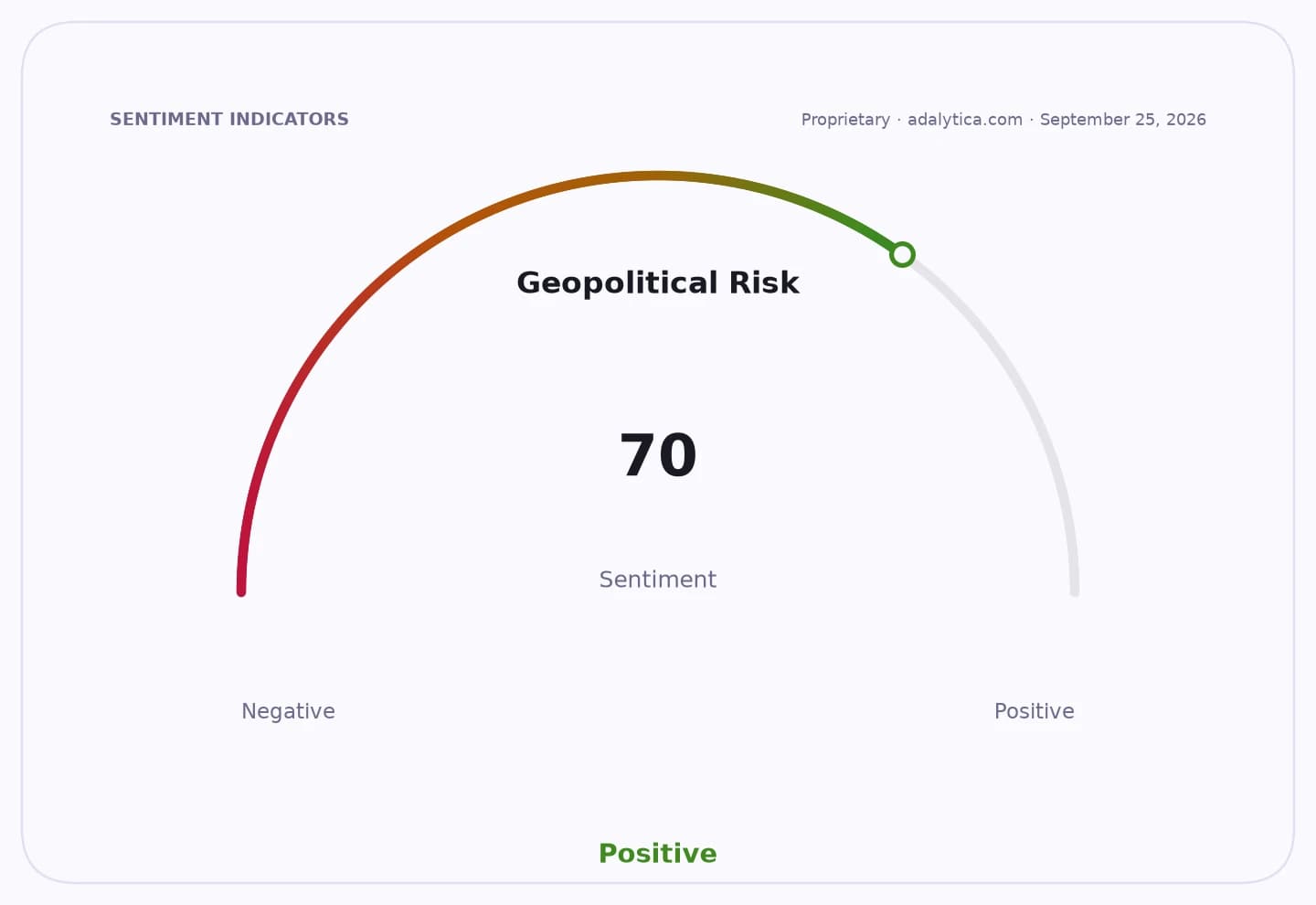
Italy’s benchmark spread over German Bunds remaining pinned at 82 basis points is telling savers that government borrowing costs are stable for now, but it is also a reminder that the market is not pricing a major improvement in Italy’s fiscal risk.
Italy Spread Stuck as Risk Premium Holds
For households holding Italian bonds, bank deposits tied to local funding conditions or funds exposed to BTPs, the narrow spread matters because it helps keep financing conditions contained. A wider gap would usually feed through to higher yields on new Italian debt, rising funding costs for banks and a heavier burden on borrowers. At 82 points, investors are signaling that Italy is not under acute stress, even as they continue to demand a premium over Germany for taking on Rome’s debt.
Sentiment IndicatorsⓘProprietary · adalytica.com · July 22, 2026
This is a snapshot — live sentiment, awareness and momentum for 130+ markets update continuously in the dashboard.Open AlphaPulse
That premium is modest by historical Italian standards, but it still reflects the basic equation that has long defined the market: Italy is a larger, more indebted sovereign than Germany, and it therefore has to pay more to borrow. The fact that the spread is stuck rather than tightening materially suggests the market sees limited near-term catalysts for a stronger rerating, even with the euro showing some resilience and broader bond sentiment remaining fragile.
Technical-style signals in the data point in the same direction. Adalytica’s proprietary Euro Trade Signals show the euro’s sentiment improving to neutral, but its awareness remains in fear territory, while US Treasury bond sentiment has fallen to extreme fear. That combination suggests investors are still cautious on duration and sovereign risk globally, which tends to limit aggressive compression in peripheral euro-zone spreads.
For Italy, the key economic implication is that stable spreads support Treasury financing and reduce pressure on domestic banks and insurers that hold large portfolios of government debt. That matters because any sharp move wider can ripple through to lending standards, mortgage pricing and the value of balance sheets across the financial system. It also matters for savers because a contained spread helps prevent a sudden spike in yields that would erode bond prices and raise volatility in income portfolios.
The bull case is that 82 points indicates a market comfortable with Italy’s near-term political and fiscal outlook, especially if growth remains orderly and the European Central Bank stays cautious about tightening financial conditions too quickly. The bear case is that the spread is merely frozen in a range, leaving Italy vulnerable to any surprise on the budget, growth or ECB policy path. In that scenario, a quiet market can turn quickly, and savers exposed to Italian debt would feel the impact first.
For investors, the message is less about exuberance than about stability. A spread locked at 82 basis points says Italy is not the euro-zone’s stress point right now, but it also says the market is not yet willing to reprice Italian risk much lower. The next move will likely depend on whether growth, fiscal discipline and global rates cooperate enough to let that premium shrink further.
| Entity | Gains | Losses |
|---|---|---|
| Italian savers and BTP holders | ▲Stable bond values | ▼Less upside from spread tightening |
| Italian Treasury | ▲Predictable funding costs | ▼No major relief in borrowing premium |
| Italian banks and insurers | ▲Lower market volatility | ▼Persistent sovereign-risk overhang |
| German Bunds | ▲Safe-haven demand | ▼Relative yield advantage compresses |