Japan stock market is poised for a steady start, with local equities supported by a softer U.S. dollar and a sharp drop in Treasury-bond sentiment even as broader global risk appetite remains mixed. The setup matters because a weaker dollar typically eases pressure on yen-sensitive exporters, while lower fear around Japanese stocks can help offset choppier signals from overseas markets.
Japan ETFs Hold Up on Softer Dollar

The benchmark EWJ exchange-traded fund has climbed to 92.72 from 79.83 in early October, a gain of about 16%, showing that investors have been willing to keep adding exposure to Japan despite bouts of volatility. The fund is now hovering just above its 50-day moving average of 92.10 and well above its 200-day average of 85.30, a sign the longer-term trend remains constructive even after recent cooling.
Sentiment IndicatorsⓘProprietary · adalytica.com · July 13, 2026
This is a snapshot — live sentiment, awareness and momentum for 130+ markets update continuously in the dashboard.Open AlphaPulse
DXJ, which tracks Japan equities with currency hedging, is also holding near elevated levels at 175.04, up from 126.01 in October and still far above its 200-day moving average of 153.30. That positioning suggests investors continue to favor Japan both as a corporate earnings story and as a way to play relative strength versus other developed markets.
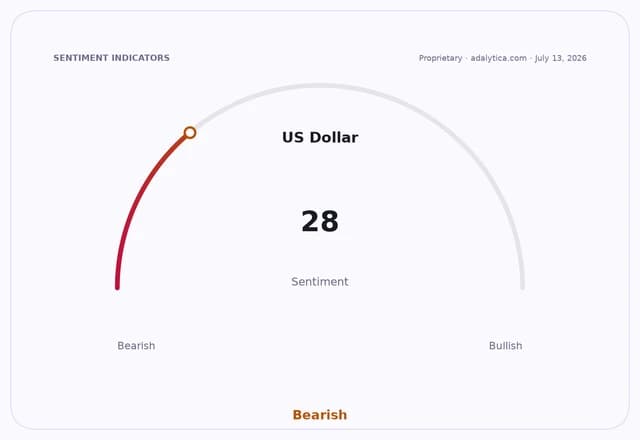
The macro backdrop is doing part of the work. Adalytica’s U.S. dollar trade signals show sentiment at 28, in “fear,” with awareness at 13, or “extreme fear,” while TLT’s bond signals are even weaker, with sentiment at 12. For Japan, that combination can support exporters and global cyclicals by keeping the yen from strengthening aggressively and by nudging capital toward equities instead of duration.

Market technicians point to a still-bullish but less overheated tape. EWJ’s RSI reading has eased to 36.0 from 61.4 on July 6, and DXJ’s RSI has slipped to 43.3 from 69.8, suggesting recent consolidation after a strong run rather than a broader trend break. Both funds remain above their 50-day and 200-day moving averages, which tends to keep dip buyers engaged.
For investors, the key question is whether Japan can hold these gains if U.S. risk appetite stays uneven. A steadier opening would reflect confidence in domestic equities’ relative resilience, but the next catalyst is likely to come from moves in the yen, U.S. rates and any shift in global growth expectations that could either extend the rally or trigger another round of profit-taking.
| Entity | Gains | Losses |
|---|---|---|
| Japan exporters | ▲Weaker yen tailwind | ▼Stronger currency risk |
| EWJ long holders | ▲Trend support above 200-day average | ▼Pullback after strong run |
| DXJ hedged investors | ▲Relative strength in Japan equities | ▼Lower upside if Japan stalls |
| U.S. bond bulls | ▲Potential haven demand | ▼Weakening sentiment and price pressure |




