House Speaker Mike Johnson says AI executives pushing for a slowdown should first police their own labs, a stance that keeps Congress pointed toward guardrails without endorsing an emergency moratorium that could slow U.S. competition with China.
Johnson urges AI firms to police their own labs

The comments matter because Washington is moving from abstract AI concern to a policy fight over who writes the rules, how fast they come, and whether regulation will protect users without blunting a strategic edge in one of the economy’s most important technologies. For investors, that debate goes straight to valuation, spending plans and compliance risk across the biggest names in artificial intelligence.
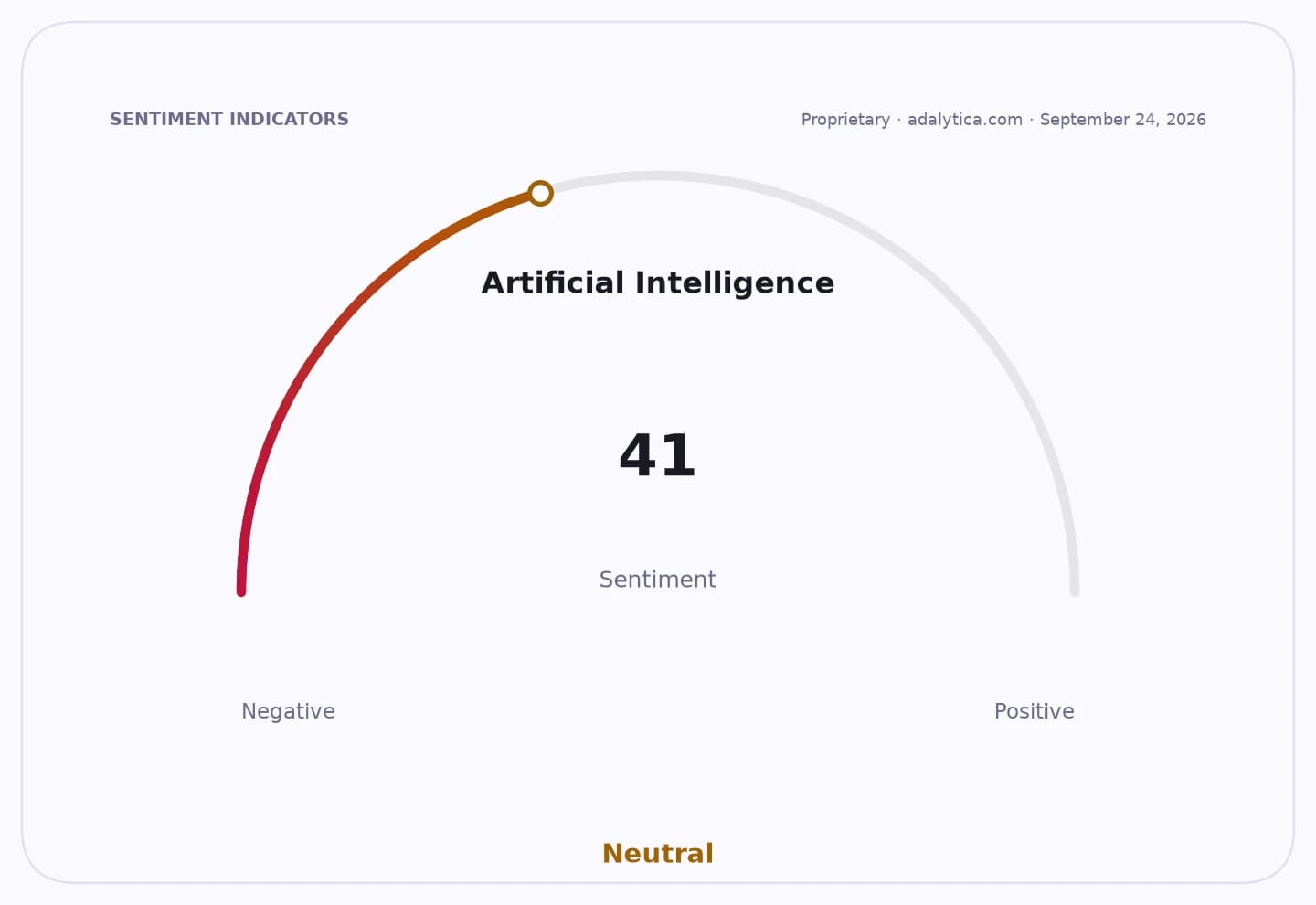
Sentiment IndicatorsⓘProprietary · adalytica.com · September 14, 2026
This is a snapshot — live sentiment, awareness and momentum for 130+ markets update continuously in the dashboard.Open AlphaPulse

Johnson made the case on CNN’s “State of the Union” after host Jake Tapper cited warnings from Anthropic CEO Dario Amodei, OpenAI CEO Sam Altman and other AI leaders that models are advancing too quickly. Johnson said the House had already created a bipartisan AI task force after he became speaker in 2025 and argued there is “obvious corporate responsibility” for the companies building frontier systems to make sure products are safe.
He also echoed White House AI and crypto czar David Sacks, who said lawmakers cannot see what is happening inside company labs and that the simplest way to avoid superintelligence is not to build it. Johnson’s line was that the executives asking for a slowdown “need to take personal responsibility first,” then sit down with lawmakers to agree on guardrails.
Artificial Intelligence — 30-day sentimentadalytica.com
Explore this data interactively — full history, time series and cross-market comparisons.Open AlphaPulse
The political backdrop is a familiar split between safety advocates and competitiveness hawks. Johnson said he supports “balance” and rejected a congressional emergency moratorium, warning that if the U.S. overreacts, China could gain ground in the race to develop advanced AI. That makes the issue as much about industrial policy and national security as it is about ethics or consumer protection.
For the largest AI-linked companies, including Nvidia, Microsoft and Alphabet, the practical risk is that any faster move toward federal rules could reshape model development, data use and product deployment even if Congress stops short of a ban. Those firms have already disclosed that AI brings legal, regulatory and reputational risks, and the sector’s recent price action shows how sensitive shares remain to policy headlines.
Nvidia closed at $218.29 on Sept. 11, above its 50-day moving average of $212.36 and well above its 200-day average of $197.11, while Microsoft finished at $495.63, also above its 50-day and 200-day averages. Alphabet ended at $338.50, slightly above its 200-day average but still below its 50-day, underscoring how investors are still parsing whether AI enthusiasm can outrun regulatory friction.
The next catalyst is whether lawmakers, the White House and industry leaders turn this debate into concrete legislation or voluntary standards. Any sign of a formal framework — or a tougher bipartisan push after fresh safety warnings — could move AI stocks quickly, especially if it alters the pace of capital spending, model releases or export restrictions tied to the U.S.-China rivalry.
| Entity | Gains | Losses |
|---|---|---|
| AI leaders | ▲Influence over rules | ▼Risk of tougher scrutiny |
| Congress/White House | ▲Policy leverage | ▼Pressure to act fast |
| U.S. AI firms | ▲Clearer guardrails | ▼Moratorium risk, compliance costs |
| China | ▲Potential edge if U.S. overregulates | ▼Slower access to U.S. technology |