Governments are no longer treating the energy transition as a slogan; they are writing the “just transition” into law, and that changes the investable landscape for decades. What was once a moral framework is becoming a policy design principle that will shape grid buildouts, utility regulation, industrial subsidies and clean-energy capital flows — a shift that can redirect hundreds of billions of dollars toward the companies that move power, materials and equipment.
Just Transition Favors Utilities and Grid Builders

That matters because the transition is no longer only about decarbonization. It is about managing who pays, who benefits and how quickly the old energy economy is unwound without breaking electricity reliability or social consent. The result is a slower but more durable policy regime: more transmission, more grid hardening, more storage, more domestic manufacturing, and more federal and state support for workers and communities tied to fossil fuels. In economic terms, that turns climate policy from a cyclical headline risk into a long-duration infrastructure program.
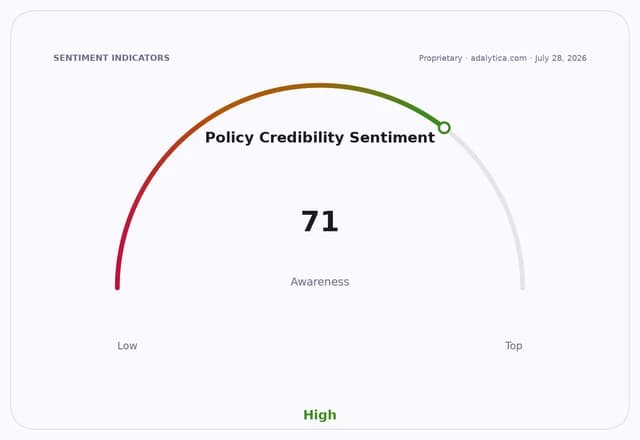
Sentiment IndicatorsⓘProprietary · adalytica.com · July 28, 2026
This is a snapshot — live sentiment, awareness and momentum for 130+ markets update continuously in the dashboard.Open AlphaPulse

Investors are already pricing that shift unevenly. The clean-energy ETF ICLN has been volatile, with its latest readings showing a close near $17.81 after a sharp pullback from June highs, while the 50-day moving average remains well above the current price. That tells you the sector is still being traded tactically, not owned as a secular compounder. Yet the broader policy direction argues the opposite: if nations keep embedding just-transition rules into law, the winners are the picks-and-shovels names that serve the buildout, not the most speculative developers that depend on perfectly smooth permitting and cheap capital.
The market is also sending a different message in the traditional energy and utility complex. XLE has staged a strong rebound and remains elevated on conventional technical indicators, while XLU has held firmer as investors look for regulated cash flows. That divergence is exactly what you would expect when policymakers try to square decarbonization with affordability: oil and gas producers are not disappearing overnight, but utilities become the central financing vehicle for the transition, and their investment needs rise as they absorb the cost of generation replacement, transmission upgrades and resilience spending.
The deeper economic implication is that “just transition” policy reduces one of the market’s biggest fears — social and political backlash against higher energy prices — by forcing governments to cushion the blow. That lowers the odds of abrupt policy reversals and improves visibility for multiyear capital plans. It also supports domestic supply chains in power equipment, transformers, conductors, industrial software and grid services, because lawmakers do not want to replace imported fuel dependence with imported clean-tech dependence. In that sense, the policy is as much about industrial strategy as climate.
There is a second-order trade here that the market underestimates. If transition rules must now address labor, community impact and affordability, then the winners are not just renewable developers but the entire regulated infrastructure stack: utilities with rate-base growth, transmission developers, grid modernization vendors, and ETF wrappers like ICLN for investors seeking broad exposure. The losers are companies that rely on a slower policy cycle, weaker disclosure and low social scrutiny to keep high-carbon assets alive longer than economics would otherwise allow.
I believe the best way to play this is to own the infrastructure layer of the transition, not chase the most crowded clean-energy names on policy headlines alone. If “just transition” keeps spreading through legislation and regulation, the next leg of returns will come from the toll roads of electrification — utilities, grid operators, equipment makers and select clean-power platforms with policy visibility and balance-sheet strength. Position early, because the market may still be treating this as ideology while governments are turning it into law.
| Entity | Gains | Losses |
|---|---|---|
| Utilities | ▲Rate-base growth | ▼Transition capex burden |
| Grid equipment makers | ▲Transmission demand | ▼Supply-chain bottlenecks |
| Clean-energy ETF holders | ▲Policy tailwind | ▼Near-term volatility |
| Fossil-fuel incumbents | ▲Slower phaseout | ▼Stranded-asset risk |