South Korea’s stock market is flashing the kind of momentum that investors are increasingly using as an early read on global risk appetite, with the iShares MSCI South Korea ETF surging even as U.S. equities have turned defensive and the dollar has strengthened. The move matters because Korea sits at the intersection of semiconductors, global trade and AI hardware supply chains, making its market one of the clearest barometers of whether the rally in cyclical tech can broaden beyond U.S. megacaps.
Korea ETF momentum cools as risk appetite narrows

The latest trading in EWY, the U.S.-listed Korea ETF, underscores how violent that repositioning has been. The fund closed at 162.54 on July 17, still far above its 200-day moving average of 132.65, but well below the recent peak near 211.45 in mid-June. That pullback has left the ETF in a technically fragile zone: the 50-day moving average is 190.76, the 14-day RSI has fallen to 30.3, and MACD remains deeply negative. In other words, the market has gone from an overbought surge to a sharp de-risking in a matter of weeks, even after one of the year’s strongest country-level rallies.
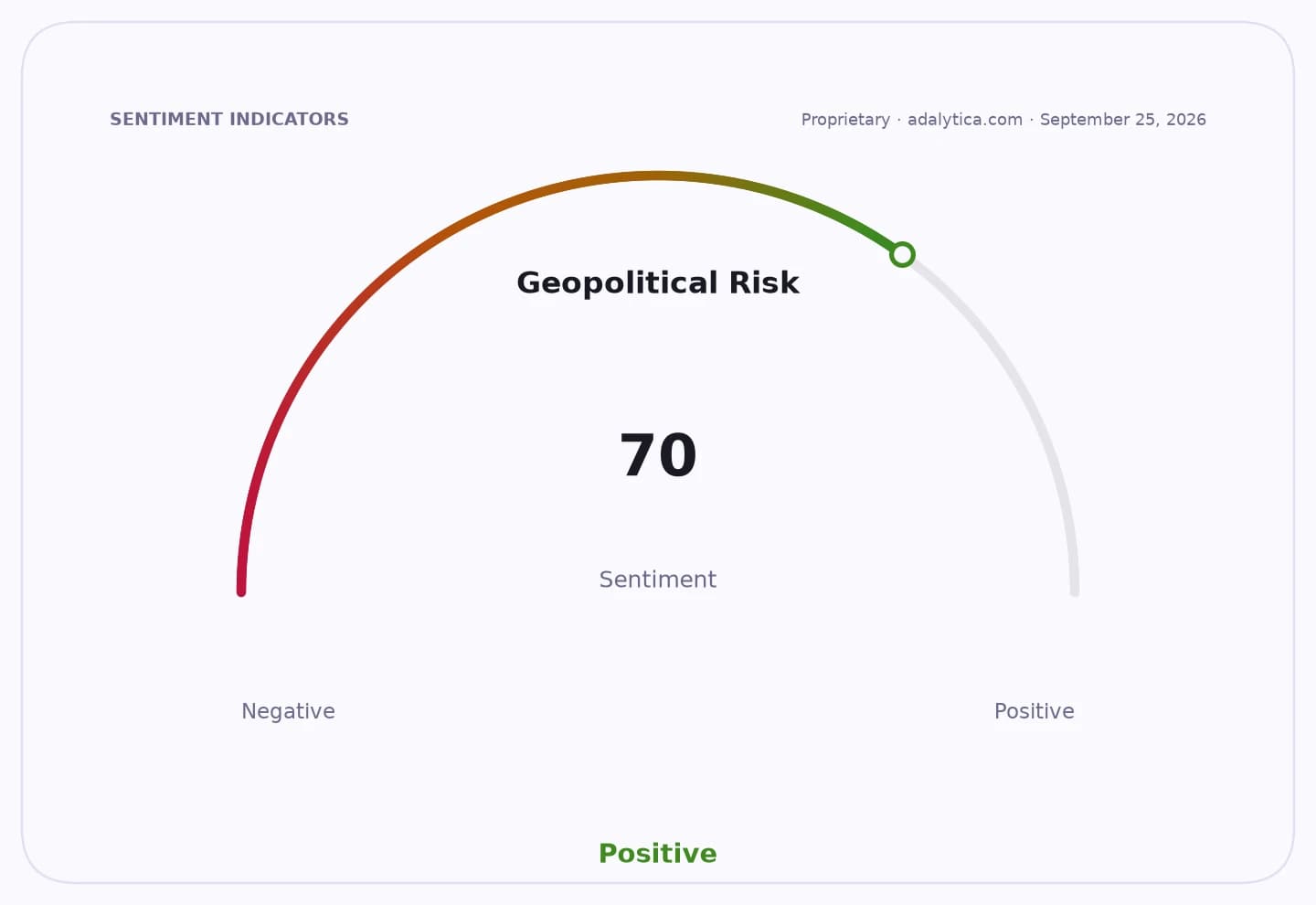
Sentiment IndicatorsⓘProprietary · adalytica.com · July 20, 2026
This is a snapshot — live sentiment, awareness and momentum for 130+ markets update continuously in the dashboard.Open AlphaPulse

That reversal is economically meaningful because South Korea is not a peripheral equity market. It is a proxy for global electronics demand, memory pricing, capital spending by chipmakers and, increasingly, the durability of the AI buildout. When Korea rallies, it often reflects confidence that the semiconductor cycle is turning higher and that export demand from the U.S. and China is holding up. When it weakens this quickly, it raises the possibility that investors are seeing the first signs of a more selective, less synchronized global growth picture.
The domestic Korea Composite Stock Price Index ETF, KOS, tells a similar story. After climbing to 2.98 in March and 3.10 in May, it slipped to 2.24 on July 17. The fund remains above its 200-day moving average of 2.00, but the 50-day average at 2.63 is now overhead resistance. That combination suggests the market is still in a longer-term uptrend, but the near-term momentum that had attracted global traders is fading. For investors, that usually means the easy money in the trade has already been made.

The contrast with China is also telling. FXI, the large-cap China ETF, has been more subdued, closing at 34.13 on July 17, below both its 50-day moving average of 34.51 and its 200-day average of 37.19. Its 14-day RSI at 83.1 points to short-term strength, but the broader trend still looks weaker than Korea’s. That divergence matters because it suggests capital is not simply rotating into Asia indiscriminately. Instead, investors appear to prefer Korea’s export-heavy, AI-linked market over China’s more policy-constrained equities, even as both remain tethered to global trade conditions.
The macro backdrop is mixed. U.S. market sentiment has deteriorated sharply, with Adalytica’s S&P 500 trade signals showing sentiment at 30, or “Fear,” after a 57-point drop over the past month. At the same time, the dollar has strengthened, with Adalytica’s U.S. dollar sentiment at 71 and in “Greed” territory. A firmer dollar typically weighs on non-U.S. risk assets and can tighten financial conditions for emerging markets and export-dependent economies like South Korea. That makes the recent weakness in EWY and KOS more than a local technical correction; it may be part of a broader global rotation away from cyclical risk.
For traders, South Korea’s market has become a faster read-through than many developed markets because of its leverage to semiconductors, memory pricing and global manufacturing demand. A strong Korea tape can reinforce the case for semiconductor suppliers, equipment makers and Asian cyclicals. A break in that tape, especially with oversold readings now appearing in EWY, can warn that the AI trade and broader industrial rebound are losing momentum at the margin.
The bull case is that the retreat is just a consolidation after an extended and crowded run, with long-term trend support still intact in both EWY and KOS. The bear case is that the recent surge was pricing in too much of a second-half recovery in exports and chip demand, leaving the market vulnerable to a deeper unwind if global growth cools or if the stronger dollar persists.
For investors, the key question is no longer whether South Korea can rally — it already has — but whether the market is still confirming a cyclical upswing or beginning to discount a late-cycle slowdown. If EWY can stabilize above its recent lows while the semiconductor complex holds, Korea may keep its status as Wall Street’s preferred early-warning signal. If not, the message from Seoul may be that global risk appetite is narrowing faster than the headline indices suggest.
| Entity | Gains | Losses |
|---|---|---|
| Korea exporters | ▲Weaker won support | ▼Slower global demand |
| Semiconductor bulls | ▲AI-cycle confirmation | ▼Inventory correction risk |
| U.S. dollar longs | ▲Firmer FX trend | ▼Emerging-market risk appetite |
| Global equity traders | ▲Early-cycle signal | ▼Crowded momentum longs |