A new workforce reskilling program from the Ministry of Labor and Employment is aimed at preventing a modestly soft job market from turning into a more persistent employment problem.
Labor Ministry Reskilling Program Targets July 4.18% Unemployment

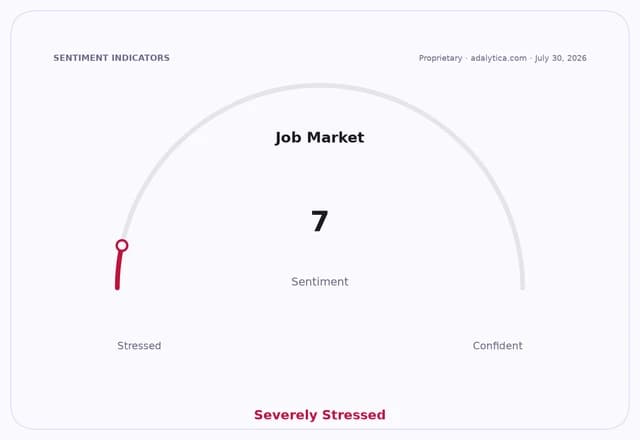
The policy matters because the labor market is not in crisis, but it is no longer tight enough to absorb mismatches without help. Unemployment has eased from 4.3% in April to 4.2% in June, and the latest forecast puts July at 4.18%. Payrolls continue to expand, with nonfarm employment projected to rise to 159.2 million in July from 159.0 million in June. But openings are no longer at the extremes seen after the pandemic, and job market sentiment tracked by Adalytica sits at 7, or “Extreme Fear,” underscoring the anxiety around hiring prospects and workforce security.

That combination points to a classic skills-gap problem rather than a broad cyclical collapse. Employers are still adding workers, but they are doing so more selectively, while job seekers face a tougher path back into work if their skills do not match current demand. A reskilling initiative is therefore an economic stabilizer: it can shorten unemployment spells, improve labor-force participation and help prevent structural joblessness from rising even if aggregate payroll growth remains positive.
For businesses, the policy could ease recruitment bottlenecks in sectors that still need labor, while also reshaping demand for staffing, placement and training services. ManpowerGroup, whose shares have swung sharply in recent months, ended July 30 at $52.17 after a rapid July rally that pushed the stock well above its 50-day moving average of $37.80. HireQuest has also firmed, closing at $13.76, above both its 50-day and 200-day moving averages. Those moves suggest investors are already positioning for a more active labor market and a potential pickup in staffing demand if retraining channels more workers into open roles.
UNRATE vs PAYEMS — macro contextadalytica.com
Explore this data interactively — full history, time series and cross-market comparisons.Open AlphaPulse
The broader context is that employers are cutting headcount in some industries even as others struggle to find qualified staff. Porsche plans a 20% workforce reduction through 2035, Visa is cutting 7% of employees, and BASF’s plant workforce is at its smallest since 1954. The common thread is not simply cost-cutting; it is the pressure to adapt to automation, efficiency demands and changing skill requirements. A government reskilling program addresses that mismatch directly, but its success will depend on whether training is tied closely enough to actual vacancies rather than broad, generic credentials.
For investors, the key question is whether this becomes a labor-market bridge or just another policy headline. If it works, it could support employment, reduce frictional unemployment and favor staffing firms, recruiters and training providers. If it disappoints, the risk is that labor demand stays uneven, with companies still forced to choose between higher hiring costs and slower growth.
| Entity | Gains | Losses |
|---|---|---|
| Ministry of Labor and Employment | ▲Policy credibility | ▼Risk of slow uptake |
| Job seekers | ▲Better employability | ▼Training mismatch risk |
| Staffing firms | ▲More placements | ▼Lower urgency if hiring slows |
| Employers | ▲Larger skilled labor pool | ▼Short-term training costs |