The industrial sector expanded 4.9% in the first half of the year, with manufacturing output up 5.5%, signaling that factory activity is regaining momentum after a weak patch and could provide a modest lift to growth in the second half.
Manufacturing Recovery Supports Cyclicals
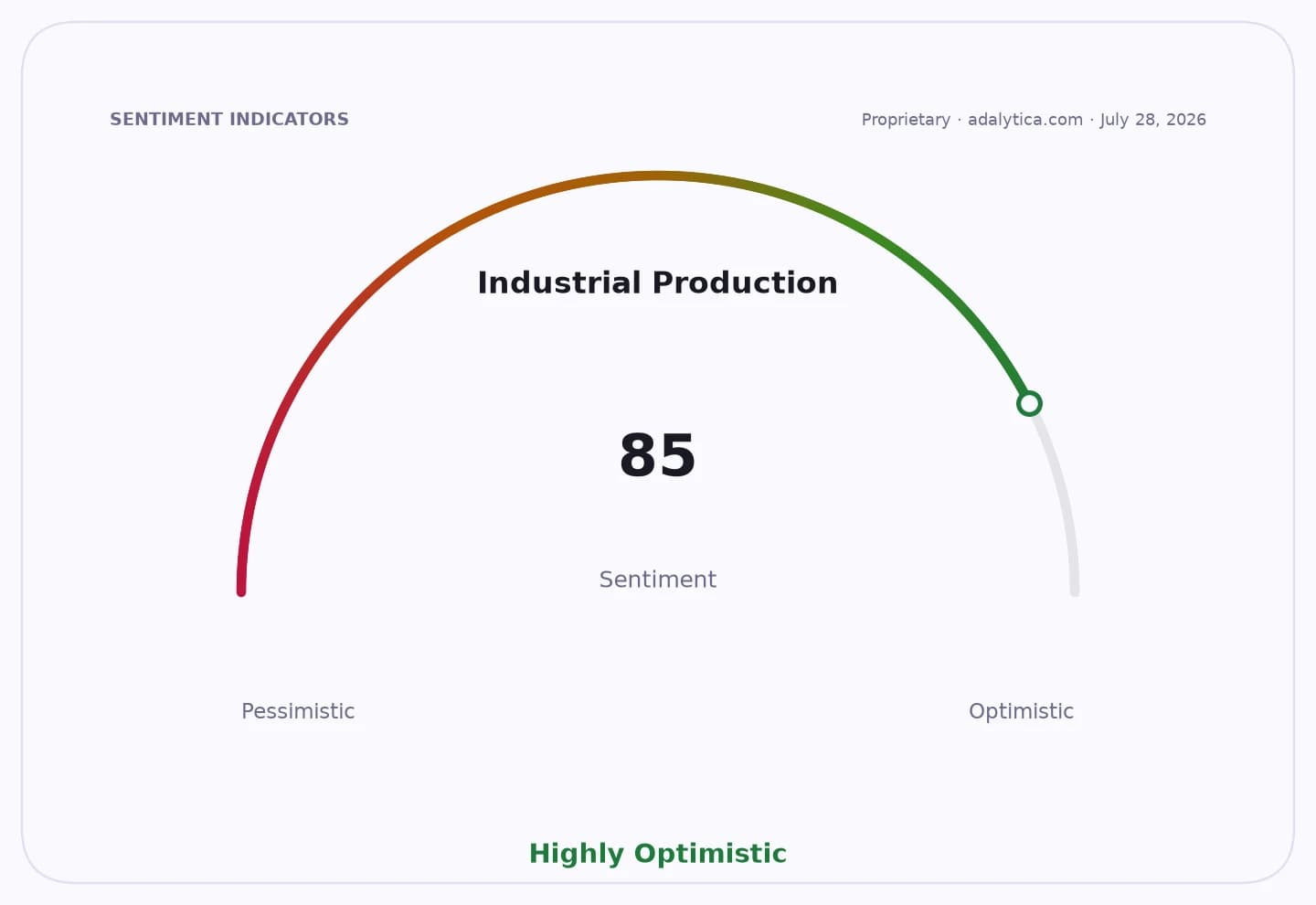
That matters because industrial production is one of the clearest gauges of demand, output and business confidence in the real economy. A 5.5% gain in manufacturing suggests producers are seeing firmer orders and better utilization, which can feed into higher employment, stronger exports and improved corporate earnings across industrial supply chains.
Sentiment IndicatorsⓘProprietary · adalytica.com · July 28, 2026
This is a snapshot — live sentiment, awareness and momentum for 130+ markets update continuously in the dashboard.Open AlphaPulse
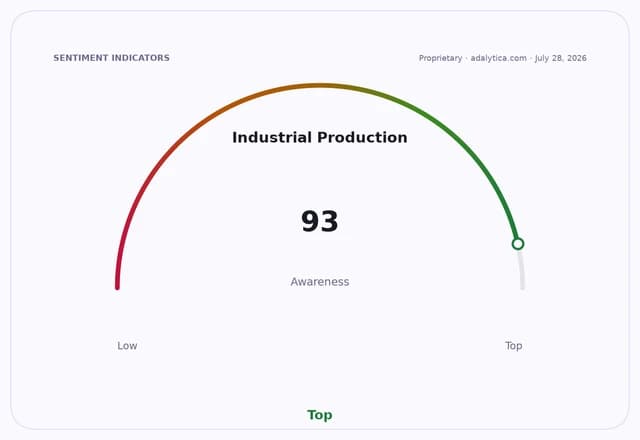
The data also points to a widening split between factory activity and other parts of the economy. The broader industrial number rose less than manufacturing, indicating that sectors outside factories may still be lagging even as production lines pick up.
For investors, the read-through is constructive for cyclical names tied to machinery, transport, chemicals and materials, while also supporting the case for industrial ETFs and exporters that benefit from firmer production. The move in the U.S.-listed Industrials Select Sector SPDR Fund, XLI, also fits a more positive tape: the ETF has climbed to $183.20 from $151.55 in late October, with its 50-day moving average above the 200-day average and technical momentum improving.
Industrial Production vs XLIadalytica.com
Explore this data interactively — full history, time series and cross-market comparisons.Open AlphaPulse
Materials have been more mixed. The Materials Select Sector SPDR Fund, XLB, is only modestly higher at $51.39, suggesting investors are still waiting for a stronger and more durable industrial upswing before fully pricing in a broad-based demand recovery.
The latest update comes as regional manufacturing signals remain uneven, with Thailand’s factory output still weak and other Asian economies showing firmer production trends. That divergence underscores how closely the next leg of the cycle will depend on trade flows, external demand and whether the current rebound can spread beyond a few stronger pockets.
If upcoming monthly data confirm that manufacturing is holding its gains, markets are likely to extend the rotation into cyclicals; if not, the half-year improvement may prove too narrow to change the broader growth story.
| Entity | Gains | Losses |
|---|---|---|
| Industrial producers | ▲Higher output and orders | ▼Weak-capacity utilization fears |
| Cyclical ETF investors | ▲Better earnings outlook | ▼Missed recovery if data fades |
| Materials firms | ▲Demand rebound potential | ▼Slow pass-through to pricing |
| Lagging factory sectors | ▲Little | ▼Competitive share and momentum |