A softening U.S. labor market is reviving recession talk even as the economy remains officially out of recession, and that matters because payment stocks are among the first financials to be repriced when investors start to doubt consumer spending. The unemployment rate is expected to edge down to 4.09% in August from 4.1% in July, but the more important market signal is that recession probability remains at zero in the official U.S. series even as investors grow more defensive around cyclicals and consumer-credit exposed names.
Mastercard Visa PayPal on U.S. recession fears

The question behind the move is not whether the economy is already in contraction, but why a market participant would begin to expect one from here. The answer is that slowing job creation, still-high borrowing costs and renewed geopolitical and inflation uncertainty are pushing investors to ask whether household spending can keep carrying growth. That is especially relevant for Mastercard, Visa and PayPal, whose revenue is tied to transaction volumes and consumer confidence even if their business models are more resilient than lenders or retailers.
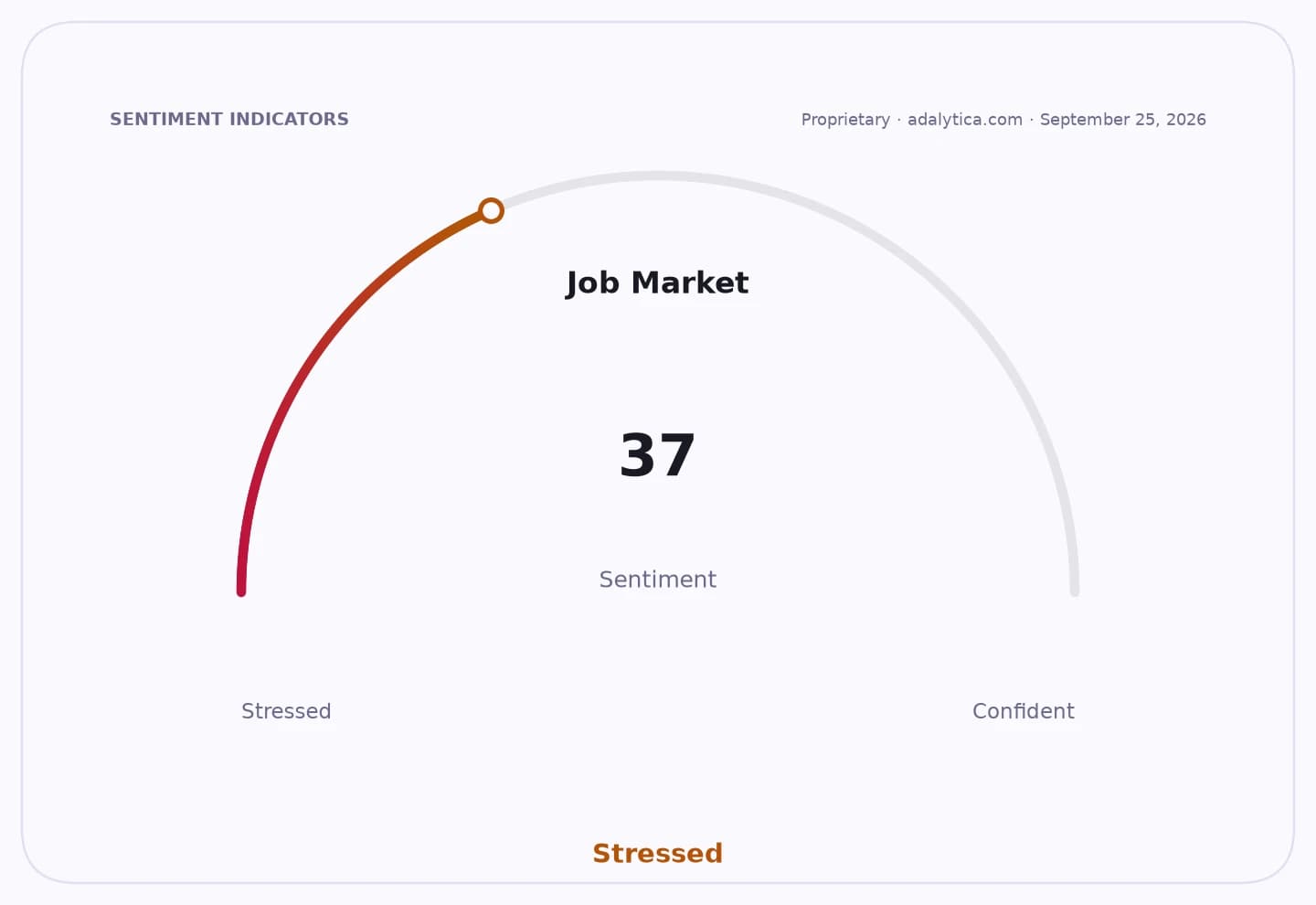
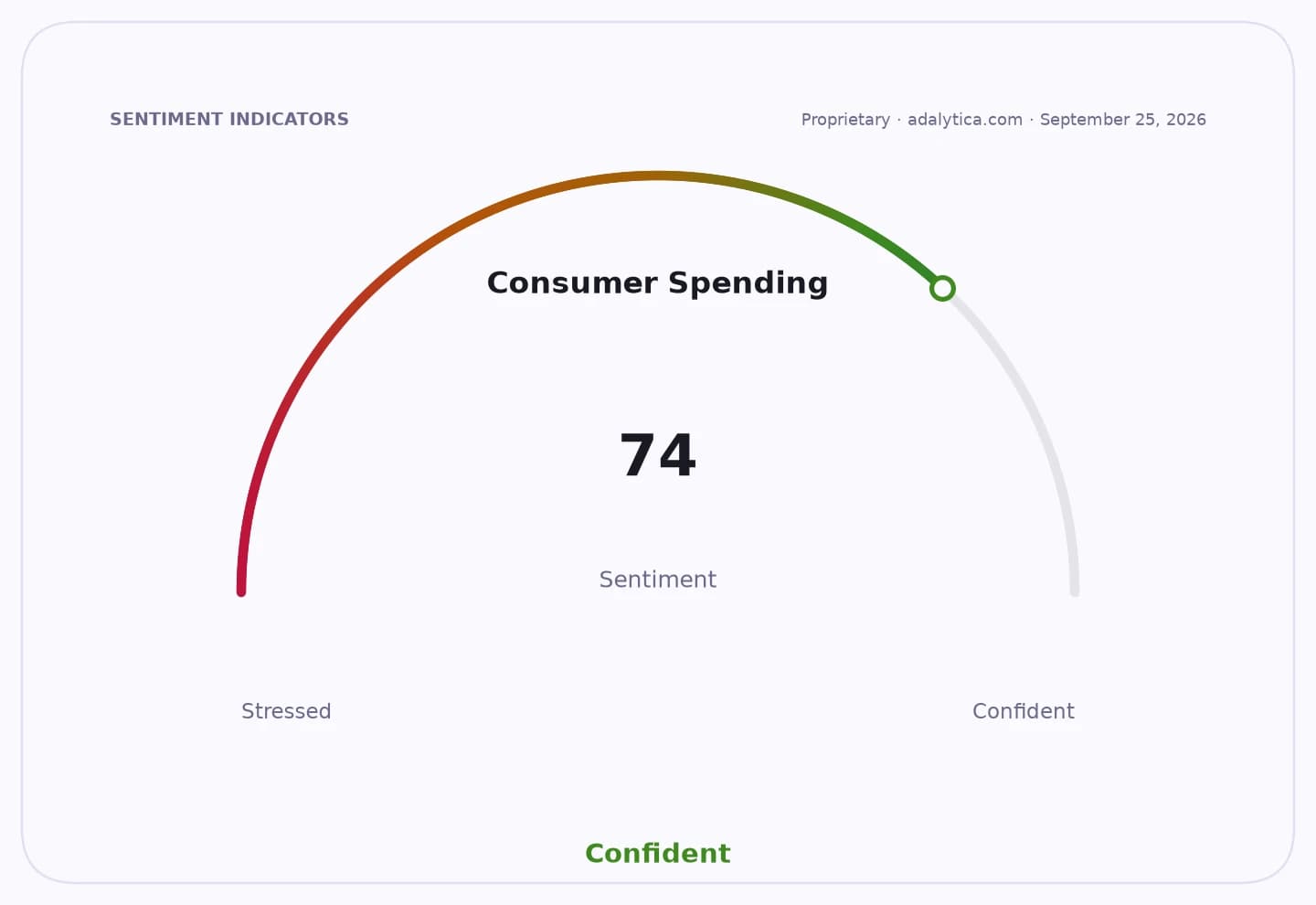
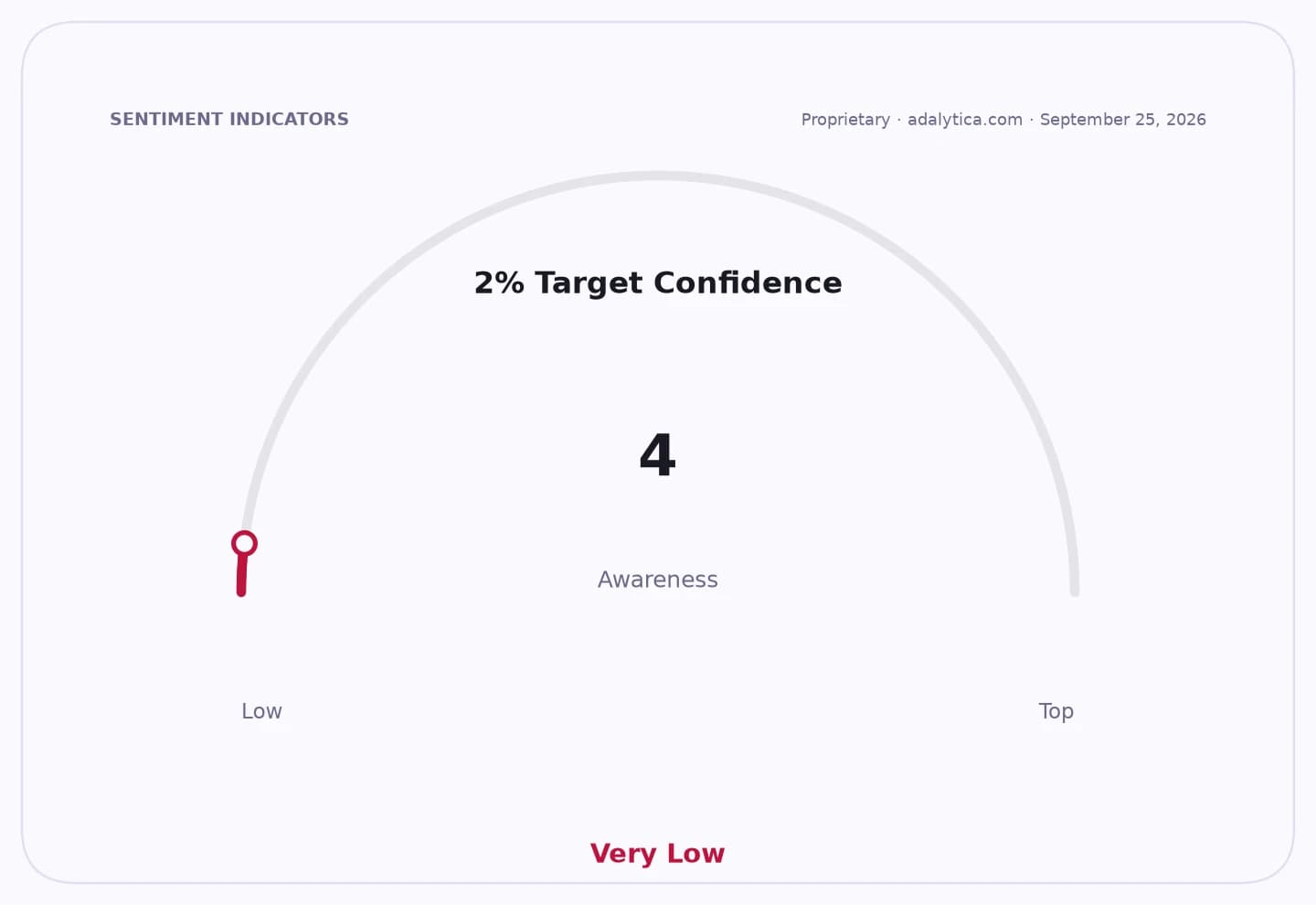
Sentiment IndicatorsⓘProprietary · adalytica.com · August 15, 2026
This is a snapshot — live sentiment, awareness and momentum for 130+ markets update continuously in the dashboard.Open AlphaPulse
Mastercard has been the steadiest of the group. Its shares closed at $569.29 on Aug. 14, above both the 50-day moving average of $528.86 and the 200-day average of $526.47, with relative strength at 63.6 — a sign the market still treats it as a quality compounder rather than a recession casualty. Visa, at $364.15, is likewise above its 50-day average of $347.88 and 200-day average of $329.97. PayPal is the outlier: after collapsing earlier this year to $38.83, it has rebounded to $61.66, but remains below its 200-day average of $51.44 only marginally and has been far more volatile, reflecting its greater sensitivity to shifts in discretionary online spending and merchant demand.
That divergence tells investors something important. In a mild slowdown, card networks can still grow because people keep spending, card mix keeps improving and cross-border volumes can hold up. Mastercard’s latest filing said payment-network net revenue rose 10% in the second quarter, or 8% on a currency-neutral basis, while rebates and incentives rose 22% as it competed for volume. Visa has also shown the market that scale and pricing power can cushion a downturn. PayPal, by contrast, is still trying to prove that its turnaround can outpace a weaker consumer backdrop after a year of deep multiple compression.
The macro backdrop is not comforting. The 10-year Treasury yield is sitting around 4.65%, up sharply from past recessionary lows, which keeps financing costs restrictive even if inflation has moderated. At the same time, the Adalytica S&P 500 trade-signal snapshot shows sentiment at neutral but awareness at a greed reading of 74, suggesting a market that has recently been too complacent for comfort and is now recalibrating. In that setting, recession headlines tend to hit the parts of the market most exposed to transaction growth, advertising spend and consumer credit assumptions.
For investors, the key issue is not a binary recession call but the path of spending. A shallow slowdown would likely favor Mastercard and Visa over lower-quality financial and consumer names because their networks benefit from secular cash-to-card migration and global travel recovery. A deeper downturn would pressure PayPal more directly, as merchants and shoppers cut back, while forcing a reassessment of valuation premiums across payment processors that have so far been defended by high margins and recurring volume growth.
The next catalysts are straightforward: the August labor data, any further move in Treasury yields and signs that consumer spending is rolling over in upcoming retail and card-usage figures. If employment holds up, recession fears may fade as another false start. If not, the market will keep treating payments as an early warning system for the U.S. consumer.
| Entity | Gains | Losses |
|---|---|---|
| Mastercard | ▲Defensive volume resilience | ▼Recession-sensitive multiple expansion |
| Visa | ▲Scale and pricing power | ▼Slower consumer spending |
| PayPal | ▲Turnaround optimism | ▼Discretionary online spend weakness |
| Consumer cyclical stocks | ▲Softer-rate relief if recession fears fade | ▼Demand slowdown if layoffs rise |