Taiwan said it has flagged thousands of suspicious Facebook and Instagram accounts to Meta Platforms as part of a widening effort to combat online election interference tied to China’s information operations, sharpening the political and regulatory risks around one of the world’s largest social media platforms.
Meta faces Taiwan election interference complaint

The complaint matters well beyond Taiwan’s borders because it underscores how social networks remain a central battleground in state-backed influence campaigns, and how governments increasingly expect platforms to act as gatekeepers for electoral integrity. For Meta, which has spent years trying to convince regulators that it can police coordinated inauthentic behavior, the episode revives a familiar risk: even when the company is not the originator of a campaign, it is often judged by how quickly and effectively it removes it.
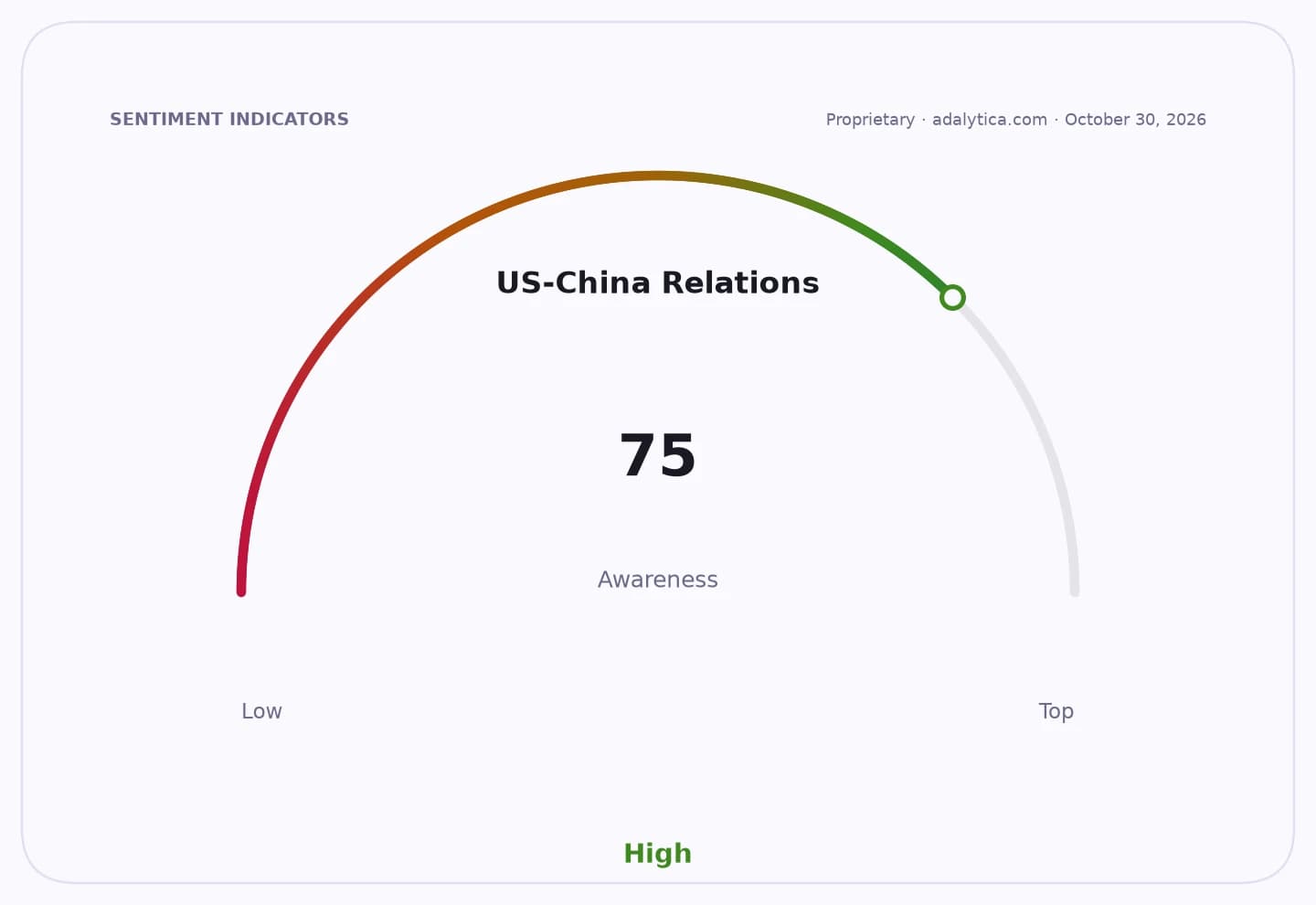
Sentiment Indicators

Taiwan’s move also lands at a sensitive moment for broader US-China relations. Adalytica’s US–China Relations Sentiment gauge showed “Extreme Greed,” with awareness at 100 and sentiment at 89, reflecting a sharp jump in market attention to the issue. At the same time, the global stability gauge sat in “Fear” at 25, suggesting investors are increasingly pricing geopolitical friction as a market variable rather than a background headline.
For Meta, the immediate financial impact is unlikely to be direct, but the reputational and policy implications are material. The company’s advertising business depends on user trust and advertiser confidence, both of which can be dented when platforms are associated with election manipulation. Any escalation could also invite tighter scrutiny from regulators in Taiwan, the US and Europe, where election integrity and platform accountability remain high on the policy agenda.
Geopolitical Risk
The market backdrop is not especially forgiving for Meta either. The stock has been under pressure, closing at $596.22 on Nov. 19, below both its 50-day and 200-day moving averages, while its RSI reading of 44.6 and negative MACD point to weakening momentum. That does not make the Taiwan episode a fundamental earnings story by itself, but it adds another overhang at a time when investors are already reassessing growth, regulation and the durability of big-tech valuations.
The more important strategic question is whether the incident becomes another data point in a broader tightening of global content rules. If more governments follow Taiwan’s lead in demanding rapid takedowns and transparency around foreign influence networks, Meta may face higher moderation costs and deeper political exposure across key markets. Bulls will argue that the company has the scale and tooling to absorb such challenges; bears will note that each election cycle tends to produce new compliance demands with uncertain operating costs.
For investors, the takeaway is that election interference is no longer just a governance issue for social platforms; it is a recurring business risk that can shape sentiment, regulatory action and, ultimately, valuation multiples.
| Entity | Gains | Losses |
|---|---|---|
| Taiwan government | ▲Tougher election defenses | ▼Political exposure if gaps persist |
| Meta Platforms | ▲Reputational cleanup if it acts fast | ▼Regulatory scrutiny and trust damage |
| China-linked influence operators | ▲Information asymmetry if unchecked | ▼Greater exposure to takedowns |
| Advertisers and users | ▲Cleaner platform environment | ▼More friction from moderation rules |