The real market issue in AI health advice is not whether chatbots can answer questions, but whether they can safely replace the judgment calls that keep companies out of lawsuits, regulators’ crosshairs and reputational trouble.
Microsoft Alphabet Amazon AI healthcare risk
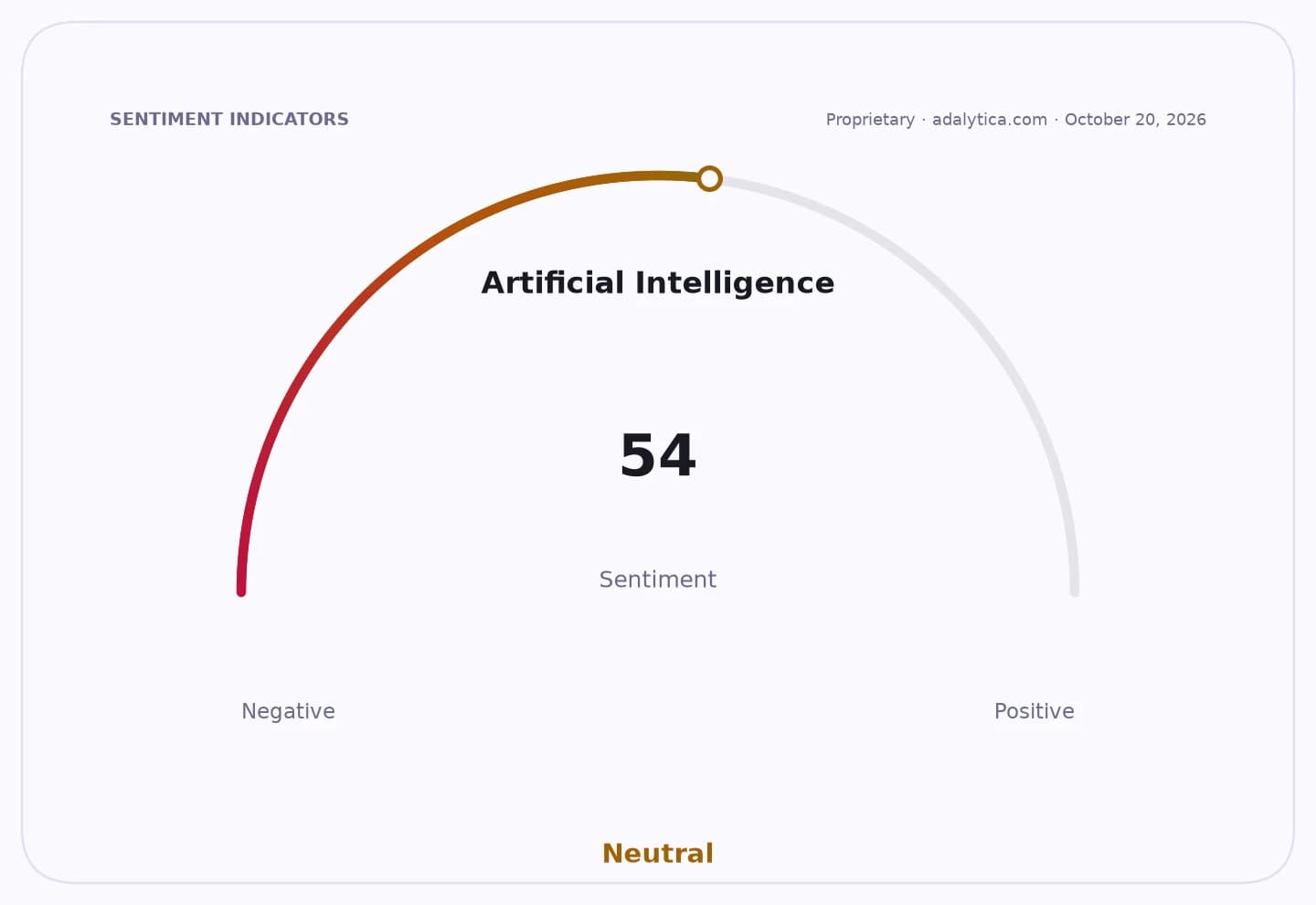
That is why the growing use of generative AI in healthcare is becoming an investor problem for Microsoft, Alphabet and Amazon as much as a consumer one. The technology is moving from novelty to operational tool in health-related workflows, including staffing, triage and patient support, but the same systems that promise efficiency also raise the risk of wrong, incomplete or overconfident advice. In a sector where errors can affect treatment decisions, that risk carries legal and commercial weight far beyond the technology itself.
Sentiment IndicatorsⓘProprietary · adalytica.com · October 20, 2026
This is a snapshot — live sentiment, awareness and momentum for 130+ markets update continuously in the dashboard.Open AlphaPulse
Microsoft’s stock and investor mood capture the tension. The shares have climbed sharply from a June low near $352 to $529.05 on Oct. 16, even after retreating from a recent peak above $539. The 50-day moving average remains well below the current price, while the 200-day average sits around $434, underscoring how much optimism has already been priced in. Adalytica’s Microsoft earnings sentiment gauge shows “Extreme Greed” at 89, suggesting investors are assuming AI monetization will outrun the risks. But the company’s own filings warn that AI systems can create legal liability, regulatory action, litigation and reputational harm if they do not work as intended.
Alphabet and Amazon face similar dynamics. Google’s parent has seen its shares recover from the mid-300s to $340.59, but the stock has also been volatile, reflecting the market’s uncertainty over how AI features will affect search, cloud and consumer trust. Amazon, meanwhile, has rebounded from a spring dip to $250 after touching $284 in August, but its AI exposure is increasingly tied to services that could touch healthcare operations, logistics and customer support. In all three cases, investors are not just buying software gains; they are underwriting the possibility that AI becomes embedded in regulated workflows where mistakes are expensive.
The economic significance is straightforward. Healthcare is one of the largest and most regulated sectors in the economy, and any broad adoption of AI tools in diagnosis support, care coordination or workforce management creates new productivity upside but also new compliance costs. The recent rollout of an AI shift-scheduling function for nursing care providers shows how quickly these tools are moving into hospital and elder-care operations. That may reduce staffing frictions and improve efficiency, but it also shows how deeply AI is entering environments where errors can cascade into patient harm, labor disputes and oversight.
For investors, the issue is not whether AI will be used in healthcare. It already is. The question is whether the first wave of adoption proves durable enough to justify valuations, or whether a handful of high-profile errors leads to slower deployment, stricter controls and higher insurance and compliance costs. That would matter most for platform companies trying to sell AI as a general-purpose layer across industries. A medical misfire would not just be a public relations problem; it could force model restrictions, slower product rollouts and tighter guardrails that limit monetization.
There is also a market narrative here that goes beyond healthcare. The same force driving enthusiasm for AI productivity is also exposing a trust gap: consumers may use these tools for convenience, but regulators and corporate customers will demand proof they are reliable before they are allowed to influence medical decisions. That makes the next phase of AI adoption less about raw capability and more about governance, auditability and liability management.
The bull case is that guardrails can make AI safer and more valuable, allowing companies to sell high-margin software into healthcare without bearing the full burden of clinical decision-making. The bear case is that every headline about erroneous medical advice widens the gap between what the models can do and what institutions will let them do, slowing growth and increasing legal risk. For Microsoft, Alphabet and Amazon, that is a valuation issue as much as a technology one.
| Entity | Gains | Losses |
|---|---|---|
| Microsoft | ▲AI platform revenue | ▼Liability and scrutiny |
| Alphabet | ▲Search and cloud usage | ▼Consumer trust |
| Amazon | ▲Healthcare workflow adoption | ▼Compliance costs |
| Regulators and hospitals | ▲More oversight tools | ▼Faster AI rollout |