Big Tech’s data model is facing a sharper regulatory and reputational test, and the pressure is landing hardest on Microsoft, Alphabet and Meta even as investors continue to pay up for AI growth.
Microsoft, Alphabet, Meta Face AI Privacy Risk

The case for the market is straightforward: the economics of artificial intelligence depend on vast amounts of data, but the legal and social tolerance for how that data is gathered, shared and used is narrowing. That tension is starting to matter for margins, product design and the pace at which the largest platforms can turn AI investment into durable earnings.
Sentiment IndicatorsⓘProprietary · adalytica.com · August 5, 2026
This is a snapshot — live sentiment, awareness and momentum for 130+ markets update continuously in the dashboard.Open AlphaPulse
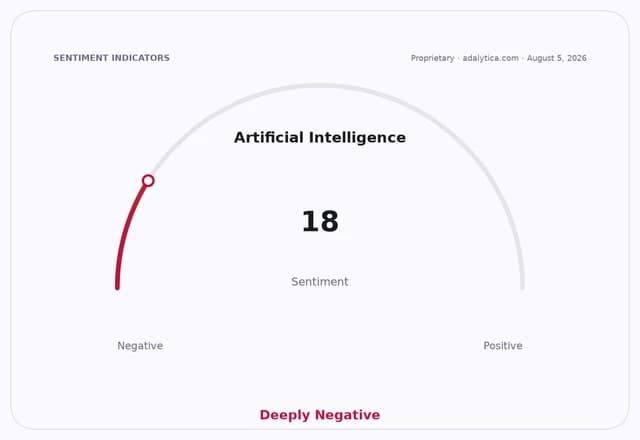
Microsoft, Alphabet and Meta all flag privacy, data-protection and AI-related disclosure risks in their latest filings, underscoring that this is no longer a theoretical issue. Microsoft’s annual report says cybersecurity and regulatory actions can increase the cost of developing and securing products, while also warning that government orders to produce customer data can damage trust. Alphabet warns that failure to comply with data-protection laws could hurt its business and operating results, and Meta says the interpretation of GDPR and other privacy rules continues to evolve, with new laws from the EU AI Act to youth social media restrictions adding to compliance risk.
That matters because the business case for AI is built on scale: more data, more training, more inference, more monetisation. But each of those steps invites scrutiny. The more companies lean on user data to improve models, the more likely they are to face slower product rollouts, tighter consent requirements, heavier legal spending and, in some cases, product changes that reduce engagement or ad efficiency. For platforms such as Meta and Alphabet, that could weigh on targeting precision and advertising yields. For Microsoft, which is betting that enterprise AI can lift cloud revenue and software margins, the risk is more about trust, data governance and the cost of compliance across a sprawling customer base.
Investors have largely treated AI as a growth lever, not a regulatory one. That has helped keep sentiment strong across the sector, with Adalytica’s Microsoft earnings sentiment snapshot at 71 and awareness at extreme levels, even after a pullback in recent days. But the broader message from filings and policy developments is that privacy is becoming part of the valuation debate. If regulators force more transparency, more opt-outs or narrower data use, the market may need to reassess the speed and profitability of the AI monetisation curve.
The stock tape shows the tension. Microsoft has rebounded to about $489, close to its recent highs, with technical indicators still showing strong momentum. Alphabet has recovered to roughly $363 after a volatile summer, while Meta remains well below its earlier peak near $683 and is trading around $583, leaving sentiment more fragile. That divergence suggests investors still prefer the companies seen as better insulated from privacy and data-governance risk, or better able to absorb it.
The bull case is that the large platforms have the money, engineering depth and legal resources to adapt faster than smaller rivals, turning compliance into a moat. The bear case is that privacy rules become another structural tax on the most profitable part of the internet, slowing AI deployment, raising costs and eventually forcing a rerating of the growth multiple.
For now, the key question for investors is not whether Big Tech will keep investing in AI, but how much of the upside survives once data practices are constrained by law, politics and public tolerance.
| Entity | Gains | Losses |
|---|---|---|
| Microsoft | ▲Enterprise AI trust | ▼Compliance costs |
| Alphabet | ▲Scale in search/ads | ▼Data-use restrictions |
| Meta | ▲Ad product resilience | ▼Targeting precision |
| Privacy regulators | ▲Enforcement leverage | ▼Big Tech discretion |




