America’s midterm election has not changed the White House, but it may have changed the balance of power over two of the world’s most dangerous conflicts — and markets are already starting to price that in.
Midterm Election Shifted Iran and Ukraine Market Risks

The biggest economic consequence is a greater chance of pressure on President Donald Trump to soften his stance on Iran and restore some flow of U.S. support to Ukraine. That matters because both wars have been feeding volatility in energy, defense spending, sanctions policy and global risk appetite. If Democrats can use control of Congress to force votes, investigations or funding measures, Trump’s room to maneuver narrows just as investors are trying to assess whether Middle East tensions and the Russia war will stay elevated into next year.
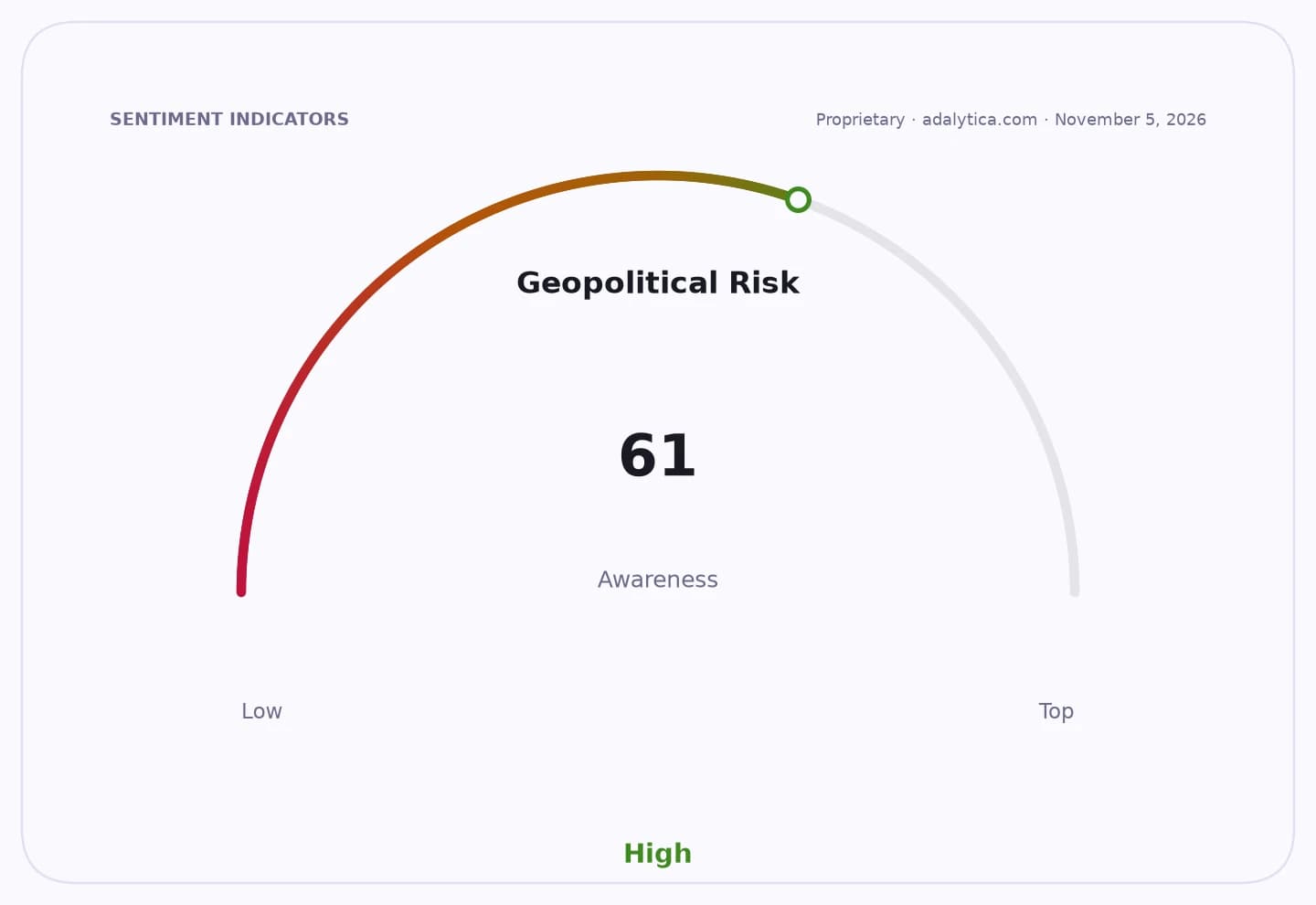
Sentiment Indicators
For Iran, the market interpretation is straightforward: less likelihood of an immediate, full-scale U.S. strike and more incentive for Washington to look for a deal. Gulf sources told Reuters the region sees Trump as having stronger reason than ever to seek a settlement after the election, and traders have already responded by marking down oil for three straight sessions. The move has not been dramatic — inventories remain tight — but it is enough to show how quickly geopolitics can hit crude. If Tehran reads the result as a sign that Trump needs an agreement, the next phase could be diplomacy rather than escalation. If it reads weakness, the risk is a new round of military confrontation.
That is why energy investors should care. The war has already disrupted crude and LNG flows from the Gulf, lifting fuel costs worldwide. Any reduction in attack risk would be bearish for oil at the margin and bullish for transport, airlines and broader consumer spending. But the path is not one-way. An emboldened Iran could also choose to press its advantage, which would keep a floor under energy prices and preserve a geopolitical risk premium.
Ukraine is the other side of the same trade. Trump has largely frozen direct U.S. financial and military aid to Kiev, even as lawmakers from both parties remain sympathetic. A Democratic Congress could try to reopen funding, and in theory could even assemble enough Republican support to override a presidential veto. But the urgent constraint is time. Ukraine’s most immediate need is Patriot interceptors to defend power infrastructure and cities through winter, and that shortage will not be solved by a new House or Senate alone. Still, the direction of travel matters: more congressional scrutiny could constrain Trump’s willingness to keep pressuring Ukraine into concessions while he pursues a broader bargain with Moscow.
The investment implication is that Washington policy is becoming more fractured, not less. That tends to support defense demand, keep energy markets sensitive to headlines and prolong the premium in safe-haven assets when tensions rise. The 10-year Treasury yield around 4.85% and the 10-year/2-year spread near 0.35 percentage point suggest growth is still being digested through a cautious macro lens, while the S&P 500 remains close to its 50-day average even after a sharp two-day pullback. In other words, markets are not pricing a crisis, but they are also not dismissing the policy risk.
The bigger narrative is that the election has reduced Trump’s freedom to act unilaterally on the two geopolitical flashpoints that matter most for markets: Iran and Ukraine. That creates a narrower, more negotiable policy path — and that is exactly where investors can find opportunity. Energy traders should watch for lower crude volatility if diplomacy gains traction. Defense investors should expect continued demand if Congress pushes back on Ukraine funding cuts and if Israel faces tighter U.S. oversight. And anyone exposed to global trade should pay attention to tariff policy, because a weaker president facing a more assertive Congress may find arbitrary trade actions harder to sustain.
The market underestimates how quickly a midterm result can change the sequencing of war, sanctions and capital flows. The next catalyst is not just who controls Congress, but whether Washington starts using that power to force deals, block escalation or simply slow Trump down. For investors, that means positioning for a more constrained White House, a more volatile Middle East and a less predictable but potentially more investable policy environment.
| Entity | Gains | Losses |
|---|---|---|
| Iran | ▲More room to bargain | ▼Risk of U.S. strike eases |
| Ukraine | ▲New aid push gains traction | ▼Trump pressure remains |
| Oil bulls | ▲Geopolitical premium persists | ▼Peace talk headlines cap prices |
| Defense stocks | ▲Oversight and conflict spending support demand | ▼Faster de-escalation would cool urgency |