Nvidia’s stock is under heavy pressure as allegations over CEO Jensen Huang’s ties to a suspected Chinese spy collide with already fragile investor sentiment around the company’s China exposure and the risk of tighter U.S. export controls.
Nvidia Falls on China Exposure and Spy Allegations
Nvidia Corp
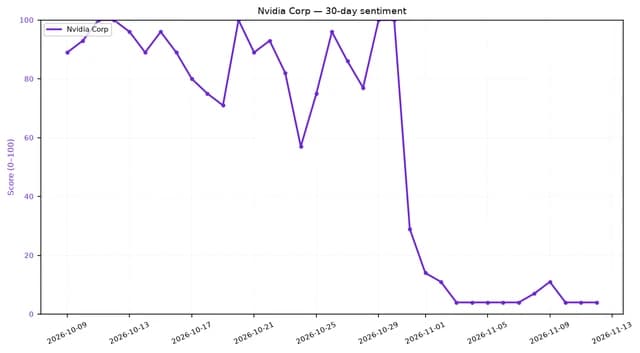
The decline matters because Nvidia sits at the center of the global AI trade, and any deterioration in its access to China or its political standing in Washington can quickly flow through semiconductor supply chains, capex plans and the broader market’s appetite for AI winners. Nvidia’s shares closed at $166.19 on Nov. 12, down sharply from $221.97 on Oct. 21, while volume surged to 742.8 million shares, underscoring how fast investors are repricing the risk.
Sentiment Indicators
The selling comes against a backdrop of mounting geopolitical friction. U.S. officials and lawmakers have been intensifying scrutiny of technology flows to China, while Nvidia has already warned in filings that export controls and sanctions can disrupt supply chains, reduce demand and leave it with excess inventory. That risk is not limited to Nvidia: Advanced Micro Devices has issued similar warnings, highlighting how Washington-Beijing tensions are hitting the entire AI chip complex.
The pressure is showing up in technicals as well. Nvidia’s 14-day relative strength index has fallen to 24.5, deep in oversold territory, while the shares sit well below both the 50-day moving average of 215.94 and the 200-day average of 204.07. The weak tape suggests investors are not waiting for a clarification before trimming exposure.
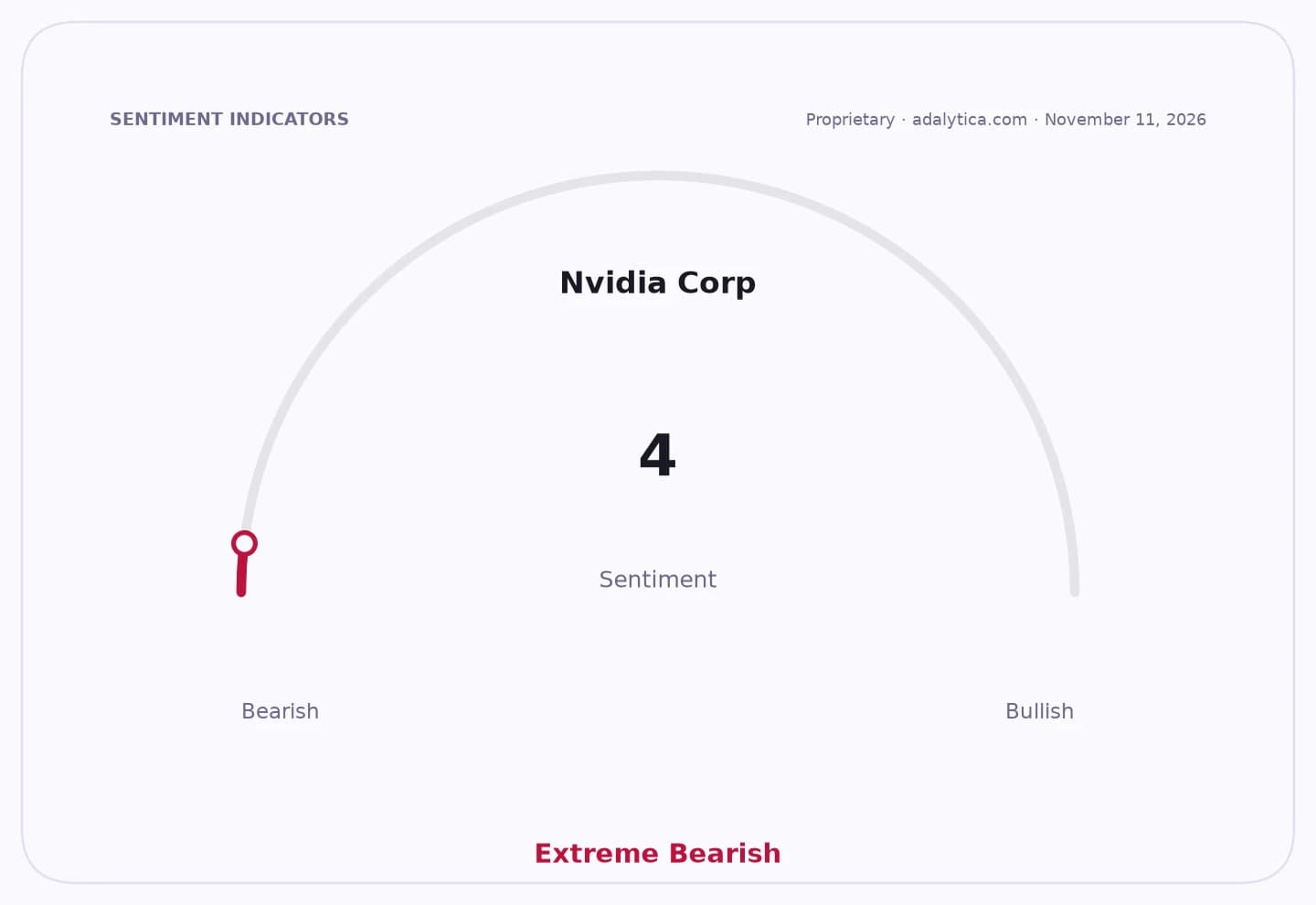
The wider market is absorbing the shock differently. The S&P 500 remains in “Extreme Greed” on Adalytica trade signals, but Nvidia’s own sentiment reading has collapsed to 4.0, or “Extreme Fear,” pointing to a sharp divergence between the broader index and one of its most important leaders. Taiwan Semiconductor Manufacturing Co., Nvidia’s key foundry partner, has held up better, with its shares at 405.49, still above the 200-day moving average of 401.36, though the stock has also pulled back from earlier highs.
The next catalyst is political, not operational. Any official response to the espionage allegations, fresh commentary on China sales, or another move on U.S. export restrictions could keep Nvidia at the center of the market’s AI rerating and determine whether the current selloff becomes a deeper reset for the chip sector.
| Entity | Gains | Losses |
|---|---|---|
| Short sellers | ▲Volatility | ▼Nvidia bulls |
| U.S. hawks | ▲Tighter scrutiny | ▼China tech access |
| AMD/TSMC peers | ▲Relative diversification | ▼Nvidia concentration risk |
| Investors in AI megacaps | ▲Buying opportunity if fears ease | ▼Near-term multiple compression |