Nvidia’s biggest near-term challenge is not demand — it is how to fund the race to keep building enough chips to meet it. That’s why Bank of America’s bullish view matters: if the financing burden proves manageable, the stock’s long-term story may be stronger than the market is giving it credit for.
Nvidia financing burden and AI demand outlook

The setup is a classic one for growth investors. Nvidia is still the central supplier to the AI buildout, and the company’s shares are trading at levels that reflect both powerful momentum and elevated expectations. Nvidia closed at $219.74 on Aug. 18, well above its 50-day moving average of $206.94 and 200-day moving average of $194.93, a sign that investors are still paying up for the company’s role in the AI infrastructure boom. The stock’s relative strength index was 77.4, which suggests the shares are technically stretched, but that has often been the case when the market is trying to price in another leg of earnings growth.
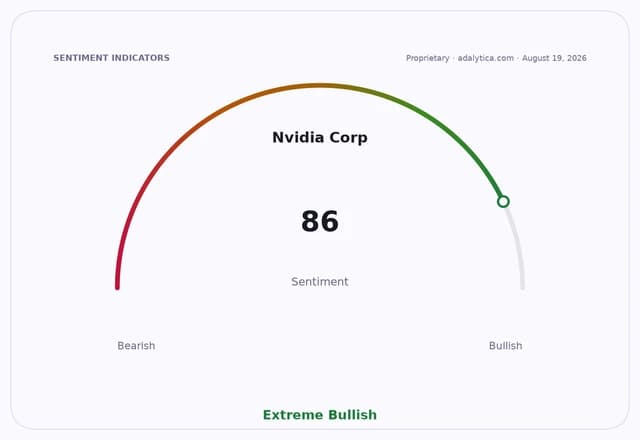
Sentiment IndicatorsⓘProprietary · adalytica.com · August 19, 2026
This is a snapshot — live sentiment, awareness and momentum for 130+ markets update continuously in the dashboard.Open AlphaPulse
The real issue is capital intensity. The AI boom is no longer just about designing better chips. It is about financing massive production, supply-chain commitments and the partnerships needed to keep wafers, packaging and assembly flowing. Nvidia’s latest filing again underscored dependence on third parties to manufacture, assemble, package and test its products. That matters because every step in that chain requires working capital, and the more aggressively Nvidia expands, the more financing support the ecosystem may need.
Bank of America’s call is important because it frames that burden as an opportunity rather than a warning sign. In other words, financing risk may be the price of admission for a business still growing into one of the most important industrial platforms in the world. If Nvidia can keep converting AI demand into cash flow, the funding needs around the business become a temporary pressure point, not a structural problem.
Nvidia Corp — 30-day sentimentadalytica.com
Explore this data interactively — full history, time series and cross-market comparisons.Open AlphaPulse
The broader market backdrop helps explain why investors are paying attention. The 10-year Treasury yield has risen to 4.694% in the latest forecast, while high-yield credit spreads sit around 2.678%, a reminder that capital is no longer free. That makes financing more expensive across the economy, including for suppliers and customers in the AI supply chain. For Nvidia, higher rates do not change the demand story, but they do raise the bar on disciplined capital allocation and on how much leverage the ecosystem can absorb.
There is also a second-order effect for investors. If Nvidia needs more financing support, that does not only speak to Nvidia’s own scale; it signals that AI infrastructure is becoming a multiyear industrial buildout. That is exactly the kind of environment that can reward the strongest platforms, while weaker rivals and thinner-margin suppliers struggle to keep up. Taiwan Semiconductor Manufacturing, one of Nvidia’s key manufacturing partners, remains part of that same capital-heavy supply chain, and Microsoft’s recent rebound shows that the broader AI trade is still concentrated in companies with the balance sheets to spend heavily.
Adalytica’s Nvidia earnings sentiment reading sits at 86, in “Extreme Greed,” which says a lot about how much enthusiasm is already baked in. That does not make the stock unattractive. It does mean investors should be patient, selective and focused on multi-year compounding rather than trying to chase every move higher.
For long-term investors, the takeaway is straightforward: Nvidia remains one of the most compelling AI names in the market, but the financing issue is worth watching because it will tell you how durable the next phase of growth really is. If the company keeps converting demand into cash and the funding needs stay contained, this could still be a stock to own for years, not quarters.
| Entity | Gains | Losses |
|---|---|---|
| Nvidia | ▲AI demand visibility | ▼Higher financing costs |
| Bank of America | ▲Credibility on bullish call | ▼If funding risk worsens |
| Long-term investors | ▲Chance to own AI leader | ▼Short-term volatility |
| Rivals/smaller suppliers | ▲Spillover from AI spending | ▼Margin pressure, weaker access to capital |