Nvidia’s push to turn AI chips into lendable infrastructure is running into a hard reality on Wall Street: creditors do not yet trust that the company’s hardware will hold value long enough to back decades-long financing.
Nvidia Faces Lender Pushback on GPU Financing

That tension matters because Nvidia is trying to do more than sell GPUs. It wants to rewire how AI compute is funded, using its chips as collateral to unlock hundreds of billions of dollars for data centers, power and server buildouts. If lenders force tougher guarantees, the whole model becomes more expensive, narrower and slower — and that could determine who can keep pace in the next phase of the AI boom.
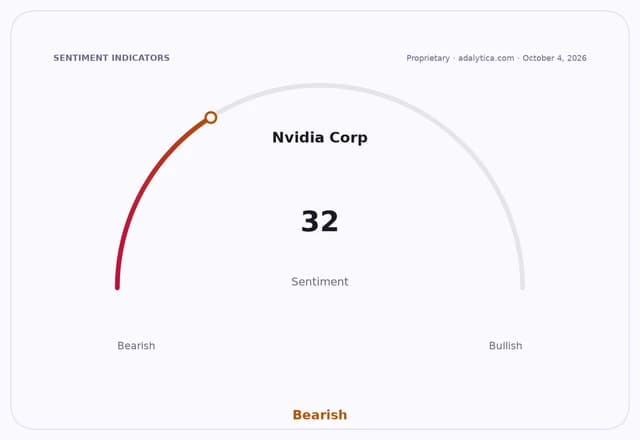
Sentiment IndicatorsⓘProprietary · adalytica.com · October 4, 2026
This is a snapshot — live sentiment, awareness and momentum for 130+ markets update continuously in the dashboard.Open AlphaPulse
Wall Street’s hesitation also exposes the fault line at the center of the AI trade. Nvidia says its latest systems can remain economically useful for 9 to 10 years, while banks typically depreciate GPUs over just 3 to 4 years. That gap is not academic. It decides whether a chip is a durable asset or a rapidly aging piece of equipment that cannot support long-dated debt without extra protection.
According to people familiar with the discussions, some lenders want Nvidia to provide stronger guarantees than originally planned, even when the collateral is its flagship AI processors. In practice, that could mean requiring broader company-backed support, or tying loans to revenue from highly rated customers such as large technology groups. For creditors, the issue is simple: they want proof that AI compute can produce cash flow long after the current generation of hardware arrives.
Nvidia is pitching the opposite view. Chief executive Jensen Huang wants compute to be treated like an investable infrastructure asset, not just a service sold through cloud contracts. The company argues that as AI demand keeps rising, its chips should generate revenue over a much longer cycle than the credit market currently assumes. It has pointed to cloud providers extending server depreciation to 5 to 6 years and to third-party assessments that its newest GB300 NVL72 systems could remain useful for nearly a decade.
But the market wants precedent, not vision. CoreWeave’s $8.5 billion GPU-backed financing was structured around investment-grade support and contract payments linked to Meta, while Broadcom backed more than 80% of a $35 billion AI financing for Anthropic. Nvidia itself has previously offered residual value guarantees on a data-center project. Those deals show the direction of travel, but they also show the price of convincing lenders: someone usually has to absorb more risk.
The broader stakes are enormous. Hundreds of billions of dollars are being poured into AI chips, data centers and electricity, and Nvidia’s financing plan is designed to pull institutional capital deeper into that ecosystem. If it works, it could become a powerful accelerant for GPU demand and for the whole AI supply chain. If it stalls, the funding burden shifts back to balance sheets, slowing deployment and narrowing the field to only the biggest, best-capitalized buyers.
For investors, the message is that Nvidia remains the toll road of AI, but the market is still debating whether those tolls can be monetized through leverage at scale. That uncertainty matters not just for NVDA shareholders, but for lenders, cloud providers, data-center developers and equipment suppliers that depend on the AI capex cycle. With Nvidia shares trading near the upper end of their recent range and momentum still strong, the stock continues to reflect a growth story the credit market has not yet fully endorsed.
The next catalyst is not another chip launch — it is whether Nvidia can prove to lenders that its GPUs behave like durable infrastructure rather than depreciating hardware. If it can, the financing model could unlock another leg of AI spending. If it cannot, Wall Street will impose the kind of guardrails that limit how fast the AI buildout can compound.
| Entity | Gains | Losses |
|---|---|---|
| Nvidia | ▲Broader AI financing reach | ▼Tougher lender demands |
| Banks/Creditors | ▲Stronger protections | ▼More limited deal upside |
| AI infrastructure builders | ▲Easier access to capital | ▼Higher financing friction |
| Competitors without financing muscle | ▲Less immediate advantage | ▼Slower scale-up options |