The real bottleneck in artificial intelligence is no longer model capability, but whether the technology can be absorbed into everyday work fast enough to lift productivity and wages.
Nvidia, Microsoft Gain as AI Adoption Lags
That is the central message behind the latest argument from Ramiro Albrieu, who says the Silicon Valley idea that bigger models and more computing alone will produce a labor-market revolution misses the harder part: turning digital intelligence into better jobs in factories, shops, schools, hospitals and small businesses. For investors, that distinction matters because the next leg of AI’s economic payoff will depend less on model benchmarks than on adoption, workflows, training and infrastructure that can bridge the gap between the data center and the workshop.
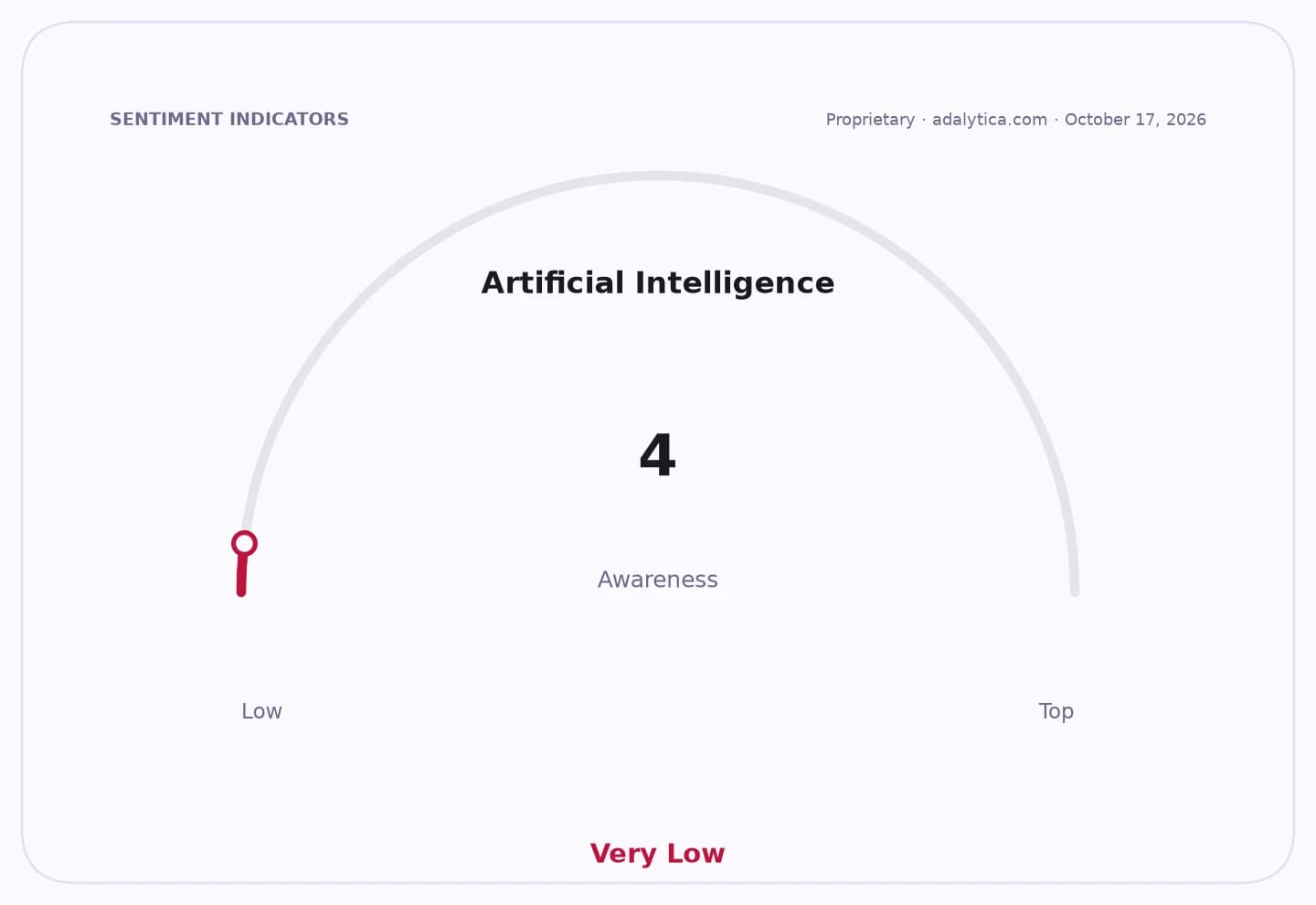
Sentiment IndicatorsⓘProprietary · adalytica.com · October 17, 2026
This is a snapshot — live sentiment, awareness and momentum for 130+ markets update continuously in the dashboard.Open AlphaPulse
The economic stakes are significant. If AI remains concentrated in cloud platforms and enterprise software, it may still generate large profits for chipmakers and hyperscalers, but its broader productivity effects could remain narrow and uneven. If it spreads into the informal and small-business-heavy economies of the Global South, where workers often combine multiple roles at once, it could become a larger source of growth and efficiency than many forecasts assume. That is why Albrieu’s emphasis on tasks, not occupations, is important: in Latin America, he argues, a single job often involves budgeting, purchasing, billing, organizing and customer service alongside the core trade, creating more points of entry for AI assistance than traditional labor statistics capture.
That framework also helps explain why the market continues to reward the infrastructure layer even as investors debate the timeline for AI’s broad productivity gains. Nvidia has staged a powerful rally, with its shares closing at $214.13 on Oct. 16 after touching $235.20 in May, while its 50-day moving average remains above its 200-day average, a sign of a still-intact long-term uptrend despite a recent pullback. Microsoft, another key AI beneficiary, closed at $529.05 on the same date, far above its 200-day average of $434.03, reflecting the market’s belief that AI spending will keep supporting cloud and software growth even if end-user transformation takes longer.
But the same price action also shows the tension inside the trade. Nvidia’s RSI had fallen to 32.9 by Oct. 16, suggesting momentum has cooled after a strong run, while Microsoft’s RSI was 63.2, still positive but no longer stretched. That fits the broader investor dilemma: earnings tied to AI buildout remain strong, but the economic case for a truly transformative AI cycle still depends on proving that productivity gains can move beyond pilot projects and premium enterprise customers.
The bull case is straightforward. AI can augment workers rather than replace them, compressing routine tasks and raising output in labor markets that are fragmented, informal and skill-constrained. In that scenario, the upside extends beyond the handful of companies building the models to the firms supplying chips, cloud capacity, connectivity and workflow software, while governments and educators that adapt training systems early could help unlock a second wave of adoption.
The bear case is equally clear. Without connectivity, language-localized tools, worker training and better measurement of what people actually do on the job, AI may remain a technology in search of institutions willing to reorganize around it. In that world, the capital intensity of the sector stays high, returns concentrate in a few large vendors, and the hoped-for productivity boom is delayed or diluted.
For now, the most important investment conclusion is that AI is still in the infrastructure phase of its economic cycle, not the transformation phase. The companies best placed to benefit immediately are those selling compute, cloud and enterprise integration. The bigger question for the market is when AI stops being a powerful tool inside the data center and starts becoming a measurable force in the labor market.
| Entity | Gains | Losses |
|---|---|---|
| Nvidia | ▲Chip demand | ▼Slower AI adoption |
| Microsoft | ▲Cloud and Copilot sales | ▼Margin pressure from AI spend |
| Workers with AI training | ▲Productivity gains | ▼Workers without reskilling |
| Small firms in Global South | ▲Cheaper digital tools | ▼Legacy workflows |