U.S. stocks tied to artificial intelligence are still acting like bond yields are somebody else’s problem.
Nvidia, Microsoft, Alphabet Hold as Yields Rise
That is the most important market takeaway as the 10-year Treasury yield climbed to 5.3% and the 2-year yield spread widened to 0.41 percentage point, levels that would normally put real pressure on the kind of long-duration growth names investors have been bidding up for much of the year. Instead, Nvidia, Microsoft and Alphabet are all holding near the top of their recent ranges, a sign that the market is still willing to pay up for companies with the strongest AI moats, the deepest cash generation and the clearest paths to compounding over the next decade.
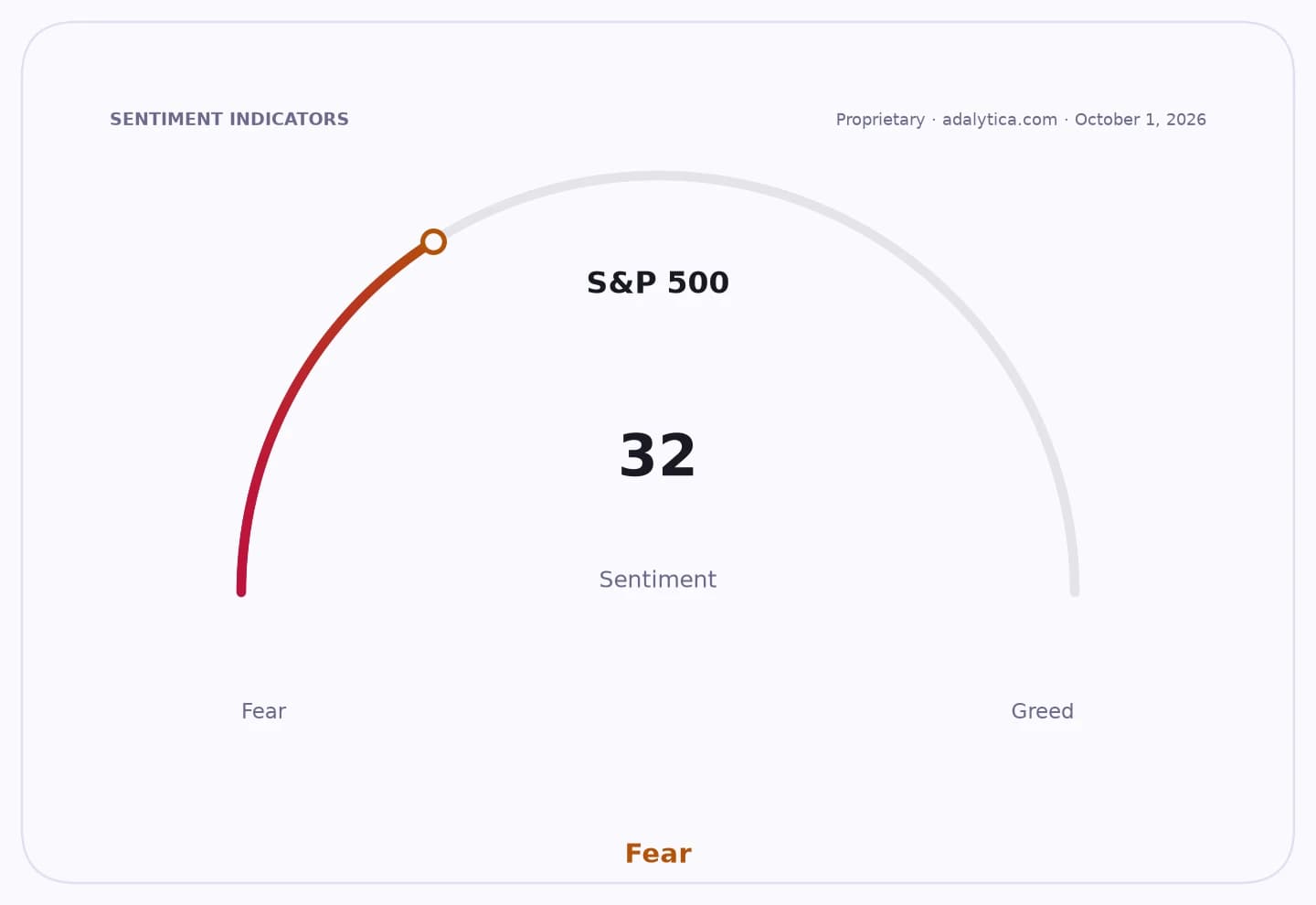
Sentiment IndicatorsⓘProprietary · adalytica.com · October 1, 2026
This is a snapshot — live sentiment, awareness and momentum for 130+ markets update continuously in the dashboard.Open AlphaPulse
Why does this matter? Because higher yields usually compress valuations. When the risk-free rate rises, future earnings are worth less in present-value terms, which is especially painful for megacap technology stocks that are priced on years of expected growth. Yet the current tape says investors are making a different judgment: AI demand is strong enough, and the winners are dominant enough, to offset the drag from borrowing costs. In plain English, the market is saying that AI is not just a theme — it is a capital-allocation priority big enough to survive a 5%-plus Treasury market.
That helps explain why Nvidia remains resilient even after a huge run. The stock closed at 228.38 on Sept. 30, well above its 200-day moving average near 199.81 and above its 50-day moving average of 217.23. Its relative strength index of 63.7 shows momentum without flashing the kind of extreme overbought reading that usually ends a trend on its own. Microsoft, meanwhile, finished at 512.90, also above both its 50-day and 200-day moving averages, with its RSI at 62.0. Alphabet closed at 344.08, roughly in line with its 50-day average and still above its 200-day trend line, which suggests the market is treating it as a durable AI beneficiary rather than a speculative trade.
The broader bond backdrop is doing two things at once. It is raising the cost of capital across the economy, which can slow housing, corporate borrowing and eventually consumer demand. Mortgage rates already above 7% reinforce that pressure. But it is also narrowing the gap between cash flows that are merely good and cash flows that are exceptional. That tends to favor the handful of firms that can fund AI buildouts internally, preserve margins and still return capital to shareholders. Nvidia, Microsoft and Alphabet fit that description better than most of the market.
There is also a cross-asset message here. Adalytica’s S&P 500 trade signals show sentiment is neutral, but awareness has shifted into fear, while U.S. Treasury bond signals show extreme greed. That is a classic late-cycle tension: investors remain eager to own the safest growth franchises even as they brace for more volatility in the bond market. The dollar is flashing extreme fear in the same framework, underscoring how quickly macro narratives can turn when yields move against consensus positioning.
For long-term investors, the key question is not whether yields can keep rising a little more. It is whether the companies leading the AI buildout can keep growing earnings fast enough to outrun that backdrop. So far, the answer appears to be yes. Nvidia still controls the most important chips in AI infrastructure. Microsoft keeps monetizing cloud and software distribution at scale. Alphabet has a search franchise and a cloud business that can still compound even as it spends to stay relevant in AI.
Could the bond market eventually catch up and force a reset in valuations? Absolutely. If the 10-year stays near 5.3% or moves higher, even the strongest growth names will have to prove they can keep expanding free cash flow fast enough to justify their premiums. But that is a future problem for investors in years, not weeks, if the businesses continue to execute.
For now, the story is simple: higher yields are a warning, but they are not yet enough to break the AI trade. Investors focused on the next 3 to 10 years should keep the best of these names on the watchlist — and, for patient capital, consider whether the market is still offering a rare chance to own extraordinary businesses through ordinary macro noise.
| Entity | Gains | Losses |
|---|---|---|
| Nvidia | ▲AI demand; premium multiple | ▼Yield-sensitive valuation |
| Microsoft | ▲Cloud and AI monetization | ▼Higher discount rates |
| Alphabet | ▲Durable AI/search franchise | ▼Capital-spending pressure |
| Treasury bears | ▲Higher carry returns | ▼Bond price decline |