NVIDIA’s new Minerva platform is aimed at one of the biggest bottlenecks in AI infrastructure: keeping sprawling data centers running efficiently enough to protect the economics of model training and inference.
NVIDIA Minerva platform targets AI data center uptime
That matters because in AI, a slow or failing component can drag down an entire cluster, wasting expensive GPU time and squeezing returns on billions of dollars in capital spending. Minerva is designed to pull together signals from GPUs, networks, storage, job schedulers and workloads so operators can spot faults earlier, trace them faster and keep more of their hardware productive.
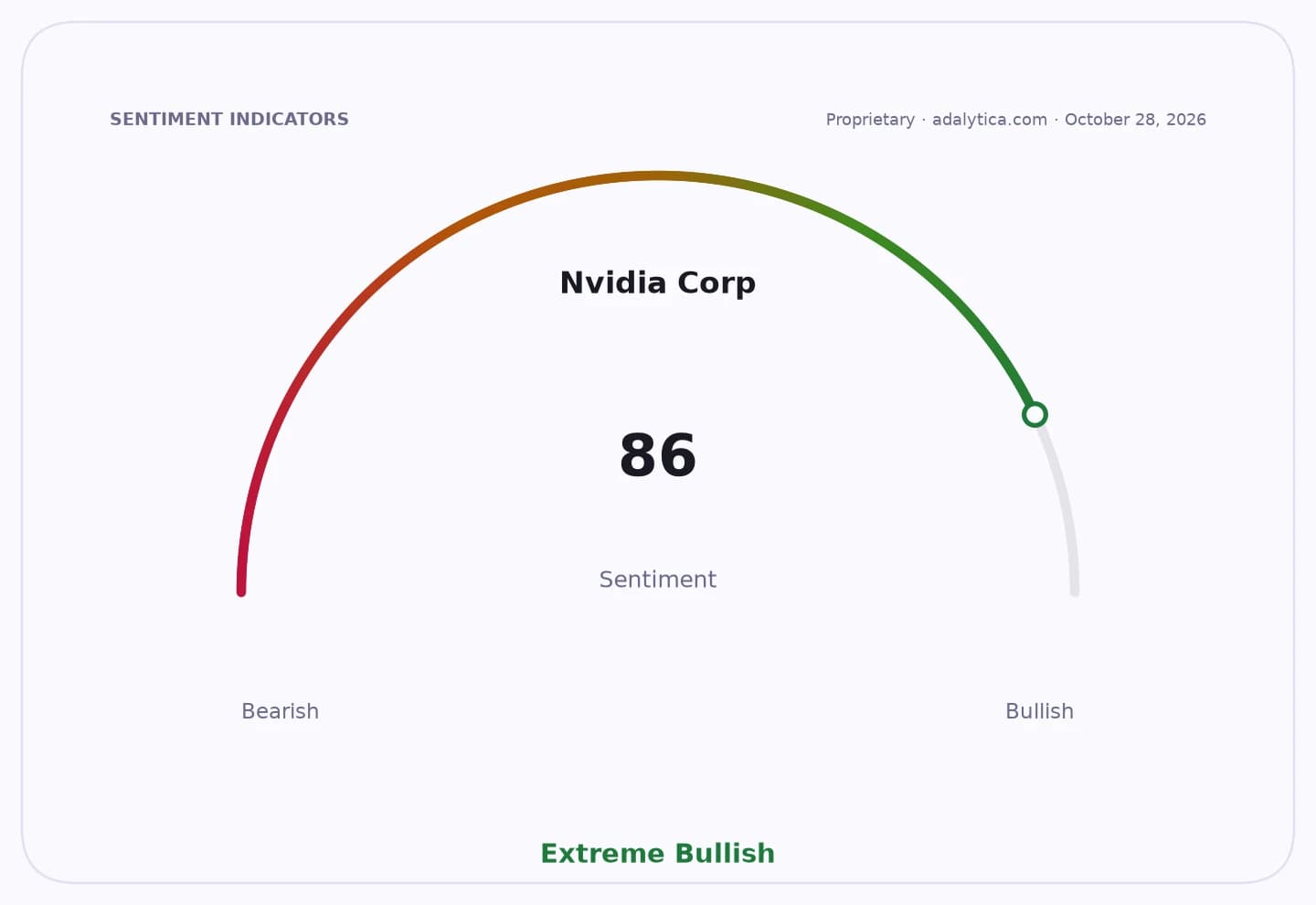
Sentiment Indicators
Nvidia Corp
The launch also shows how NVIDIA is widening its reach beyond chips and systems into the software layer that governs how AI factories operate. If the company can help customers improve “yield” — its term for the useful output produced by AI infrastructure — it could make its hardware more attractive and harder to displace, while deepening customer dependence on NVIDIA’s platform.
NVIDIA said Minerva can analyze billions of data points an hour and uses machine learning models to learn normal behavior, flag unusual patterns and predict failures before they spread. The company said it can also group related alerts into a single incident and offer operators suggested fixes through an AI assistant.
The pitch is straightforward: when data centers are running hundreds of thousands of GPUs, uptime is the product. Better observability can reduce wasted compute, lower repair friction and help operators spend more time on preventive maintenance instead of chasing scattered alarms. For large cloud providers and AI infrastructure operators, even modest gains in efficiency can meaningfully improve economics.
NVIDIA is not claiming proof yet. The company did not disclose measured productivity gains, test periods or before-and-after performance data for Minerva. But it did say IREN is already using the platform, while Aolani, Bitdeer AI, IBM, Jio, Lambda, Quake AI and Tesla plan deployments. Dell Technologies, Lenovo and Supermicro will also sell it as part of their AI factory portfolios.
For investors, the message is that the AI buildout is no longer just about buying more accelerators. As the industry scales, software that helps manage power, heat, reliability and job scheduling becomes part of the value stack. That is good news for NVIDIA, because it extends the company’s moat from silicon into operations.
The broader backdrop is important too. AI infrastructure spending is huge, but so are the operational risks: energy use, hardware failures, local resistance and the rising cost of keeping massive clusters online. Tools like Minerva are NVIDIA’s answer to that reality, and they help explain why the company remains central to the AI economy even as competition intensifies.
For long-term investors, this is another reason NVIDIA deserves a place on the watchlist: not because every product launch immediately moves revenue, but because each one reinforces the company’s control over a growing, mission-critical ecosystem. The AI race will be won by the firms that can build, operate and optimize the factory layer best.
| Entity | Gains | Losses |
|---|---|---|
| NVIDIA | ▲More software lock-in | ▼Less dependence on chips alone |
| AI data center operators | ▲Better uptime and yield | ▼More platform complexity |
| Competitors | ▲Harder to match ecosystem | ▼Risk of falling behind |
| IREN and early adopters | ▲Faster fault detection | ▼Implementation risk |