Global equities are starting the week on the back foot as renewed conflict risks around Iran and the Strait of Hormuz push oil higher, lift Treasury yields and keep investors in a defensive mood.
Oil rises as Iran risk weighs on global equities
The immediate market concern is supply disruption. West Texas Intermediate is trading around $87 a barrel in the latest forecast, up sharply from early-August levels near $80, after attacks on tankers in the Gulf raised the prospect of wider shipping interruptions through the world’s most important oil chokepoint. Ten-year Treasury yields are also edging up to about 4.64%, reinforcing the message that inflation and geopolitical risk have not gone away.
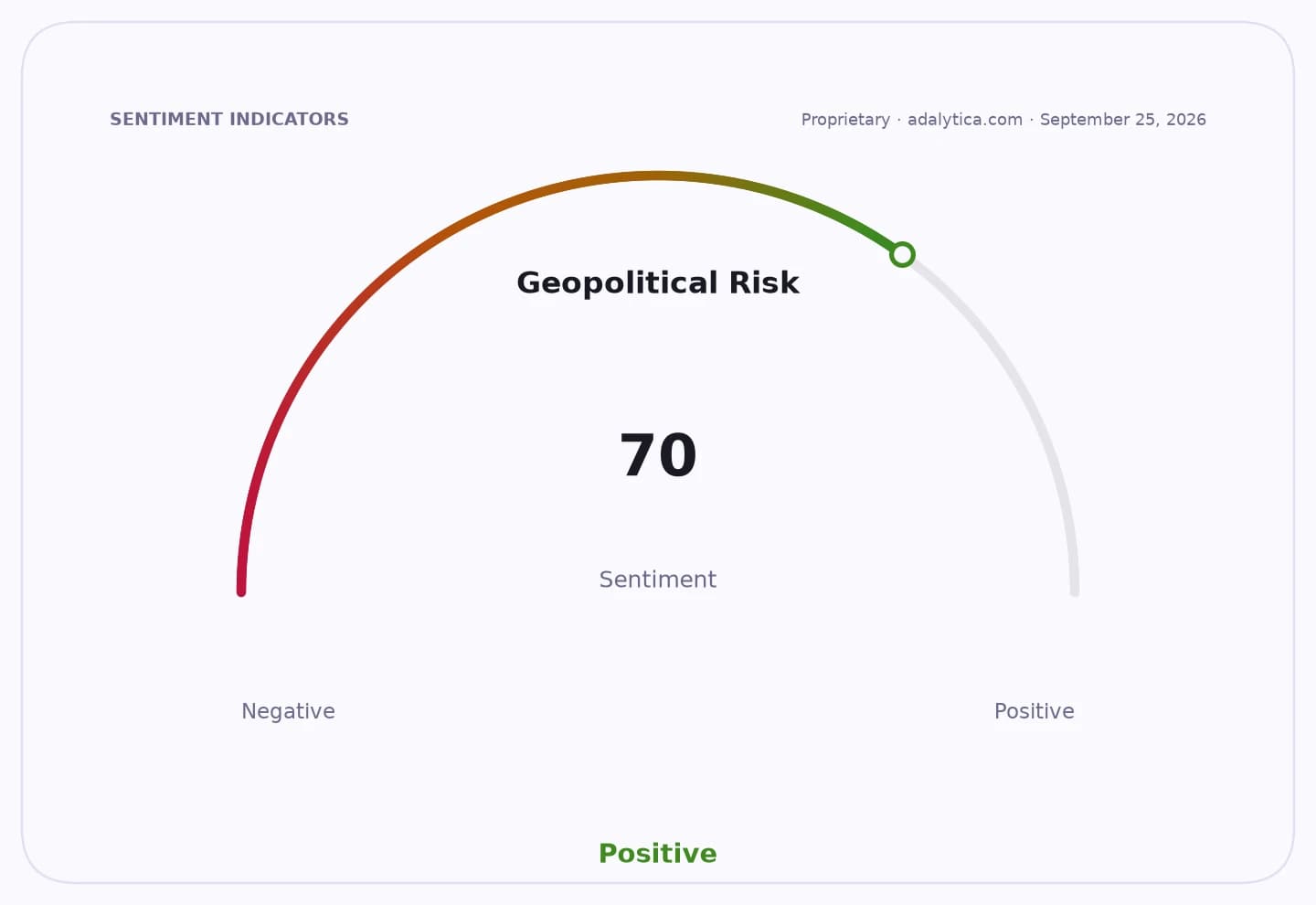
Sentiment IndicatorsⓘProprietary · adalytica.com · August 17, 2026
This is a snapshot — live sentiment, awareness and momentum for 130+ markets update continuously in the dashboard.Open AlphaPulse
That combination is weighing on broader risk assets. The S&P 500 gauge from Adalytica.com shows neutral sentiment at 45, while the US dollar trade signal sits in “Extreme Fear,” underscoring how fast markets have turned cautious. In Europe, the DAX closed weaker, and US stock exchanges were lower as investors trimmed exposure to cyclicals and other areas most vulnerable to higher energy costs and a risk-off tone.
The corporate backdrop is mixed rather than uniformly negative. Alphabet continues to benefit from long-term buying interest, including Berkshire Hathaway’s ongoing accumulation, and the stock is holding above its 200-day moving average even after a modest pullback to $344.00. Nvidia is also in better shape, trading at $225.01 and above both its 50-day and 200-day moving averages, reflecting continued AI demand optimism despite a high RSI reading that suggests the shares are still extended.
DGS10 vs DCOILWTICO — macro contextadalytica.com
Explore this data interactively — full history, time series and cross-market comparisons.Open AlphaPulse
Apple, by contrast, is lagging. The stock finished at $305.59, below its 50-day average of $308.84 and with its RSI at 22.1, a sign of heavy recent selling pressure. That makes the iPhone maker more vulnerable if investors keep rotating toward names tied to AI infrastructure and away from consumer hardware, especially in a market where geopolitics and rates are pressing on sentiment.
The broader read-through for investors is that Iran-related tension is now acting as a macro variable again, not just a regional headline. Higher oil prices would feed into transport, industrial and consumer costs, while also complicating the outlook for central banks already dealing with sticky inflation and a still-sensitive growth backdrop. Unless diplomatic efforts ease pressure in the Gulf, energy, defense and select large-cap tech names may keep outperforming while more rate-sensitive and consumer-facing shares remain under strain.
| Entity | Gains | Losses |
|---|---|---|
| Oil producers | ▲Higher crude prices | ▼— |
| Defense stocks | ▲Geopolitical demand bid | ▼Broader risk appetite |
| Alphabet / Nvidia | ▲Relative haven in large-cap tech | ▼— |
| Apple / cyclicals | ▲— | ▼Safe-haven rotation, higher oil costs |