Peru’s housing credit market has hit its strongest level in five years, but the recovery is uneven: mortgage lending is approaching S/18 billion while state-backed Fondo Mivivienda financing remains well below its 2022 high. That gap matters because it shows that the broader rebound in home loans is being driven more by banks’ own liquidity than by the government’s flagship affordable-housing channel.
Peru Mortgage Lending Reaches Five-Year High
Between August 2025 and July 2026, total mortgage disbursements reached S/17.939 billion, up 13.2% from the prior 12-month period and 18.7% above the start of the five-year comparison window, according to CAPECO’s construction economics report using data from the banking regulator and Fondo Mivivienda. Loans funded with banks’ own resources accounted for S/16.141 billion of that total, a 22.7% increase over the start of the period.
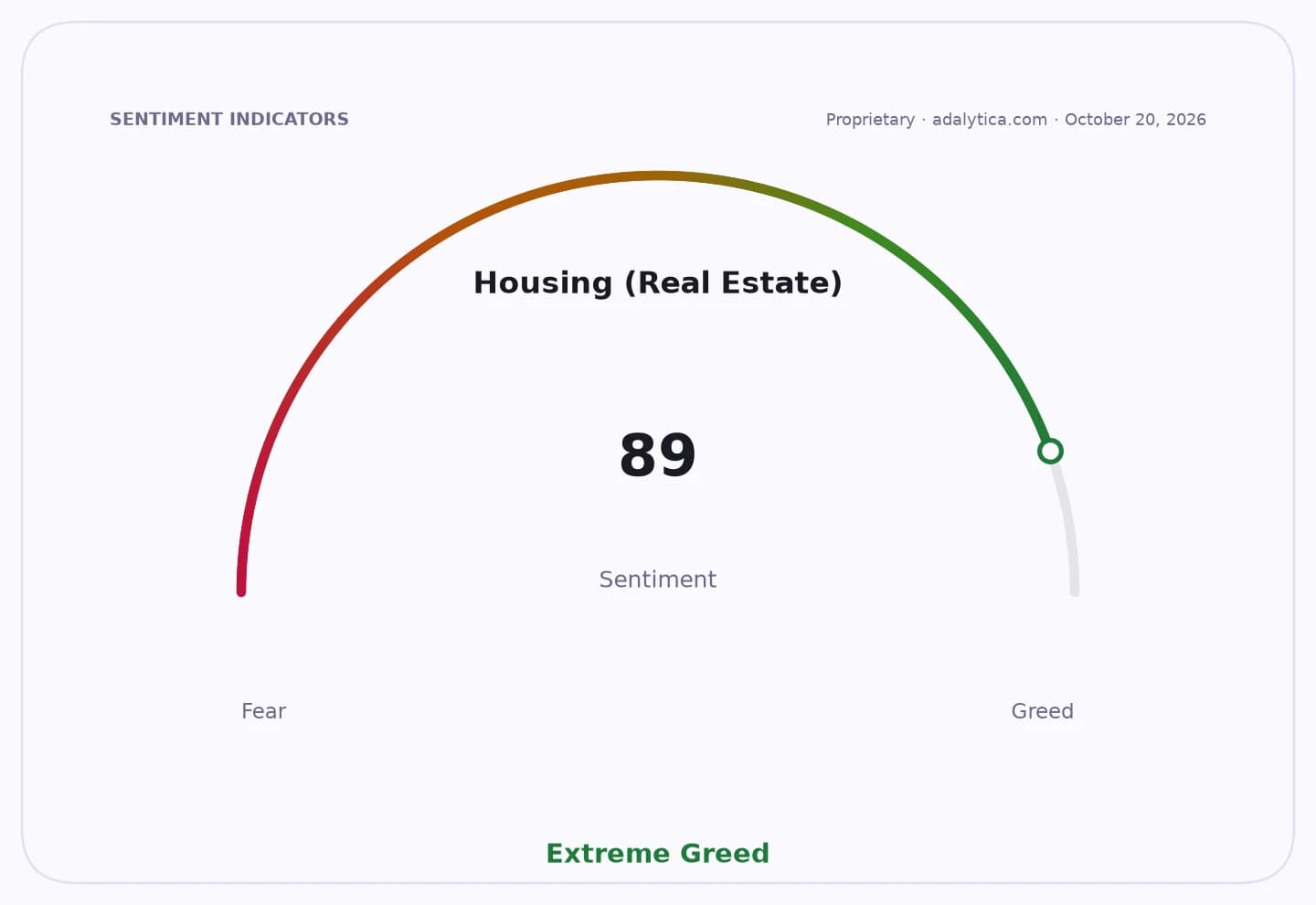
Sentiment IndicatorsⓘProprietary · adalytica.com · October 3, 2026
This is a snapshot — live sentiment, awareness and momentum for 130+ markets update continuously in the dashboard.Open AlphaPulse
By contrast, credits financed through Fondo Mivivienda totaled only S/1.799 billion, still 27.2% below the S/2.470 billion posted between August 2022 and July 2023. That leaves the program about S/671 million short of its earlier level even as the overall mortgage market expands.
The same split shows up in volumes. The financial system granted 47,815 mortgage loans in the latest 12-month period, with 38,164 coming from institutions using their own funds and 9,651 tied to Mivivienda. The system-wide figure was the highest in the five-year sample, but the state-backed segment has not recovered at the same pace.
For investors and developers, the message is that demand for housing finance is still holding up, yet the composition of that demand matters. A market led by bank balance sheets rather than public subsidy can support lending growth, but it does less to ease access for lower-income buyers or accelerate the social-housing pipeline that Mivivienda is meant to serve.
Monthly data also point to a choppier backdrop. CAPECO said mortgage disbursements fell for a fourth straight month in July 2026 versus March, even though July lending was still 20.8% higher than a year earlier across the system and 18.4% higher in the Mivivienda-linked segment. In August, social-housing lending rebounded 34.3% from July, helped by a 57.7% jump in Techo Propio placements and a 44.9% increase in the complementary Techo Propio credit.
The next read-through for the market will be whether that August bounce marks a genuine improvement in subsidized housing finance or just a short-lived catch-up after a softer midyear stretch. For now, Peru’s mortgage market is growing — but the state program at the center of affordable housing is still playing catch-up.
| Entity | Gains | Losses |
|---|---|---|
| Banks using own funds | ▲Higher mortgage volumes | ▼Less reliance on public support |
| Fondo Mivivienda | ▲August rebound in placements | ▼Still 27.2% below 2022-2023 level |
| Homebuyers seeking market-rate loans | ▲More credit available | ▼Higher cost than subsidized channels |
| Low-income housing applicants | ▲August Techo Propio recovery | ▼Slower full recovery in state-backed finance |