Poland’s government says it will unveil a “very concrete” response within about 10 days to help households cope with rising gas prices, moving to cushion consumers just as Europe’s energy market shows signs of relief from last week’s geopolitical shock.
Poland to unveil gas bill relief in 10 days

Finance Minister Andrzej Domański said the price spike was being driven by international tensions linked to the Middle East conflict, and that the government wants to limit the impact on households. He gave no details on the measures, but the timing suggests Warsaw is weighing a politically sensitive intervention in household energy costs while trying to avoid a broader inflationary spillover.
Sentiment Indicators
The move matters because gas prices feed directly into utility bills, heating costs and, increasingly, wider consumer inflation across Europe. Even after Monday’s retreat, European gas remains a major macro risk: prices had climbed sharply on supply fears before dropping back below 100 euros on hopes of diplomatic de-escalation and with EU storage still around 72%, a level that offers some near-term buffer but not a full shield against another disruption.
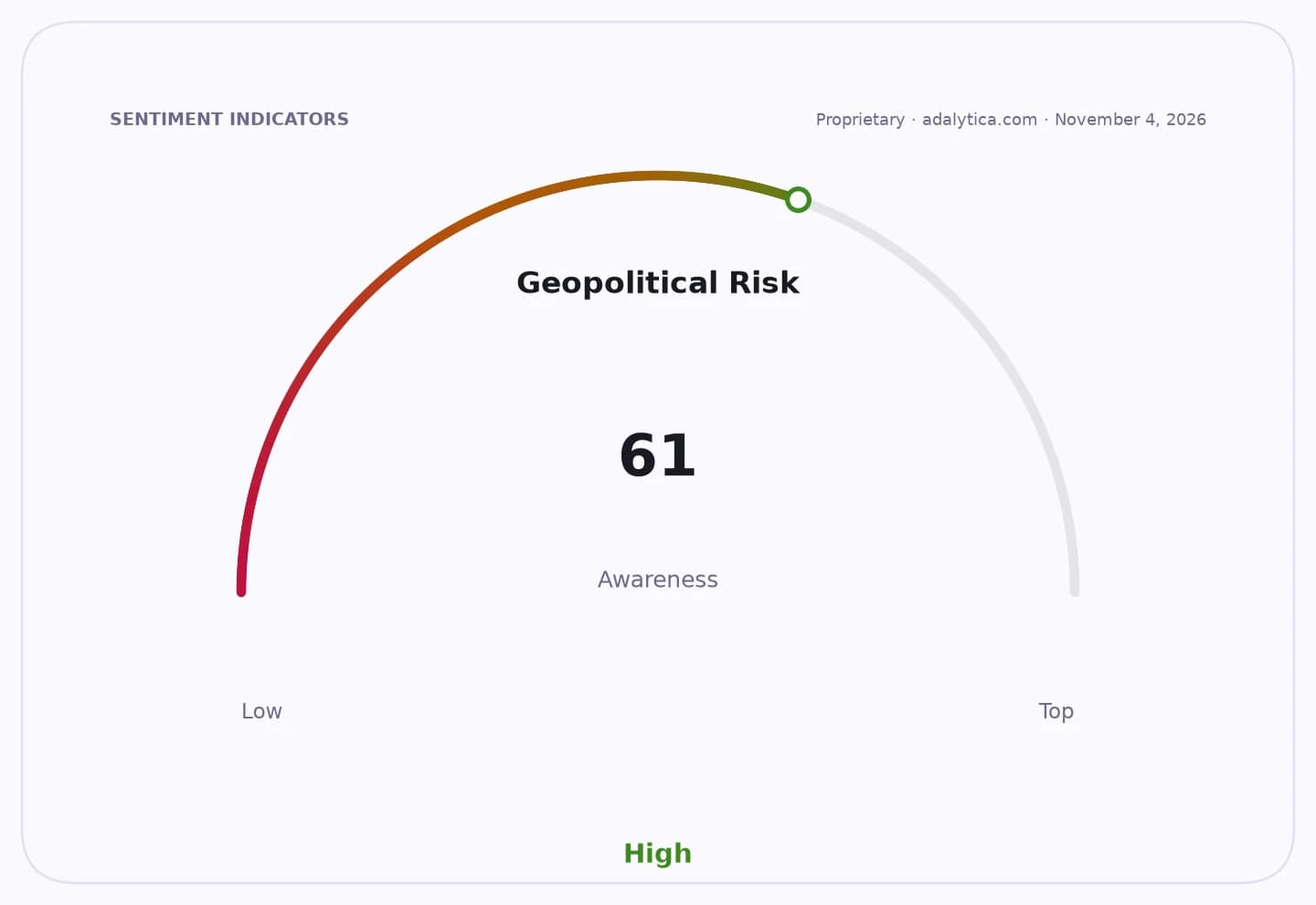
Markets have been treating the energy shock as a growth and inflation problem rather than just a commodity trade. Crude benchmarks and energy equities have remained volatile, with oil-linked funds such as USO and sector gauges like XLE swinging on changing expectations for Middle East risk and supply interruptions. Adalytica’s WTI trade signals showed sentiment slipping to neutral, while its global stability gauge also weakened, reflecting a market that is still pricing geopolitical fragility even as spot prices ease.
For investors, the key question is whether this is a temporary dislocation or the start of a longer policy response cycle in Europe. If governments move to subsidize bills or cap household charges, that may support consumer demand and reduce social pressure, but it can also widen fiscal costs and distort energy-price signals. Poland’s budget position gives Domański some room to maneuver — he said this year’s public-finance deficit should be about 6.7% of GDP, slightly better than previously expected thanks to strong VAT and corporate tax receipts — yet any relief package still adds to the broader tension between inflation control and budget discipline.
There is also a second-order market implication: if gas prices remain volatile, central banks may be slower to declare victory over inflation, even as headline energy prices retreat from their recent highs. That keeps pressure on policymakers to respond quickly, but it also means any intervention may be judged as much on credibility as on generosity. Investors will be watching whether Poland opts for direct household support, tax relief or regulated pricing, and whether similar measures spread if Europe’s energy market tightens again.
| Entity | Gains | Losses |
|---|---|---|
| Polish households | ▲Lower utility bills | ▼Less price exposure |
| Polish government | ▲Political cover | ▼Fiscal flexibility |
| Energy consumers | ▲Short-term relief | ▼Distorted price signals |
| Oil and gas markets | ▲Higher policy attention | ▼Greater intervention risk |