The White House’s warning that “Castroism” is infiltrating the Democratic Party escalates a political fight that is as much about power and voter coalitions as it is about ideology, sharpening the partisan contrast ahead of the next election cycle and heightening the risk of policy volatility in Washington.
Polarized White House Raises Policy Risk Premium

The charge matters economically because it signals a harder-edged political environment in which compromise becomes more difficult and congressional bargaining more fragile. When the White House frames the opposition in Cold War terms, it is not just messaging to the base; it is a sign that policy disputes over taxes, spending, regulation and foreign policy are likely to be conducted with less room for negotiation. That raises the odds of more frequent standoffs in Congress, more stop-start policymaking and a greater premium on positioning around legislative risk.
Sentiment IndicatorsⓘProprietary · adalytica.com · July 20, 2026
This is a snapshot — live sentiment, awareness and momentum for 130+ markets update continuously in the dashboard.Open AlphaPulse
Investor significance lies in what this rhetoric says about the governing backdrop. Markets tend to discount not only policy outcomes but the probability of gridlock, reversals and executive action. A more polarized White House-Democratic relationship can affect expectations for federal spending, healthcare and energy regulation, trade policy and the pace of approvals across sectors sensitive to government oversight. It also reinforces the sense that political risk in the US is not easing, even as broader sentiment around presidential approval has improved and congressional gridlock remains elevated in the data.
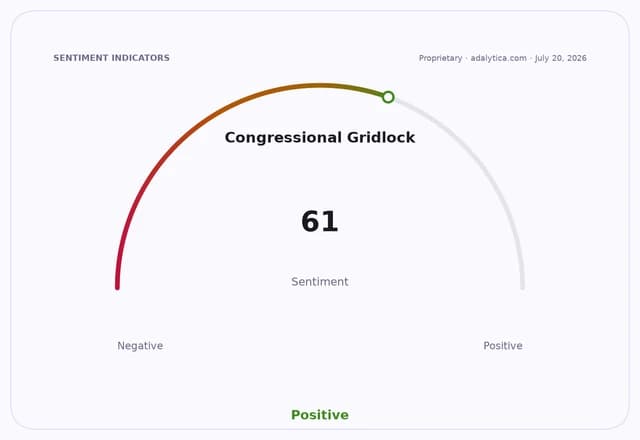
The latest sentiment gauges point to a politically charged but still unsettled landscape. US presidential approval sentiment stands at 79, in “greed” territory, after a modest three-day pullback, while congressional gridlock sentiment is at 61, signaling neutral conditions but with awareness of institutional friction still high. That combination suggests investors are not dealing with a clean policy mandate; they are dealing with a White House trying to define the opposition in stark ideological terms while lawmakers remain locked in a system that can still delay budgets, tax deals and regulatory changes.
Presidential Approval — 30-day sentimentadalytica.com
Explore this data interactively — full history, time series and cross-market comparisons.Open AlphaPulse
For investors, the key question is not whether the language is provocative — it is whether it hardens expectations around policy confrontation. The bull case for markets is that the rhetoric is largely performative, aimed at mobilizing supporters without materially changing legislative outcomes. The bear case is that it further narrows the already limited political space for bipartisan deals, increasing the chance of fiscal brinkmanship, shutdown risk or abrupt policy shifts after elections.
The broader narrative is a White House betting that cultural confrontation can strengthen its political position, even as that strategy deepens Washington’s partisan divide. That may help shape voter energy, but it also leaves investors facing a more uncertain policy path, where the cost of political messaging can show up in valuations for regulated industries, government contractors and sectors exposed to federal budgets and rulemaking.
For now, markets are likely to treat the warning as another sign that US politics is entering a more adversarial phase. The next catalyst will be whether the rhetoric stays at the level of campaign framing or starts to feed into legislative behavior, budget negotiations and regulatory enforcement.
| Entity | Gains | Losses |
|---|---|---|
| White House | ▲Base mobilization | ▼Policy flexibility |
| Democrats | ▲Clearer contrast | ▼Broader coalition appeal |
| Markets | ▲Short-term clarity on rhetoric | ▼Longer-term policy predictability |
| Regulated sectors | ▲Limited immediate impact | ▼Higher political risk premium |