Poland’s central bank can keep interest rates unchanged and still leave households paying less on their mortgages if the zloty, funding costs and bank pricing continue to ease, which is why some borrowers may see instalments fall by as much as PLN 1,000 without a policy rate cut.
Polish Mortgage Relief Can Arrive Without Rate Cuts
That matters because mortgage payments are one of the clearest channels through which monetary policy hits consumer spending and the broader economy. If loan burdens decline even in the absence of a rate move, it would soften the drag on household cash flow, support retail demand and reduce pressure on indebted families, while also changing the market’s interpretation of how restrictive policy really is.
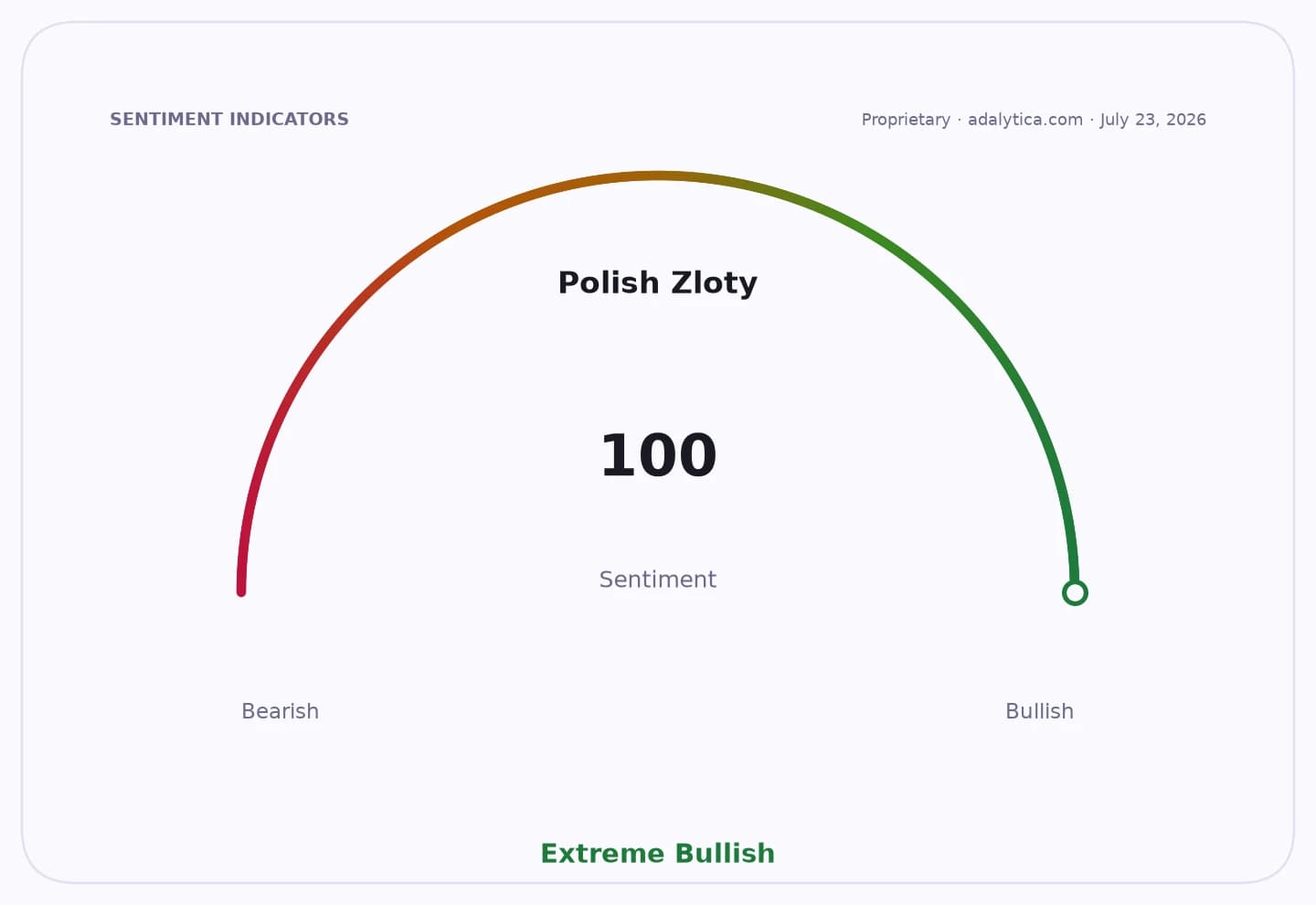
Sentiment IndicatorsⓘProprietary · adalytica.com · July 23, 2026
This is a snapshot — live sentiment, awareness and momentum for 130+ markets update continuously in the dashboard.Open AlphaPulse
The key is that mortgage instalments are driven by more than the headline policy rate. Banks reprice loans against market funding costs, risk premiums and the cost of hedging, while borrowers on variable rates are exposed to changes in interbank benchmarks and FX-related assumptions. A stronger or more stable zloty can also lower the local-currency cost of imported inflation and reduce pressure on the central bank to keep policy tight for longer. Adalytica’s Polish zloty trade signals show extreme greed, with the currency gaining sharply over the past week, a sign that markets are leaning toward further currency strength rather than renewed stress.
That helps explain why a flat rate decision does not automatically translate into flat monthly payments. For households, even a modest decline in market rates or bank margins can have an outsized effect on amortizing loans, especially after the steep reset that borrowers have already absorbed over the past two years. In that sense, the “PLN 1,000” figure is less a forecast than a reminder of how sensitive debt-service costs remain to market pricing, not just to the policy rate set in Warsaw.
The lender side is more nuanced. Banks benefit from higher margins when rates stay elevated, but they also face political and social pressure if mortgage costs remain punishing while inflation cools. Poland’s credit market has already shown signs of strain, with approvals still uneven and a significant share of borrowers leaning on repayment relief. That suggests the system is balancing two competing forces: the need to preserve asset quality and the need to avoid a deeper squeeze on consumption and housing demand.
For investors, the implication is that the transmission from policy to the real economy may be loosening. If borrowers get relief without an explicit rate cut, rate-sensitive assets such as Polish consumer stocks and homebuilders could outperform on improving household liquidity, while banks may face some compression in expectations for net interest income if market rates soften faster than deposit costs. The zloty’s recent strength also matters for fixed income and the broader macro trade, because currency stability can reinforce disinflation and raise the odds that easing comes through market channels before the central bank formally moves.
The bear case is that this is a temporary repricing, not a structural shift. If inflation re-accelerates, global yields rise or the zloty loses momentum, banks could quickly pass higher funding costs back to borrowers. The bull case is that Poland is entering a phase where financial conditions improve ahead of the policy rate, giving households some breathing room and investors a signal that the tightening cycle may be working more through the market than through new central bank action.
| Entity | Gains | Losses |
|---|---|---|
| Mortgagors | ▲Lower monthly payments | ▼Less debt relief if rates re-tighten |
| Polish households | ▲More disposable income | ▼Ongoing refinancing uncertainty |
| Banks | ▲Stable credit quality | ▼Narrower margins if funding costs fall |
| Consumer and housing sectors | ▲Better demand outlook | ▼Slower relief if currency weakens |