Self-employed workers in Portugal who rely economically on a single client now have a clearer path to unemployment support, but only if they meet a strict set of contribution, residency and filing requirements that underscore how narrow the safety net remains for Portugal’s “recibos verdes” workforce.
Portugal Unemployment Support Rules for Freelancers
The rules matter because they define when independent contractors can access a cash benefit after losing work through no fault of their own, a growing issue in economies where companies increasingly outsource labor while workers shoulder more income risk. For investors and employers, the framework is a reminder that labor flexibility comes with contingent social costs, particularly in sectors that depend on freelancers, contractors and other non-payroll labor.
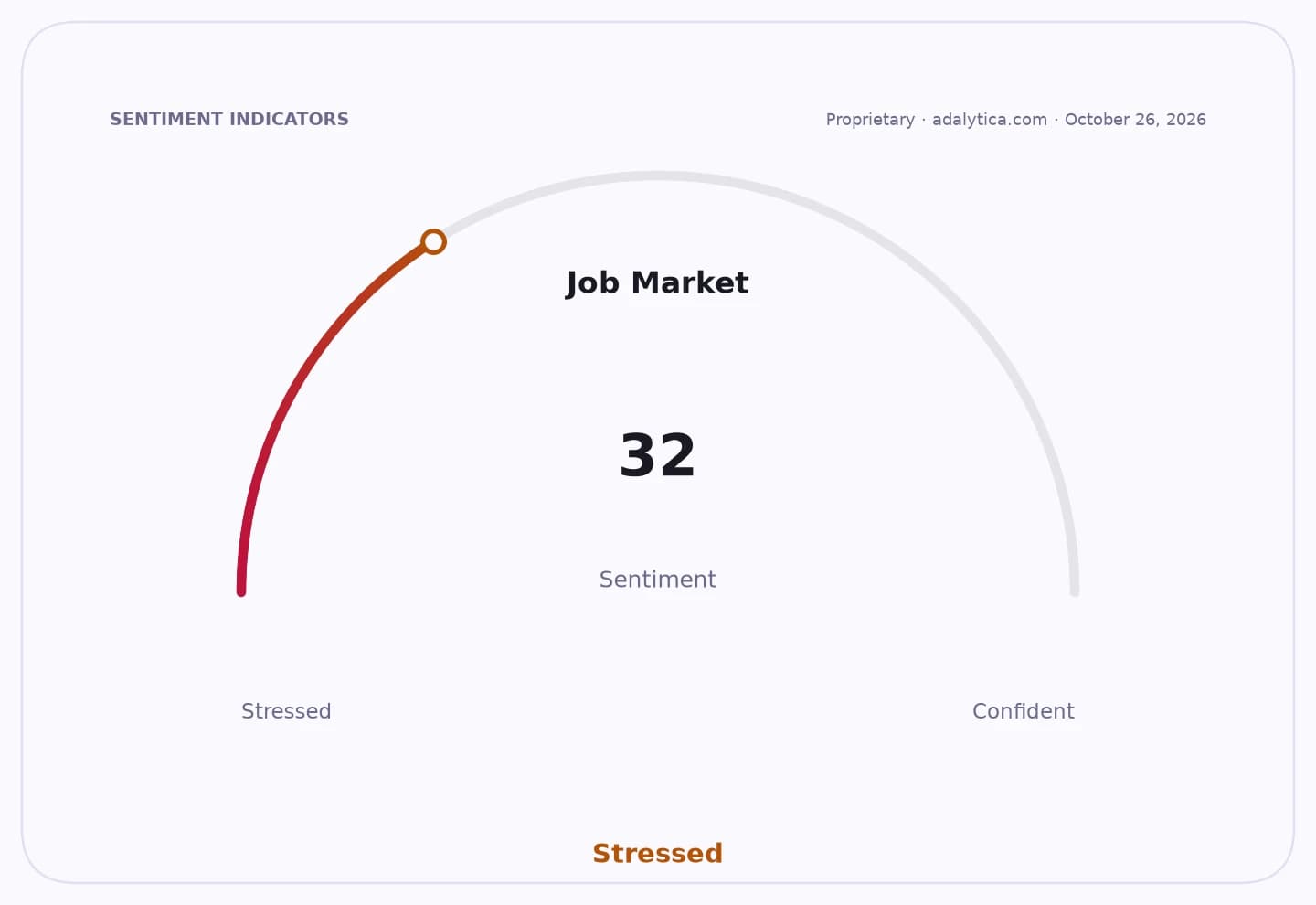
Sentiment IndicatorsⓘProprietary · adalytica.com · October 26, 2026
This is a snapshot — live sentiment, awareness and momentum for 130+ markets update continuously in the dashboard.Open AlphaPulse
Under the Portuguese regime, the benefit — known as the subsidy for cessation of activity — is available only to self-employed workers who are economically dependent on one contracting entity, reside in Portugal and can show the contract ended by the client’s decision. They must also have accumulated 360 days of independent activity with the required social security contributions in the 24 months before termination, been classified as economically dependent in the prior calendar year and at the date of cessation, and apply within 90 consecutive days. Those not deemed economically dependent, pensioners, those already eligible for old-age pension and workers registered under the cultural professionals registry are excluded.
The administrative burden is significant. Applicants cannot file through Portugal’s online social security portal and must go instead to the local employment service before applying, with only one supporting request form allowed digitally. That friction is economically relevant because it can delay benefit access for households facing sudden income loss, limiting the stabilizing effect of the system at the point when consumption is most vulnerable.
The benefit itself is capped and floor-protected. Monthly payments cannot exceed 2.5 times the Portuguese social support index, or 1,306.25 euros in 2025, and cannot be lower than the index value of 522.50 euros, with a 10% uplift in certain family situations, including when a spouse or de facto partner is unemployed and there are dependent children, or in single-parent households. The design shows a policy compromise: enough support to soften a shock, but not enough to create an open-ended substitute for salaried unemployment insurance.
For investors, the story is less about the direct fiscal cost than about the labor-market structure it reveals. Portugal, like other European economies, continues to depend on flexible work arrangements that help employers manage costs and demand swings. But as self-employment becomes more economically dependent and less entrepreneurial, pressure rises for clearer protections, which can translate into higher compliance costs, more payroll formalization and greater scrutiny of contractor classification.
The broader implication is that labor-market resilience is now tied not just to headline unemployment, but to the quality of off-balance-sheet work arrangements. If more freelancers are effectively single-client workers, benefit rules such as these become a key part of the macro safety net — and a factor investors should watch in labor-intensive industries, consumer-facing services and any business model built on contingent labor.
| Entity | Gains | Losses |
|---|---|---|
| Economically dependent freelancers | ▲Income protection after job loss | ▼Stringent eligibility tests |
| Portuguese Social Security | ▲Clearer benefit rules | ▼Higher administrative burden |
| Employers using contractors | ▲Regulatory clarity | ▼Greater compliance pressure |
| Consumers / households | ▲Some spending support | ▼Delays in benefit access |