Romanian households could see monthly electricity bills rise by as much as 100 lei this autumn as new 12-month supply offers are reset around higher wholesale costs, a move that threatens to squeeze already stretched budgets and feed through into broader inflation.
Romania electricity bills may rise on higher wholesale costs
The warning matters because electricity is one of the most visible and politically sensitive household expenses, and the next round of pricing appears to be driven less by a one-off shock than by a more persistent repricing of supply, hedging and grid costs. For families using about 200 kilowatt-hours a month, the Association Energia Inteligentă sees a central-case bill of about 334 lei, up 74 lei from a comparable offer a year earlier, with a more stressed scenario taking the increase close to 100 lei.
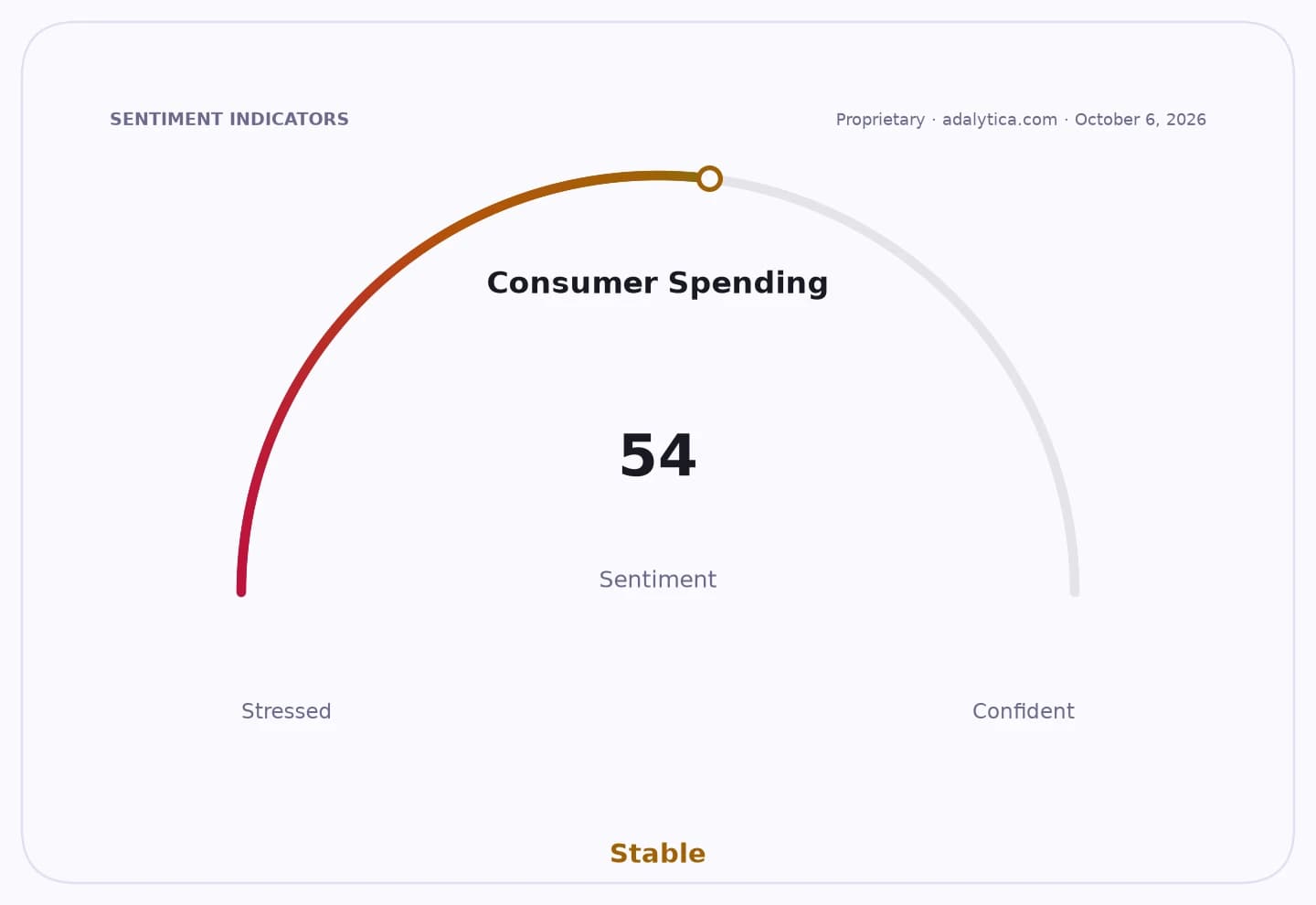
Sentiment IndicatorsⓘProprietary · adalytica.com · October 9, 2026
This is a snapshot — live sentiment, awareness and momentum for 130+ markets update continuously in the dashboard.Open AlphaPulse
That would leave electricity as a larger drag on disposable income at a time when the International Monetary Fund is already warning that the affordability of essentials has deteriorated for a prolonged period globally. In Romania, where food and housing already take a heavy share of household spending, a steeper power bill can force consumers to trim discretionary purchases, delay other payments or draw down savings. The Adalytica Household Savings Rate Sentiment gauge remains neutral, but consumer spending sentiment has weakened sharply over the past week, suggesting households are already more cautious.
The immediate pressure comes from the wholesale market. AEI estimates the average new retail offer could reach about 1.67 lei per kilowatt-hour, including VAT, in its central case, versus 1.30 lei/kWh for a comparable offer last autumn. It said the biggest contribution comes from suppliers renewing long-term procurement, while spot-market purchases, balancing costs, risk premiums and network tariffs add to the bill. Prices on Romania’s day-ahead market climbed to 917.36 lei per megawatt-hour in September from 506.05 lei a year earlier, underscoring how sharply replacement power has become more expensive.
For suppliers, the message is mixed. Those who locked in fuel and power earlier or carry better hedges may be able to soften the pass-through. More exposed retailers may have to reprice aggressively, especially if they are carrying currency, imbalance or non-delivery risk. For consumers, the difference between contracts could become more important than headline market averages, which means shopping around may offer some relief even if the trend is higher.
The broader macro effect is that more expensive electricity can complicate the central bank’s inflation fight and narrow room for policy easing. It also hits lower-income households harder because energy takes a larger share of their budget than it does for better-off families. That makes the political response harder as well: broad subsidies are costly, but targeted support can be difficult to administer and unpopular to remove once introduced.
For investors, the story is less about one tariff change than about what it says on inflation persistence, household resilience and utility pricing power. If wholesale costs stay elevated, Romanian consumers may retrench faster, which would weigh on retail, transport and broader domestic-demand names. If suppliers continue to reprice upward, utilities and energy traders may preserve margins, but the risk is that higher bills eventually feed bad debt, regulation or political intervention.
The key watchpoints are whether the autumn retail offers settle near the central AEI case or the more severe scenario, how quickly distribution and balancing costs flow through, and whether higher electricity bills start to show up in consumer spending, inflation readings and bank loan performance over the coming quarters.
| Entity | Gains | Losses |
|---|---|---|
| Power suppliers with hedges | ▲Better margins | ▼Less exposure to spot spikes |
| Exposed retailers | ▲Ability to pass through costs | ▼Consumers who shop around |
| Households | ▲Potential savings from lower-use behavior | ▼Higher monthly bills |
| Policymakers | ▲Chance to target aid | ▼Pressure from inflation and voters |