Romania’s housing market is increasingly dividing into winners and strugglers, with the strongest construction and mortgage activity clustered in the country’s best-paid and most economically dynamic counties. That matters because it shows housing supply is following income, jobs and credit, not just population growth — a pattern investors should recognize as a long-term signal for where demand, pricing power and development activity are likely to stay resilient.
Romania Housing Growth Favors Cluj, Timiș, Bucharest

The clearest takeaway from the latest data is that county-level housing deliveries mirror the salary map. Outside Bucharest and nearby Ilfov, the leaders are Cluj and Timiş, followed by Braşov and Constanţa, while weaker counties such as Teleorman, Vrancea, Harghita and Mehedinţi sit at the bottom with average net salaries that did not even reach 3,000 lei in 2022. That gap is not just about real estate. It reflects a wider split in Romania’s economy between urban growth engines and regions still struggling with low incomes and shrinking demographics.
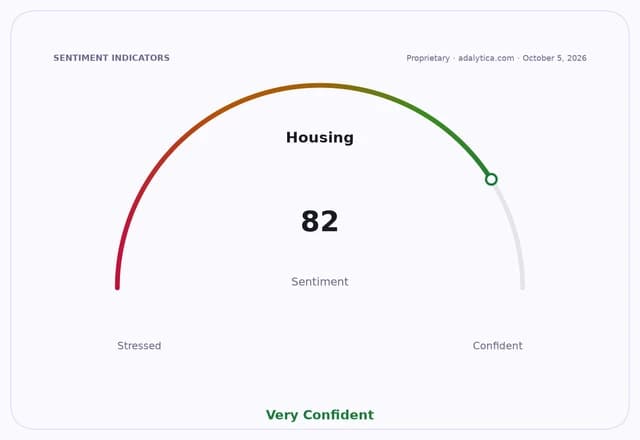
Sentiment IndicatorsⓘProprietary · adalytica.com · October 5, 2026
This is a snapshot — live sentiment, awareness and momentum for 130+ markets update continuously in the dashboard.Open AlphaPulse
For investors, that is a useful framework. Where salaries rise, mortgage lending follows, and where mortgage lending is deeper, new housing supply tends to be larger. Bucureşti-Ilfov remains the clear leader in mortgage balances, with Cluj, Timiş, Iaşi, Constanţa and Braşov also standing out. In plain terms, the places with the most robust labor markets are also the places where banks are willing to finance homeownership and developers can still find enough demand to justify new projects.
The residential market is being supported by a more favorable affordability backdrop than many buyers remember from the last cycle. Average wages in Romania rose 15.7% in the first half, while prices were broadly stagnant, improving the math for mortgages. SVN Romania said the typical monthly payment for a new two-room apartment in Bucharest was equal to about 58% of the national average salary at midyear, down from 64% in January. That is still expensive, but it is markedly better than the stress levels seen in 2008, when the same home cost the equivalent of more than 393 average salaries.

Mortgage demand is recovering, but many buyers are still using cash. Loans for housing rose to 2.54 billion euros in the first half of 2023, up 10.2% from a year earlier, yet more than 59.5% of homes sold in Romania in the same period were bought without bank financing. That mix tells you the market is still not a pure credit cycle. It is being driven by higher-income households, corporate employees, entrepreneurs and Romanians with income from dividends or abroad — exactly the groups most able to absorb today’s prices and interest rates.
That has important implications for the next few years. Big cities and their surrounding counties should continue to attract capital, people and development, while poorer regions are likely to lag unless wages, infrastructure and demographics improve. For property investors, builders and lenders, the message is simple: Romania’s residential market is not moving in one direction, but the counties tied to the strongest economic growth are still where the best opportunities — and the healthiest balance between demand and financing — are concentrated. Long-term investors should keep those regions on the watchlist.
| Entity | Gains | Losses |
|---|---|---|
| Bucureşti-Ilfov, Cluj, Timiş | ▲Higher home demand and financing | ▼Less affordable entry prices |
| Developers in major cities | ▲Stronger sales pipeline | ▼Tougher margins in weaker regions |
| Banks and mortgage lenders | ▲More loan demand | ▼Slower growth where incomes are low |
| Low-income counties | ▲Little near-term benefit | ▼Fewer new homes and weaker credit access |