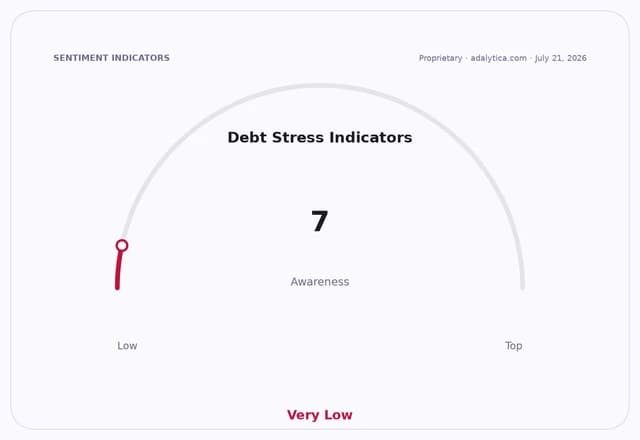
Romania’s position as the European Union’s least indebted household market matters because it gives the economy room to grow without the kind of consumer leverage that can turn a boom into a bust.
Romania’s Low Debt Supports Long-Term Lending Growth

For investors, that is not a trivia point. It is a sign that domestic demand can expand from a low base while banks, lenders and retailers still have runway to compound earnings over years, not quarters. In a region where high household debt can squeeze spending, raise default risk and force regulators to tighten credit, Romania’s starting point looks unusually resilient.
Sentiment IndicatorsⓘProprietary · adalytica.com · July 21, 2026
This is a snapshot — live sentiment, awareness and momentum for 130+ markets update continuously in the dashboard.Open AlphaPulse
The contrast is most obvious when you look at the broader rate backdrop. U.S. 10-year Treasury yields are around 4.5% and two-year yields are near 4.1%, while unemployment remains close to 4.2%. That is a reminder that financing conditions are still meaningful for borrowers globally. In that environment, countries with lighter household balance sheets generally have more flexibility to absorb higher rates, support consumption and avoid the stress that often follows debt-fueled growth.
That is why Romania’s ranking matters economically. A low-debt household sector tends to leave more income available for spending, saving and housing rather than debt service. It also means policymakers have more room to encourage lending without immediately stoking systemic risk. In practical terms, that can support steadier growth in mortgages, consumer credit, deposits and bank profitability if lending expands responsibly.
The market message is just as important. Banks with a meaningful Romanian footprint, along with consumer-facing businesses tied to wages and domestic spending, may be looking at a market where penetration is still relatively low and long-term growth potential remains intact. That is the kind of environment long-term investors often want: not a saturated credit cycle, but a gradually deepening one.
There are, of course, reasons for caution. Low household debt can also reflect lower income levels, weaker credit access or a financial system that has not yet fully reached consumers. But for patient investors, that is exactly what makes the opportunity interesting. Underpenetrated markets can become durable compounders when lending grows alongside wages, employment and confidence rather than ahead of them.
You can see the broader theme in bank stocks elsewhere. BBVA has been trading near 25.12, well above its 50-day and 200-day moving averages, while Bancorp’s CBU has also held above both trend lines. Those moves show how investors continue to reward lenders that can pair balance-sheet strength with growth. Romania’s low household debt suggests a similar long-duration thesis may be forming in Central and Eastern Europe, where financial deepening can be a multi-year story.
The real takeaway for investors is simple: Romania’s debt ranking is not just a macro headline, it is a structural advantage. A country that starts from low household leverage can often grow with less fragility, and that is the kind of foundation that matters when you are thinking in five- and ten-year horizons. Worth watching, and worth putting on the long-term watchlist.
| Entity | Gains | Losses |
|---|---|---|
| Romanian households | ▲More borrowing capacity | ▼Limited credit access today |
| Romanian banks | ▲Long runway for lending growth | ▼Near-term loan growth may stay modest |
| Consumer companies | ▲Higher future spending power | ▼Slower debt-fueled demand now |
| Highly indebted EU peers | ▲Less immediately relevant | ▼Greater refinance and default risk |