Romania’s coming minimum wage increase is set to lift pay for about 1.4 million workers, but the numbers show why the move is more likely to redistribute income than to trigger the labor-market collapse critics predict.
Romania minimum wage rise could lift 1.4 million workers
The labor ministry is weighing three options for 2027: a minimum gross wage of 4,593 lei under the current formula, 4,884 lei if set at 50% of average gross pay, or 5,079 lei at 52% of the average. Even the highest scenario would leave the minimum wage far below the cost of a decent standard of living, which the Friedrich Ebert Foundation and Syndex put at 4,407 lei a month for a single adult and 11,668 lei for a two-adult, two-child family in 2026. That gap explains why unions want a larger increase and why employers are resisting it.
Sentiment Indicators
The economic argument is not just about fairness. Romania’s minimum wage still covers only about 48.7% of the minimum decent-consumption basket, compared with 180% in Poland and more than 68% in Slovakia on comparable measures cited by labor researchers. With pay at the bottom lagging so far behind living costs, the wage floor functions less as a growth engine than as a pressure valve for household spending and public revenue.
Supporters of a higher floor argue that the economy can absorb it. Economist Ștefan Guga says claims that firms will close or investors will flee because of a 200- to 300-lei increase are not borne out by the data, while Andrei Mocearov says repeated warnings of “apocalypse” have failed to materialize over two decades of minimum-wage hikes. Their case is that firms facing a modest rise in labor costs should either adjust margins, improve productivity or exit if they cannot operate without paying poverty wages.
That view matters for investors because the distributional effects are not neutral. A higher minimum wage can support consumer demand, improve tax receipts and narrow the gap between wages and profits, but it can also squeeze the weakest small employers, especially in low-margin retail, services and labor-intensive local businesses. IMM Romania’s call for a freeze reflects that risk. The market question is less whether the headline number rises and more how much of the increase is passed through to prices, margins or employment.
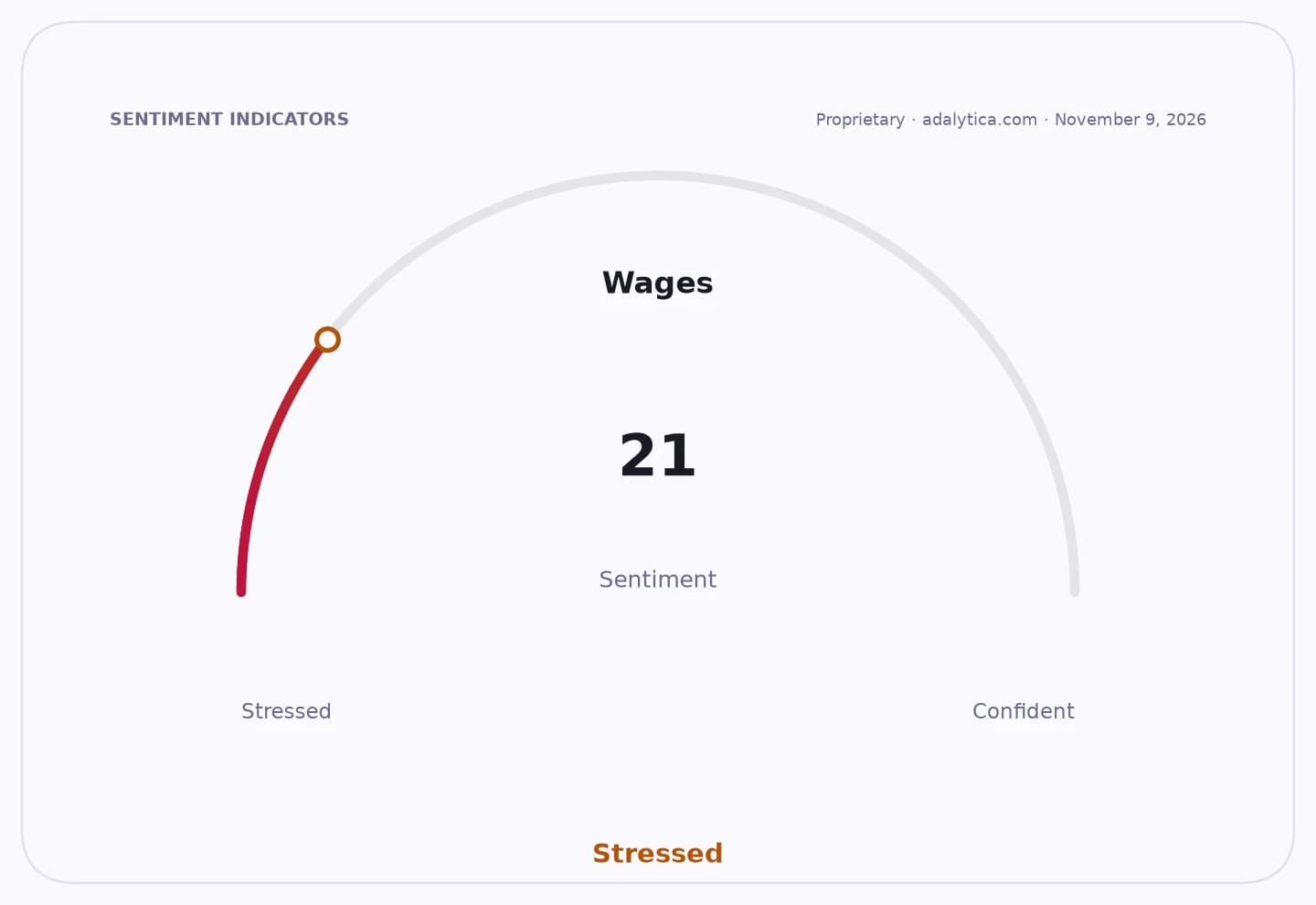
The wider macro backdrop also tilts against the doomsday narrative. With unemployment around 4.1% and payrolls still near record highs, Romania is not facing a labor-market shock that would make a moderate wage floor more dangerous than usual. Adalytica’s wage-inflation sentiment gauge is in fear territory, underscoring how politicized the debate remains, but the broader signal is that wage pressure is being discussed in a labor market that still has room to absorb change.
For investors, the key implication is that the minimum wage debate is a test of Romania’s growth model: whether firms compete on low pay and low value-added work, or whether higher labor costs force a shift toward productivity, formalization and better capital allocation. The immediate risk is margin compression for the smallest firms. The longer-term opportunity is a stronger consumer base and a labor market less dependent on artificially cheap work.
| Entity | Gains | Losses |
|---|---|---|
| Low-paid workers | ▲Higher take-home pay | ▼Modest wage-floor gap persists |
| Romanian households | ▲Stronger consumption power | ▼Possible price pass-through |
| Small employers | ▲— | ▼Higher labor costs |
| State budget | ▲More tax receipts | ▼Potential political friction |