A French lender’s India treasury desk is signaling the rupee may be close to a floor near 96 per dollar, a level that would give Asia’s second-largest emerging market one of its weakest exchange rates on record and underscore how far U.S. dollar strength has distorted capital flows.
Rupee near 96 per dollar on August 10
That view matters because the rupee’s path now sits at the intersection of imported inflation, hedging costs and foreign investor returns. If the currency is already close to “fair value,” as the lender’s treasurer argues, then much of the adjustment may already be in the price — but only if the Reserve Bank of India keeps volatility contained and the dollar stops repricing higher.
Sentiment IndicatorsⓘProprietary · adalytica.com · August 10, 2026
This is a snapshot — live sentiment, awareness and momentum for 130+ markets update continuously in the dashboard.Open AlphaPulse
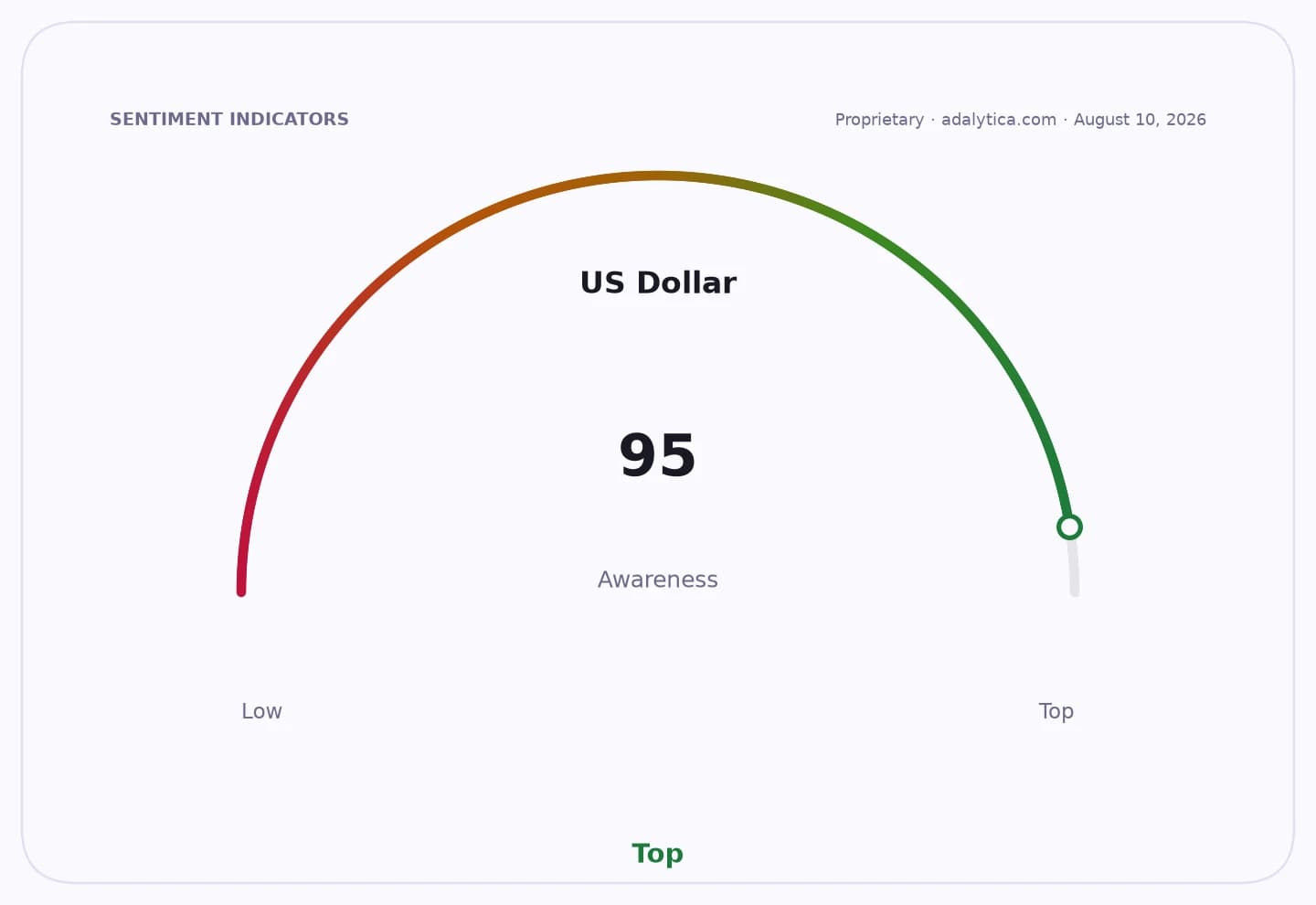
The spot rupee closed at 95.29 per dollar on Aug. 10, after trading near 95.31 on Aug. 7, leaving it only a small distance from the 96 threshold cited by market participants. The move comes as the dollar has reasserted itself across currencies, with Adalytica’s US Dollar Trade Signals snapshot showing “Extreme Greed” and unusually elevated awareness, a sign of strong momentum in the greenback rather than a calm valuation debate.
India’s exchange rate is also being shaped by policy credibility. Traders have pointed to central bank intervention to support the rupee, while the Reserve Bank of India has kept rates steady, a combination that suggests officials are trying to balance inflation control with a desire to avoid disorderly currency weakness. That matters for growth because a softer rupee can help exporters but raises the local-currency cost of oil, intermediate goods and overseas debt servicing.
For investors, the key issue is whether 96 becomes a ceiling for depreciation or merely a waypoint in a broader repricing. If the rupee stabilises there, foreign holders of Indian assets may get more confidence that currency losses are nearing exhaustion. If it breaks through, portfolios exposed to India could face another leg of FX drag even if local equities remain resilient.
Market indicators point to a currency that is extended but not yet broken. The rupee is trading above its 50-day moving average of 95.49, while its RSI at 30 suggests the pair is approaching oversold territory. That does not guarantee a rebound, but it does show the market may be tiring after a persistent slide. By contrast, the broader dollar backdrop remains firm, and U.S. Treasury yields near 4.6% on the 10-year note and 4.2% on the two-year continue to support the dollar’s appeal relative to lower-yielding alternatives.
The corporate angle is clear. For lenders, exporters and companies with unhedged dollar liabilities, a rupee near 96 compresses margins and raises funding costs. For importers and energy-intensive sectors, it is a direct inflation shock. Banks and multinationals with active treasury operations, by contrast, can benefit from wider hedging spreads and more customer demand for currency protection.
The bigger narrative is that India’s currency is no longer trading purely on domestic growth optimism. It is being priced against a strong dollar, sticky U.S. yields and a central bank that appears willing to lean against volatility rather than defend a hard peg. Whether 96 proves to be the floor will depend less on local fundamentals than on the next move in the dollar and whether the RBI keeps signaling that disorderly depreciation is off-limits.
| Entity | Gains | Losses |
|---|---|---|
| RBI | ▲Volatility control | ▼FX reserve strain |
| Exporters | ▲Higher rupee revenues | ▼Imported input costs |
| Importers | ▲Predictable hedging if stable | ▼Higher dollar bills |
| Foreign investors | ▲Clearer floor near fair value | ▼FX losses if rupee breaks lower |




