Small-cap stocks have unraveled because the macro backdrop that usually powers them higher has turned unfriendly fast: borrowing costs are still elevated, Treasury yields are pressing against cycle highs, and investors are no longer willing to pay up for the most economically sensitive corner of the market.
Russell 2000 Falls as Treasury Yields Stay High

That is why the Russell 2000’s sharp retreat matters. The IWM exchange-traded fund, which tracks small-cap stocks, fell from a recent peak of 290.56 to 271.37 in just a matter of days and is now down roughly 10% from its high. The move looks less like a routine pullback and more like a repricing of earnings risk, financing costs and recession sensitivity all at once.
Sentiment IndicatorsⓘProprietary · adalytica.com · October 16, 2026
This is a snapshot — live sentiment, awareness and momentum for 130+ markets update continuously in the dashboard.Open AlphaPulse
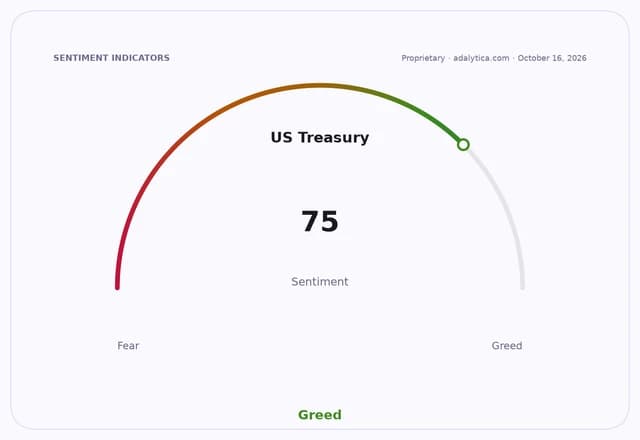
The pressure starts with rates. The 10-year Treasury yield has been hovering around 5.19% and the 2-year near 4.82%, with the Federal Reserve’s policy rate still around 3.75%. For small companies, that combination is especially uncomfortable. They tend to rely more heavily on floating-rate debt, bank lending and refinancing than large-cap peers do. When the cost of capital climbs, profit margins get squeezed and balance sheets become more important than growth stories.
Investors are also realizing that small caps do not have the same cushion as mega-cap technology leaders. Big companies can fund growth with strong free cash flow and fortress balance sheets. Smaller ones often need benign credit markets and steady economic growth to justify their valuations. When yields rise and risk appetite fades, those assumptions get tested quickly.
The technical picture reflects that shift in sentiment. IWM has slipped below its 50-day moving average, now around 289.21, and is trading only slightly above its 200-day moving average near 276.42. Its relative strength index, a conventional technical indicator, has fallen to 37.7, which suggests momentum has weakened sharply after the summer rally. The fund’s retreat is even more notable because it had briefly surged to 290.56 in June after a strong run from spring lows.
This is also a reminder that small caps are not just a stock market theme; they are a proxy for the domestic economy. If investors are nervous about inflation, higher-for-longer rates or slower growth, they usually show it first in smaller, more cyclical companies. That is why the selloff matters beyond trading screens. It is a verdict on the cost of money.
For long-term investors, the bigger question is whether this is a breakdown or an opportunity. The answer depends on inflation and the path of rates. If yields stabilize or the Federal Reserve signals easier policy ahead, small caps can recover quickly because they are leveraged to an improving domestic backdrop. If rates stay elevated, though, the market is likely to keep favoring cash-rich large caps and punishing businesses that need cheap capital to expand.
The lesson here is simple: small caps can be explosive on the way up, but they are also the first place investors feel a rate shock. For patient investors with a multi-year horizon, the group is worth watching closely, but the recent drop is a reminder to favor strong balance sheets, durable cash flow and diversification over blind optimism.
| Entity | Gains | Losses |
|---|---|---|
| Large-cap stocks | ▲Relative safety premium | ▼Less upside if growth broadens |
| Small-cap stocks | ▲Potential rebound if rates fall | ▼Higher funding costs, weaker sentiment |
| Treasury bulls | ▲Higher-yield appeal | ▼Equity risk appetite |
| Rate-sensitive borrowers | ▲None | ▼Refinancing pressure |