Russia’s foreign minister used a security conference in Central Asia to sharpen Moscow’s argument that Western military and political expansion is destabilizing Eurasia, while warning that Afghanistan will need years to recover from the collapse left by the US and NATO withdrawal.
Russia Frames Afghanistan as Central Asia Security Risk
Sergey Lavrov’s comments matter less as a diplomatic sound bite than as a signal of how Moscow intends to frame regional security: as a contest over influence stretching from Afghanistan to Central Asia, where Russia wants to remain the dominant external power and to present itself as a guarantor of stability. That narrative is increasingly important as tensions between Pakistan and Afghanistan rise, cross-border militancy remains a live risk and regional governments look for ways to contain spillovers from Kabul.
Lavrov said no country is safe from what he called Western-orchestrated “color revolutions,” arguing that NATO is trying to project its reach beyond the North Atlantic into Eurasia. For Moscow, that claim serves a strategic purpose. It reinforces Russia’s effort to bind Central Asian states more closely through security structures such as the CSTO, CIS and SCO, and to cast Western involvement in the region as a source of instability rather than support.
Afghanistan was the other central pillar of his remarks. Lavrov said the country faces a prolonged recovery after 20 years of US and NATO occupation and pointed to the absence of national financial reserves as a major obstacle to economic normalization. The practical implication is that Afghanistan’s reconstruction will remain dependent on outside assistance, with little chance of a self-sustaining rebound while banking access, aid flows and investment remain constrained.
That matters for investors and regional policymakers because Afghanistan’s weakness does not stay inside its borders. Lavrov repeated Moscow’s longstanding warning that militant and extremist groups retain a presence near Afghanistan’s frontiers with Tajikistan, Turkmenistan and Uzbekistan, raising the risk of infiltration into Central Asia. He also cited continuing arms and drug trafficking routes into the region and onward to Russia, making security conditions a direct economic issue for trade corridors, border controls and energy and infrastructure planning.
Russia is trying to position itself as part of the answer. Lavrov said Moscow will continue providing economic and humanitarian support and described the Taliban government as a reality that must be accepted. That stance suggests Russia sees engagement, rather than isolation, as the least-bad way to manage spillovers from Afghanistan while preserving leverage with Kabul and its neighbors.
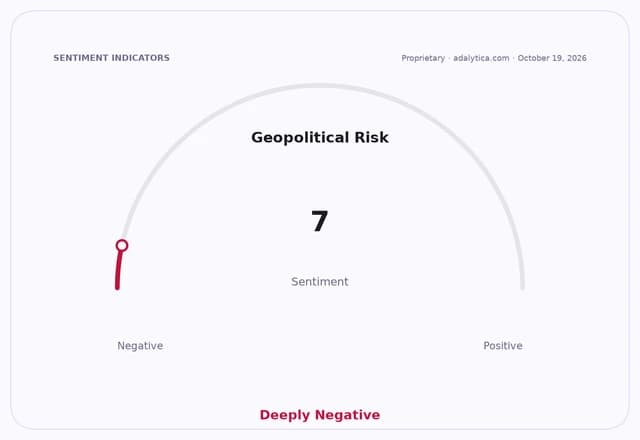
There is, however, a gulf between Moscow’s political messaging and the underlying economics. Even Lavrov’s acknowledgment that opiate production has fallen 90% since 2022, according to the UN, does not erase the broader fragility of the Afghan economy, which remains vulnerable to sanctions, capital shortages and security shocks. For markets, the bigger takeaway is that the region is still being priced as a geopolitical risk zone, not a stable investment destination.
The immediate watch point is whether the latest escalation between Pakistan and Afghanistan widens the security envelope beyond bilateral tensions. If it does, Russia’s warning about Afghanistan becoming a platform for threats into Central Asia could gain traction with neighboring governments — and deepen pressure on already fragile regional stability.
| Entity | Gains | Losses |
|---|---|---|
| Russia | ▲Regional influence | ▼Western leverage |
| Central Asian governments | ▲Security backing | ▼Stability premium |
| Taliban authorities | ▲Pragmatic recognition | ▼Investment access |
| Investors in the region | ▲Clarity on risk | ▼Lower risk appetite |