Russia is reshaping its migration system around controlled labor inflows, and that matters because the Kremlin is trying to preserve access to workers while reducing social and security risks that have become more politically sensitive.
Russia migration policy shifts to legal labor inflows

President Vladimir Putin was told this week that the number of foreigners in Russia has fallen to 6 million-6.5 million, about 8% below earlier levels, while the share of legal labor migration has climbed to 50% from 45% over the past year and a half. That is the key investment and macro message: Moscow is not closing the door on foreign labor, but forcing it through a narrower, more traceable channel.
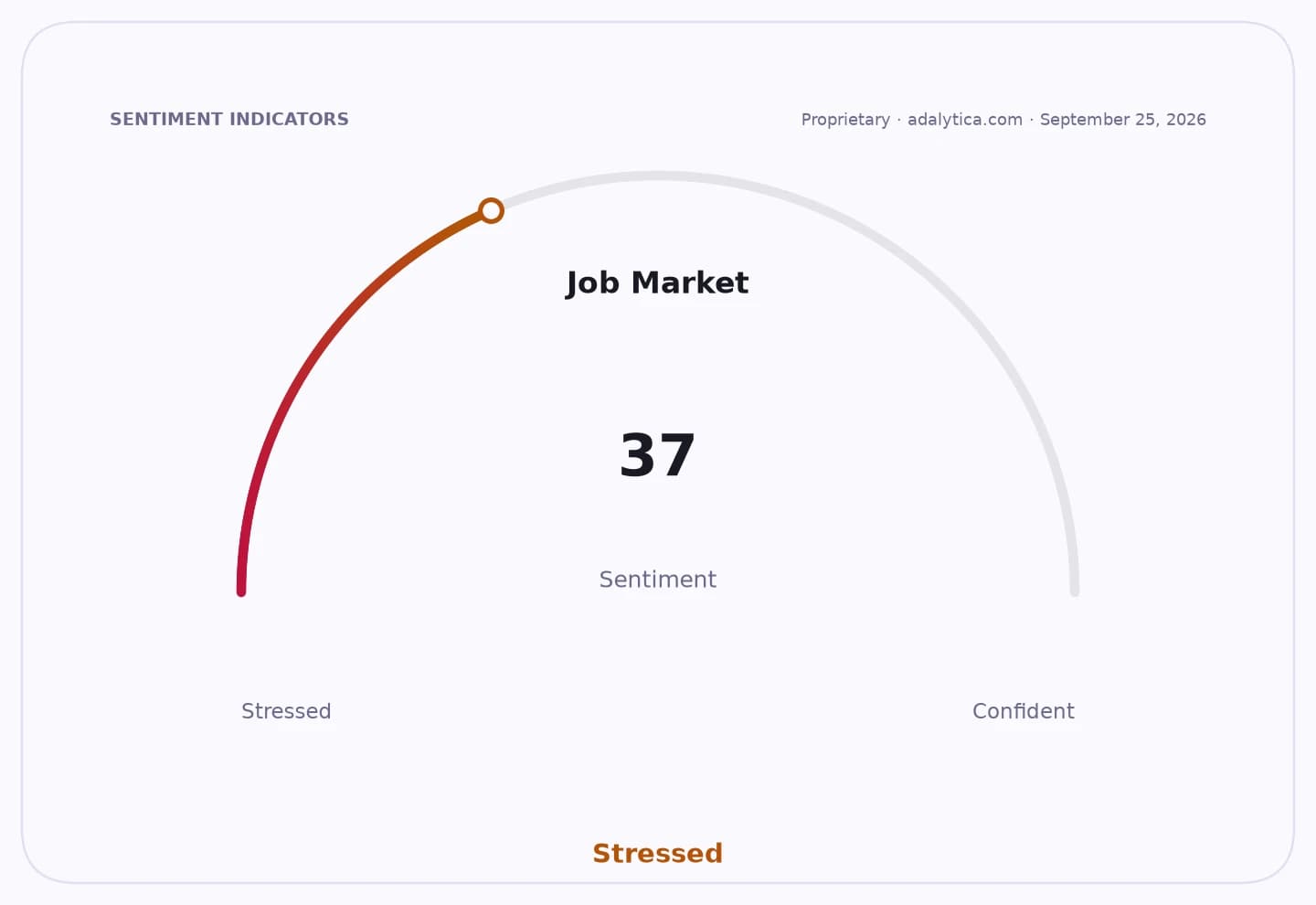
Sentiment IndicatorsⓘProprietary · adalytica.com · September 11, 2026
This is a snapshot — live sentiment, awareness and momentum for 130+ markets update continuously in the dashboard.Open AlphaPulse
For Russia’s economy, the shift is a pragmatic response to a labor market under strain. A country facing demographic weakness and war-related labor distortions still needs workers in construction, logistics, services and regional industry. By moving toward organized recruitment, tighter registration and more data-driven monitoring, the state is trying to keep labor supply flowing without leaving migrants outside the formal system. That can support taxable employment and reduce black-market hiring, even as it raises compliance costs for employers.
The figures underscore how far the state wants to go. About 3 million of the foreigners currently in Russia are labor migrants, 1.7 million are family members and roughly 800,000 have violated migration rules and been placed on a controlled list. The government said migrant-related revenues reached 321 billion rubles in 18 months, up 30%, with more than 250 billion rubles flowing to regional budgets. That makes migration policy not just a policing issue, but a fiscal one.
Putin’s backing for a “civilized” organized hiring model is especially important for investors watching Russia’s labor-dependent sectors. A system in which employers order workers through the migration service could improve predictability for large builders, infrastructure contractors and industrial employers that rely on imported labor. It could also favor formal operators over smaller firms that depend on ad hoc hiring and weak enforcement. In that sense, the policy is another step toward channeling economic activity into the state’s controlled framework.
There is also a geopolitical angle. The Kremlin said partner countries want their citizens prepared for work and life in Russia, including Russian-language training. That suggests Moscow is trying to turn labor migration into a managed diplomatic pipeline with source countries, rather than a loose flow of individual arrivals. The planned analytics center using artificial intelligence to unify migrant data shows how deeply surveillance and administrative control are being built into the system.
The near-term implication is straightforward: Russia is not likely to get less dependent on foreign workers, but it is likely to become more selective, more monitored and more expensive to navigate. For markets, that means the real winners are not the migrants themselves or informal labor brokers, but the companies and institutions able to operate inside the formalized system the state is building. I believe that is the trend to watch: tighter migration controls, but a more durable legal labor pipeline to keep the economy staffed.
| Entity | Gains | Losses |
|---|---|---|
| Russian state | ▲Higher control and tax intake | ▼Less informal flexibility |
| Formal employers | ▲More predictable labor access | ▼Higher compliance burden |
| Regional budgets | ▲More migration revenue | ▼Exposure to labor shortages |
| Informal recruiters | ▲Little benefit | ▼Share of labor market |