Russia’s signal that it wants Ukraine peace talks to resume soon keeps diplomacy back in focus, but investors are still positioning for a drawn-out conflict because the real economic beneficiaries of any breakthrough — from Europe’s gas buyers to global risk assets — are far from priced in.
Russia Peace Talk Hopes Pressure Gold and Dollar

Kremlin spokesman Dmitry Peskov said Moscow hopes U.S.-mediated peace negotiations with Kyiv can restart “in the near future,” the clearest indication yet that back-channel diplomacy remains active after talks stalled in February. The timing matters because the war’s financial spillovers are still running through energy markets, safe-haven flows and Europe’s growth outlook, even as Washington explores new proposals and leaders try to keep the door open.
Sentiment IndicatorsⓘProprietary · adalytica.com · September 10, 2026
This is a snapshot — live sentiment, awareness and momentum for 130+ markets update continuously in the dashboard.Open AlphaPulse

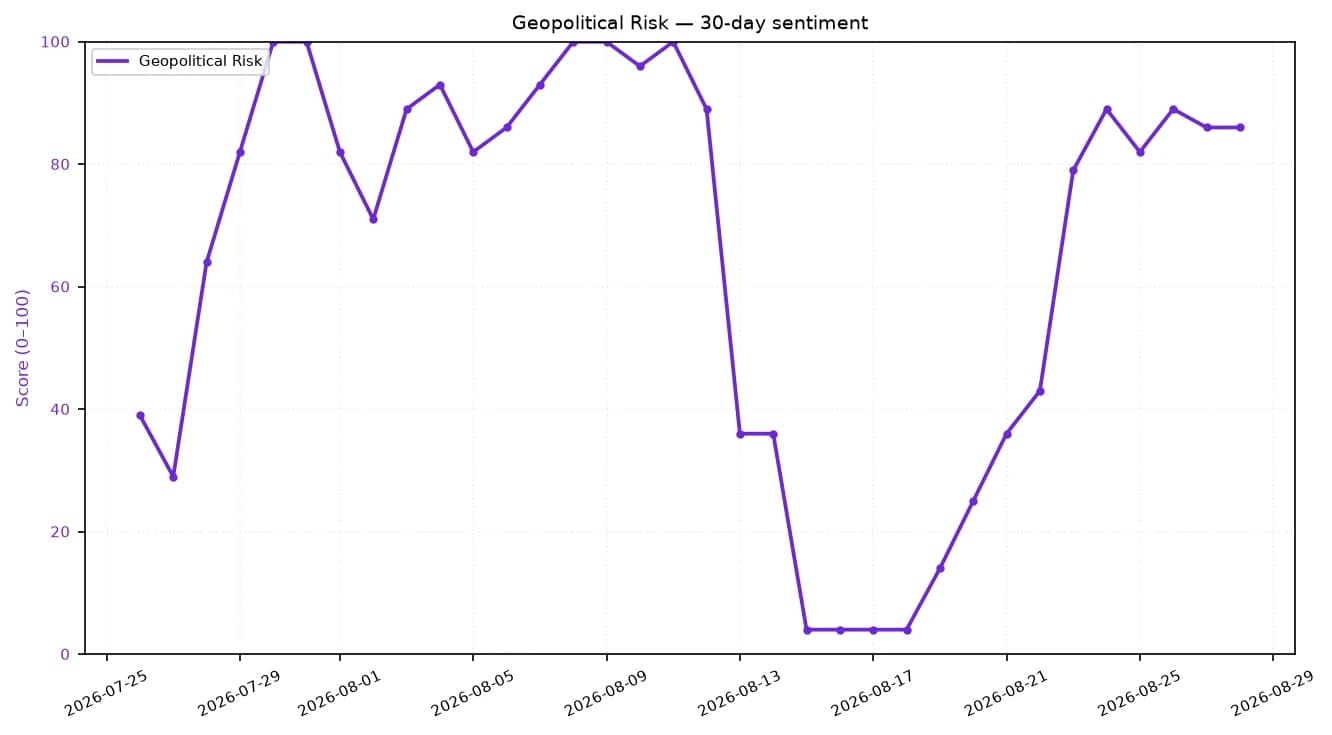
For investors, the key question is not whether one statement moves markets for a day, but whether it marks an inflection point in the risk premium attached to war, inflation and energy security. A durable thaw would pressure defensive trades built on conflict fear, especially gold and the dollar, while potentially easing the strain on European importers that have paid up for energy since Russian pipeline supplies were cut. But until a credible negotiation framework emerges, markets are likely to keep treating every peace hint as optionality, not resolution.
That explains the recent behavior in traditional havens. Gold, tracked by GLD, is still elevated around $396, even after slipping from its recent highs, with the ETF still well above its 200-day moving average of about $416 after a sharp correction and rebound in recent months. Technical indicators point to a market that is no longer in panic mode — GLD’s relative strength has cooled from overbought levels — but also one that has not abandoned the geopolitical hedge. The dollar, via UUP, is hovering around $28, with its 50-day average near $28.22 and momentum still firm enough to suggest investors have not fully rotated out of safety positioning.
Geopolitical Risk — 30-day sentimentadalytica.com
Explore this data interactively — full history, time series and cross-market comparisons.Open AlphaPulse

That is the mispricing. The market is quick to trade headlines, but slow to value the second-order effects of diplomacy. If talks genuinely resume and progress, the upside is not limited to a softer gold bid or a weaker dollar. Europe could see relief in gas costs, which would support industrial margins, consumer purchasing power and central-bank confidence. That would be bullish for cyclicals, European equities and energy-sensitive sectors that have been held back by the war premium.
The Russian argument that Europe is paying too much for gas is self-serving, but the broader economic reality is not: energy remains one of the fastest transmission channels from geopolitics into inflation, growth and asset allocation. Even modest progress toward a ceasefire framework could compress volatility across commodities and foreign exchange, while reducing demand for crisis hedges.
For now, the trading takeaway is to respect the asymmetry. GLD still benefits if talks stall again, but it faces the most air-pocket risk if diplomacy gains traction. UUP is similarly vulnerable if investors begin to fade the safety bid. The more interesting opportunity, in my view, is to look past the headline and toward the beneficiaries of a lower war premium: European industrials, transport, consumer sectors and energy-intensive manufacturers that have been priced as if the conflict will remain frozen indefinitely.
If Peskov’s comments are the first step toward a real negotiating track, the market is still underestimating how much geopolitical normalization could matter for inflation, capital flows and valuation multiples. Stay positioned for a peace premium to return — but only after the market finally believes it.
| Entity | Gains | Losses |
|---|---|---|
| GLD | ▲safe-haven demand | ▼peace-deal premium |
| UUP | ▲flight-to-safety flows | ▼risk-on FX rotation |
| Europe gas buyers | ▲lower energy costs | ▼high import bills |
| European cyclicals | ▲margin relief | ▼war discount remains |