Russia’s accusation that Romania is helping deliver military aid to Ukraine through the Giurgiulesti port sharpens a fast-deteriorating security backdrop that is lifting Europe’s war risk premium and forcing investors to reckon with a wider confrontation between Moscow and the NATO alliance.
Russia Accuses Romania Over Giurgiulesti Ukraine Aid Route
The claim matters because it pushes the war in Ukraine closer to NATO territory and gives the Kremlin another way to argue that the alliance is already a party to the conflict. That raises the stakes for border states on the Black Sea flank, where logistics corridors, ports and airspace are increasingly central to sustaining Ukraine’s war effort.
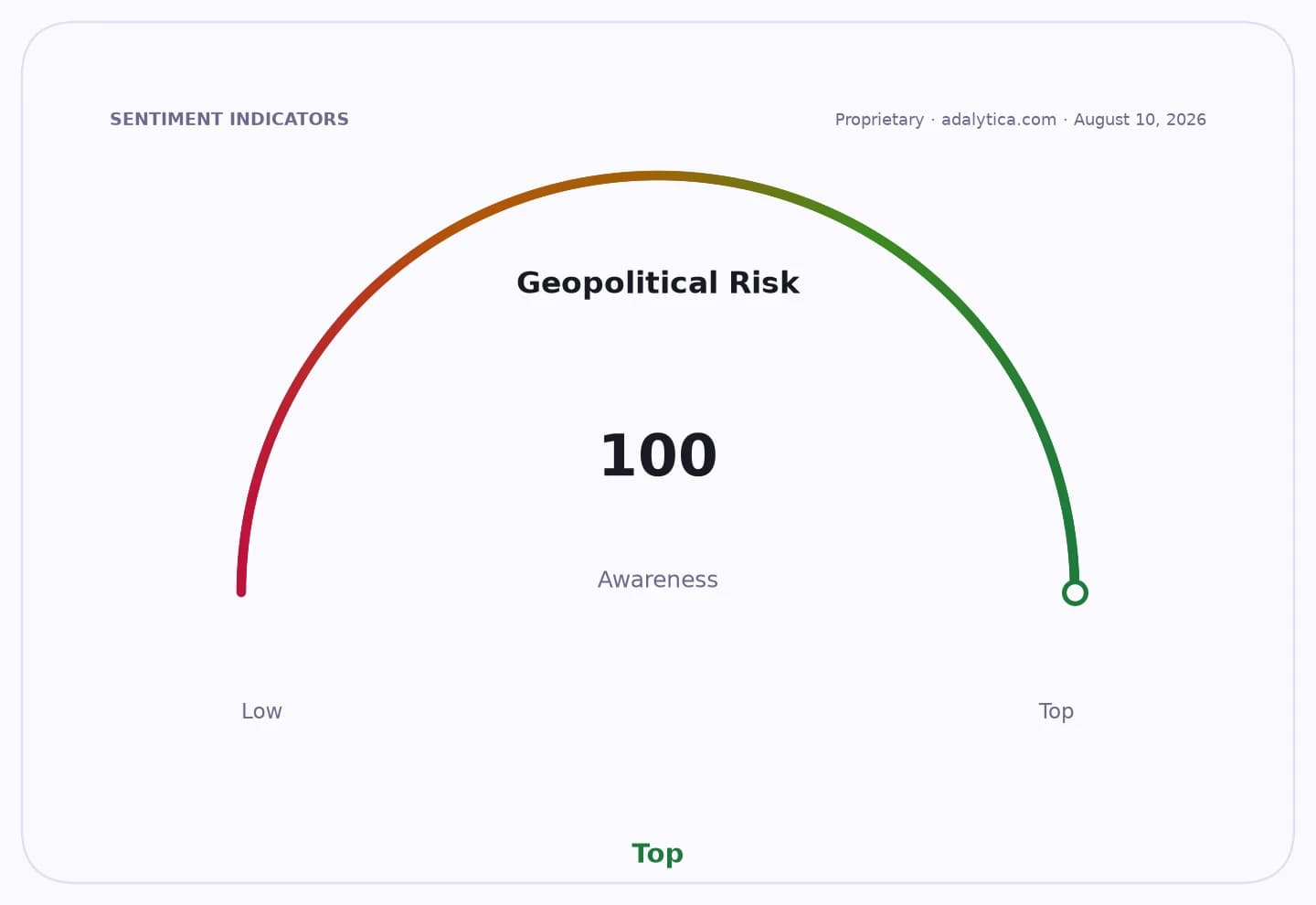
Sentiment IndicatorsⓘProprietary · adalytica.com · August 10, 2026
This is a snapshot — live sentiment, awareness and momentum for 130+ markets update continuously in the dashboard.Open AlphaPulse
For markets, the immediate issue is not a direct repricing of defense equities — which have already been bid up on expectations of prolonged rearmament — but the broader effect on European risk assets. Heightened confrontation risk tends to support defense spending, cyber-security and surveillance demand, while weighing on transport, insurers, regional banks and assets linked to the Black Sea supply chain. It also reinforces the case for higher security spending by NATO members, especially those closest to Russia.
The geopolitical narrative is being amplified by intelligence warnings that Russia could soon test a NATO member with drones, cyberattacks or a limited incursion. That backdrop makes any allegation about military aid moving through a port in Moldova’s Giurgiulesti corridor politically explosive, even if Moscow has offered no public evidence. Russia is trying to frame logistics support for Kyiv as direct participation in the war, a message aimed at sowing doubt inside the alliance and discouraging deeper Western involvement.
Geopolitical Risk — 30-day sentimentadalytica.com
Explore this data interactively — full history, time series and cross-market comparisons.Open AlphaPulse
The market reaction in the broad “NATO” risk gauge reflects that escalation. The Adalytica Global Stability Sentiment reading is at an “Extreme Greed” level of 100, with awareness also at 100, suggesting traders are pricing in a more intense and persistent security cycle rather than expecting de-escalation. Standard technical indicators on the NATO benchmark also point to momentum: the price is above both the 50-day and 200-day moving averages, while RSI readings are elevated, which is consistent with a market still leaning into the theme of higher defense spending and geopolitical strain.
The bull case for the alliance’s defense and security complex is straightforward: if Moscow’s rhetoric continues to harden and NATO members keep expanding support for Ukraine, demand for missile defense, drones, ammunition and border protection should remain firm. The bear case is that confrontation rhetoric can flare without immediately changing military realities, leaving some of the risk premium vulnerable if diplomacy, sanctions enforcement or battlefield dynamics shift.
For investors, the more important point is that the war premium is no longer confined to Ukraine exposure. It is bleeding into the security architecture of the alliance itself, and any further escalation around Romania, Moldova or the Black Sea would likely deepen that repricing. The next catalyst is whether NATO responds with more visible force posture on the eastern flank, or whether Russia follows its warnings with a concrete provocation that tests the alliance’s resolve.
| Entity | Gains | Losses |
|---|---|---|
| NATO defense contractors | ▲Higher procurement demand | ▼If tensions ease |
| Russia | ▲Narrative pressure on NATO | ▼Diplomatic credibility |
| Romania / eastern flank states | ▲More allied security focus | ▼Higher exposure to retaliation |
| Black Sea logistics and insurers | ▲None | ▼Higher disruption risk |